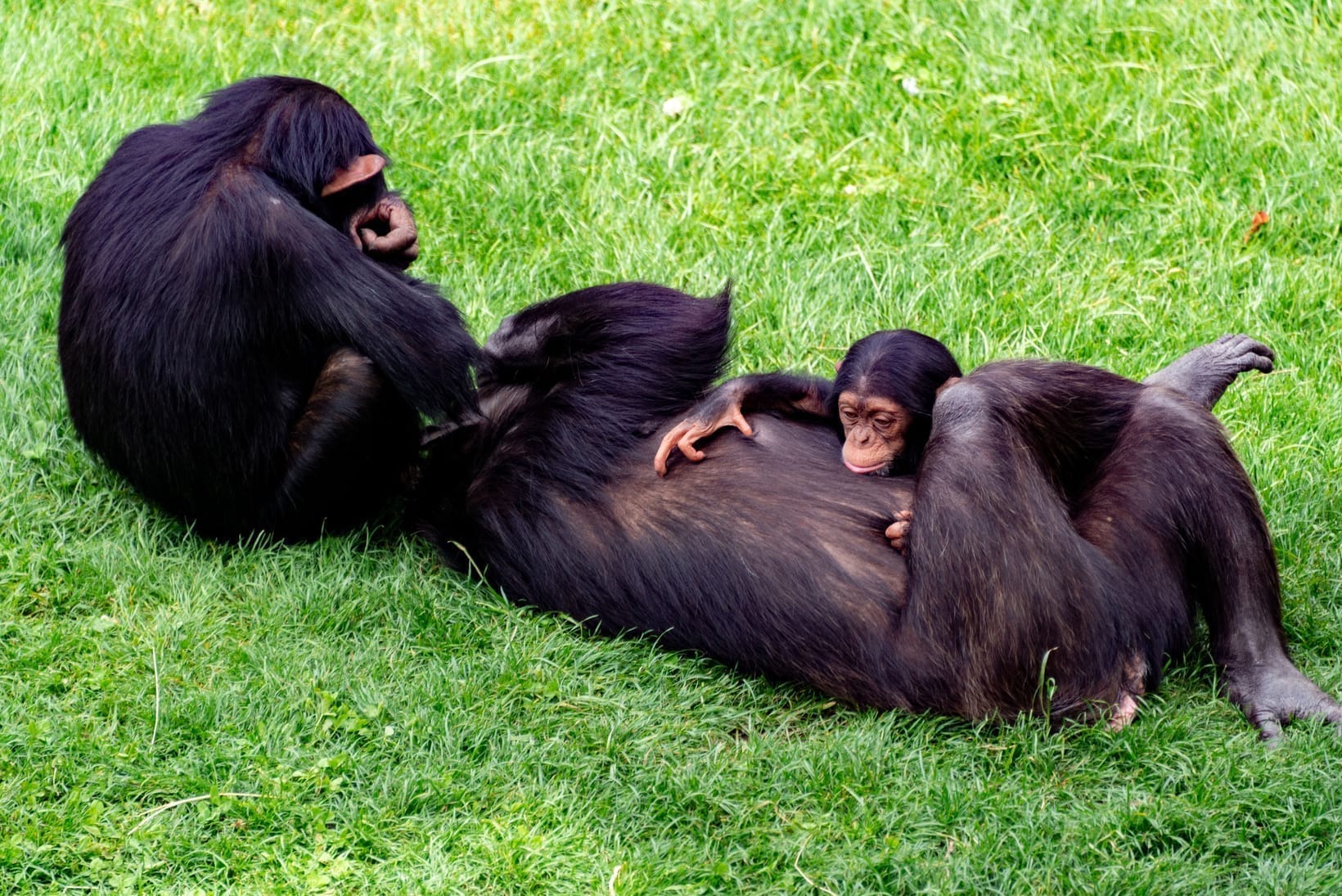
Gorillas and chimpanzees are both African great apes, both share the vast majority of their DNA with us, and both can be trekked in Uganda — sometimes on the same trip. But side by side they’re strikingly different animals: different in size, diet, temperament, social life, and even in how closely they’re related to humans.
Here’s a clear, myth-free rundown of how a gorilla and a chimpanzee actually differ — and, because Uganda is one of the only places on earth you can see both, where to find each in the wild.
Gorilla vs Chimpanzee at a Glance
- Size: gorillas are far bigger — a silverback can exceed 200 kg; a chimp weighs around 40–60 kg
- Diet: gorillas are mostly herbivorous; chimps are omnivores that also hunt
- Temperament: gorillas are generally calm and gentle; chimps are excitable, noisy, and can be aggressive
- Social groups: gorillas live in stable family units led by one silverback; chimps live in large, shifting communities
- Closest to humans: chimpanzees — our single closest living relative
- Where in Uganda: gorillas in Bwindi & Mgahinga; chimps in Kibale, Kyambura, Budongo and Kalinzu
Size & Strength
The most obvious difference is scale. Gorillas are the largest primates on earth; a mature male silverback stands up to six feet and can weigh three times what a chimpanzee does. Chimps are much smaller and leaner — roughly the size of a large dog when on all fours — but pound for pound they’re astonishingly strong and far more agile, spending a great deal of time climbing and swinging through trees, where an adult gorilla is mostly too heavy to go. If you want the full numbers on gorilla size, we cover them in how big is a silverback gorilla.
Diet: Leaf-Eater vs Opportunist
Gorillas are overwhelmingly herbivorous, eating huge quantities of leaves, stems, shoots, and pith, with some fruit. Chimpanzees are true omnivores: fruit forms the core of their diet, but they also eat insects, eggs, and — famously — hunt. Chimp communities cooperatively hunt smaller monkeys such as red colobus, sharing the kill afterward. It’s one of the starkest behavioural differences between the two: one grazes, the other forages and, on occasion, hunts.
Social Life & Temperament
Gorillas live in tight, stable family groups — typically one dominant silverback with several females and their offspring — and the mood of a gorilla group is usually calm and unhurried. Chimpanzees live in much larger communities of dozens of individuals that split into smaller parties and rejoin (a pattern scientists call “fission–fusion”). Chimp society is louder, faster, more political, and more overtly aggressive: territorial disputes between neighbouring communities can turn violent in a way gorilla life rarely does.
Intelligence & Tool Use
Both apes are highly intelligent, but chimpanzees are the celebrated tool-users of the animal kingdom — stripping twigs to “fish” for termites, using stones to crack nuts, and chewing leaves into sponges to soak up water. Gorillas use tools far less often in the wild. Watching a chimp problem-solve in real time is one of the quiet thrills of a Kibale trek.
Which Is More Closely Related to Humans?
Chimpanzees — and it’s not especially close between the two. Chimpanzees (along with bonobos) are humanity’s nearest living relatives, sharing very roughly 98.8% of our DNA, while gorillas sit a little further out on the family tree. In other words, a chimpanzee is more closely related to you than it is to a gorilla. It’s a big part of why time spent watching chimps can feel so uncannily familiar.
Where to See Each in Uganda
This is Uganda’s great advantage: it’s one of the very few countries where you can trek both apes on a single trip.
- Gorillas: Bwindi Impenetrable Forest and Mgahinga Gorilla National Park, in the misty south-west
- Chimpanzees: Kibale Forest (the primate capital of East Africa), plus Kyambura Gorge in Queen Elizabeth, and the Budongo and Kalinzu forests
Our Uganda gorilla & primates safari is built precisely to pair the two — chimpanzee tracking in Kibale and a gorilla trek in Bwindi within one itinerary.
Gorilla Trek vs Chimp Trek: What to Expect
The two experiences feel quite different on the ground. Gorilla trekking is slower and more physical — often hours of steep, muddy hiking to reach a family, rewarded with one intense, quiet hour at close range. Chimp tracking is faster-paced and noisier: you follow the hoots and screams of a community moving and feeding through the canopy, necks craned upward.
Permit costs differ too. A Uganda gorilla permit is USD $800 per person in peak season, while a chimpanzee permit in Kibale is considerably less. We walk through gorilla-trek preparation in detail in our gorilla trekking tips.
Gorilla vs Chimpanzee FAQ
Which is stronger, a gorilla or a chimpanzee? A gorilla, by a wide margin on raw size and power. But chimps are far more agile and, for their size, remarkably strong.
Which is more closely related to humans? The chimpanzee — it’s our closest living relative, closer to us than it is to a gorilla.
Are gorillas more dangerous than chimps? Counter-intuitively, no. Gorillas are generally gentle; chimpanzees are more excitable and account for more aggressive incidents despite their smaller size.
Can you see both on one trip? Yes — Uganda is one of the best places in the world to trek gorillas and chimpanzees on a single itinerary.
See Both in One Trip
If choosing between them feels impossible, the good news is you don’t have to. Uganda lets you stand with a silverback in Bwindi and watch a chimpanzee community swing through Kibale on the same journey. Tell us what you’d love to see and we’ll shape it into a gorilla & primates safari built around you.