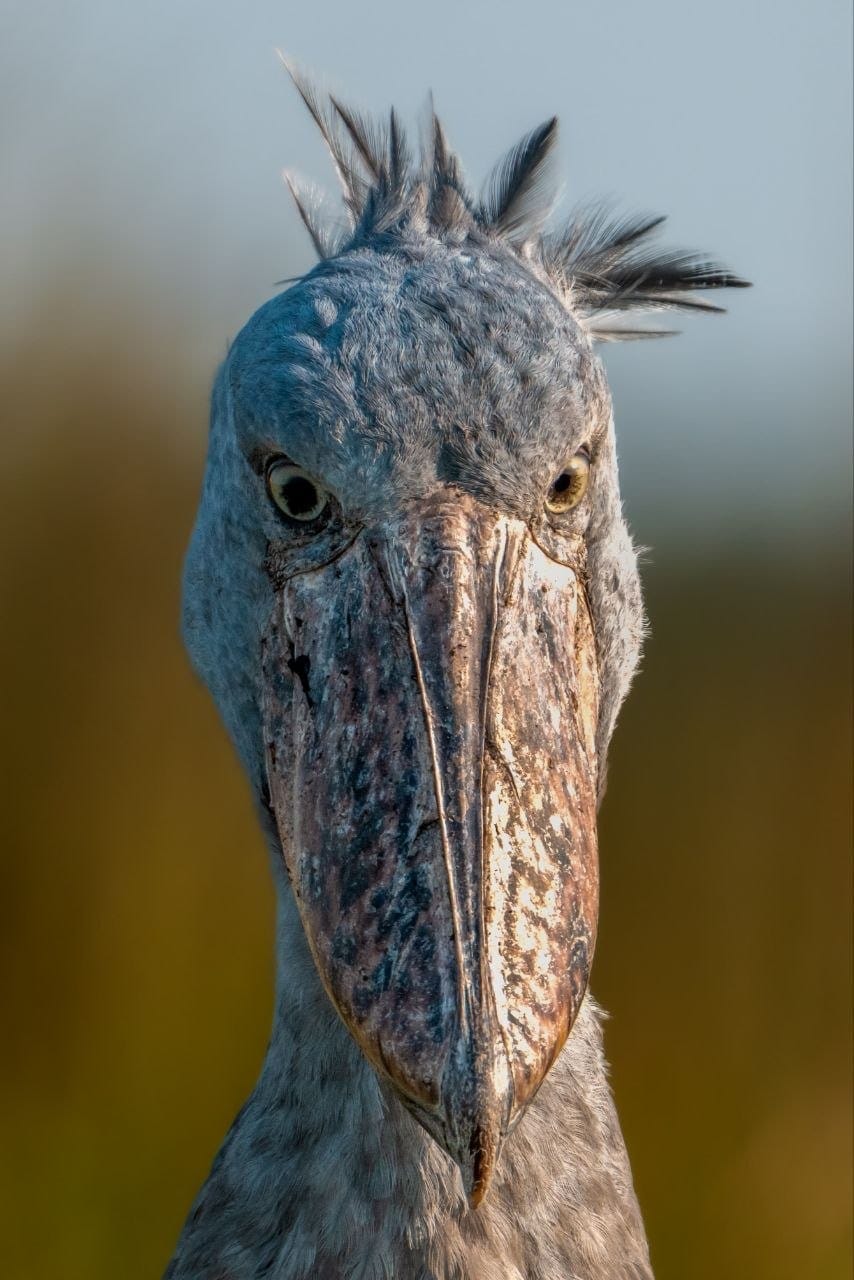
The first time most people see a photo of a shoebill, they assume it’s fake. It stands up to a metre and a half tall, wears a bill shaped like a wooden clog, and fixes the camera with a pale, unblinking, faintly murderous stare. It looks less like a living bird than something that should have gone extinct with the dinosaurs — which is exactly why one of the most-searched questions about it is whether it actually is one.
Here’s the honest answer to that question — the one most articles dodge — along with everything else worth knowing about this swamp giant: how big it really is, what it eats, why it isn’t as terrifying as it looks, how many are left, and, because we run birding trips to the one wetland where you’re almost certain to meet one, exactly where and when to see a shoebill in the wild.
What Exactly Is a Shoebill?
The shoebill (Balaeniceps rex) is a large wading bird of Central and East African freshwater swamps. Its name comes from the obvious feature: that massive, shoe-shaped bill. You’ll also see it called the “whale-headed stork” or simply “whalehead,” and in Arabic abu markub— “father of the shoe.”
Despite the “stork” label, it isn’t a true stork at all. For birdwatchers it sits near the very top of the global “most wanted” list — a genuinely strange, hard-to-find species that people plan entire trips around. And Uganda is its stronghold, which is where the story gets interesting for anyone hoping to see one.
Image: Portrait of a shoebill in papyrus swamp, showing the clog-shaped bill and pale eyeIs the Shoebill Stork a Dinosaur?
Short answer: not in the way people usually mean — but there’s a genuine twist that makes the question smarter than it sounds.
The shoebill is not a leftover from the age of dinosaurs. It isn’t a surviving pterosaur, it didn’t coexist with T. rex, and it’s no more a direct relic of the Mesozoic than a pigeon is. Its prehistoric look is a coincidence of size, that reptilian yellow eye, the hooked bill, and its habit of standing dead still for minutes at a time.
Now the twist: birds genuinely are dinosaurs. Modern science places all birds within the theropod dinosaurs — the same lineage as Velociraptor and T. rex. So in the strict scientific sense, every living bird is an avian dinosaur, and the shoebill is exactly as much a “living dinosaur” as a sparrow or a chicken. It just happens to look the part far more convincingly than either.
As for its actual family tree: genetic studies place the shoebill in the order Pelecaniformes, alongside pelicans and herons, in a family all its own (Balaenicipitidae). Its closest living relative is the hamerkop, a far smaller brown wading bird. So it’s not a stork, not a dinosaur in the Hollywood sense, and not quite like anything else alive — which is a large part of the appeal.
How Big Is a Shoebill?
Big enough to stop you mid-sentence when one stands up. Shoebills are among the tallest flying birds on earth, and up close the scale of the bill is genuinely startling.
- Height: typically 110–140 cm (about 3.6–4.6 ft), with large individuals reaching 152 cm — roughly five feet
- Wingspan: around 2.3–2.6 m (7.5–8.5 ft)
- Weight: roughly 4–7 kg (9–15 lb)
- Bill: up to about 24 cm long and unusually wide, with a sharp hooked tip — the whole reason for the name
What Does a Shoebill Eat, and How Does It Hunt?
The shoebill is an ambush predator of swamps, and its favourite prey tells you why it hangs around Uganda’s papyrus channels: lungfish and catfish, the air-breathing fish that come to the surface in oxygen-poor swamp water. It will also take tilapia, water snakes, frogs, monitor lizards, and — on the larger end — baby crocodiles and turtles.
Its hunting style is unforgettable to watch. A shoebill will stand utterly motionless for long stretches, head lowered, giving the famous “death stare” down into the water. When prey surfaces, it pitches its entire body forward in a violent lunge birders call the “collapse,” scooping up fish, water, and vegetation together, then using the sharp edges of that bill to decapitate the catch before swallowing. All that patience, and then a fraction of a second of chaos.
Is the Shoebill Dangerous? Its Strange Behaviour
It looks like it wants to hurt you. It doesn’t. For all the menace of that stare, shoebills are not known to attack people — they’re famously calm and tolerant, and captive birds are even documented “bowing” to keepers they recognise. On a quiet canoe approach, a wild shoebill will often simply hold its ground and watch you, which is precisely what makes the encounter so extraordinary.
A few things that make its behaviour genuinely odd:
- They’re loners. Even a breeding pair will often feed at opposite ends of their territory, and the birds are usually seen singly.
- They’re mostly silent— but when they do make noise, they clatter the two halves of the bill together in a rapid burst that’s often compared to a machine gun.
- They practise siblicide. A female usually lays two eggs, but the stronger, older chick typically outcompetes and kills the younger one, and the parents raise a single chick. It’s bleak, but it’s normal for the species.
How Many Shoebills Are Left?
Not many, and that’s part of what makes seeing one feel like such a privilege. The shoebill is listed as Vulnerable on the IUCN Red List, with a wild population commonly estimated at roughly 5,000–8,000 birds — though estimates vary and the number of breeding adults is lower.
Its range spans the swamps of South Sudan, Uganda, the eastern Democratic Republic of the Congo, and Zambia’s Bangweulu wetlands, with smaller numbers elsewhere in the region. The main threats are all human: the drainage and conversion of wetlands, disturbance at nesting sites, and illegal capture of eggs and chicks for the exotic-bird trade. Low-impact, respectful birding tourism — the kind that gives these swamps an economic reason to stay wet — is one of the quiet forces working in the shoebill’s favour.
Where to See a Shoebill in Uganda
This is where Uganda earns its reputation. If seeing a shoebill in the wild is on your list, the country offers arguably the best odds on earth — concentrated in a handful of accessible wetlands.
Mabamba Bay Wetland is the headline. A Ramsar-listed swamp on the northern shore of Lake Victoria, it sits only about an hour’s drive from Entebbe International Airport, and it’s widely considered the single most reliable place in the world to find a shoebill. You explore it the way the fishermen do — gliding through narrow papyrus channels in a dugout canoe, with a local guide reading the water for that unmistakable grey silhouette. It’s the centrepiece of our Uganda birding safari, and because it’s so close to Entebbe it also makes a perfect first or last morning of almost any trip.
Murchison Falls National Park is the other classic. Where the Victoria Nile spills into Lake Albert, the delta shelters shoebills among the papyrus, and they’re spotted on the boat cruises there — a very different, more expansive setting than the intimate Mabamba canoe. It slots naturally into a Murchison Falls safari alongside the park’s big game and the falls themselves.
Image: Dugout canoe gliding through papyrus channels at Mabamba Bay, shoebill in the reedsWhen to Go & What a Shoebill Safari Is Actually Like
Shoebills are present in Uganda’s wetlands year-round, so there is no closed season for seeing one. The best time of day matters more than the month: an early-morning start gives you calmer water, cooler air, and more active birds, which is why Mabamba trips usually launch not long after dawn. Timing your wider trip around the best time to visit Uganda is really about the rest of your itinerary — the shoebill will be there either way.
The experience itself is unlike any other African wildlife moment. There are no engines and no crowds — just the slow push of a canoe pole, the rustle of papyrus, and your guide scanning the channels. It can take twenty minutes or it can take a couple of patient hours; the swamp doesn’t run to schedule. But when you finally round a bend and find a shoebill standing motionless a few metres away, five feet of prehistoric stillness staring straight back at you, most people simply stop talking.
Shoebill FAQ
Is the shoebill stork a dinosaur? Not a surviving prehistoric one — but since all birds descend from theropod dinosaurs, it’s technically an avian dinosaur, just like every other bird. It only looks more the part than most.
Is the shoebill dangerous to humans? No. Despite the intimidating appearance, shoebills are not known to attack people and are strikingly tolerant of a calm, respectful approach.
How rare is the shoebill? Genuinely rare — a Vulnerable species with only a few thousand left in the wild, which is why dedicated birders travel a long way to see one.
Can you see shoebills year-round in Uganda? Yes. They live in the wetlands permanently, so any time of year can work; early morning is the prime window.
How tall is a shoebill? Usually 110–140 cm, with the biggest birds reaching about 152 cm — roughly five feet tall.
See One for Yourself
A shoebill is one of those animals that photographs can’t quite prepare you for — the scale, the stillness, the sense that you’re looking at something far older than you are. If you’d like to meet one, the Mabamba swamp is only an hour from where most Uganda trips begin, and it pairs beautifully with gorillas, chimps, and big-game country on our Uganda birding safari. Tell us what you’d love to see and our planners will build the trip around it.