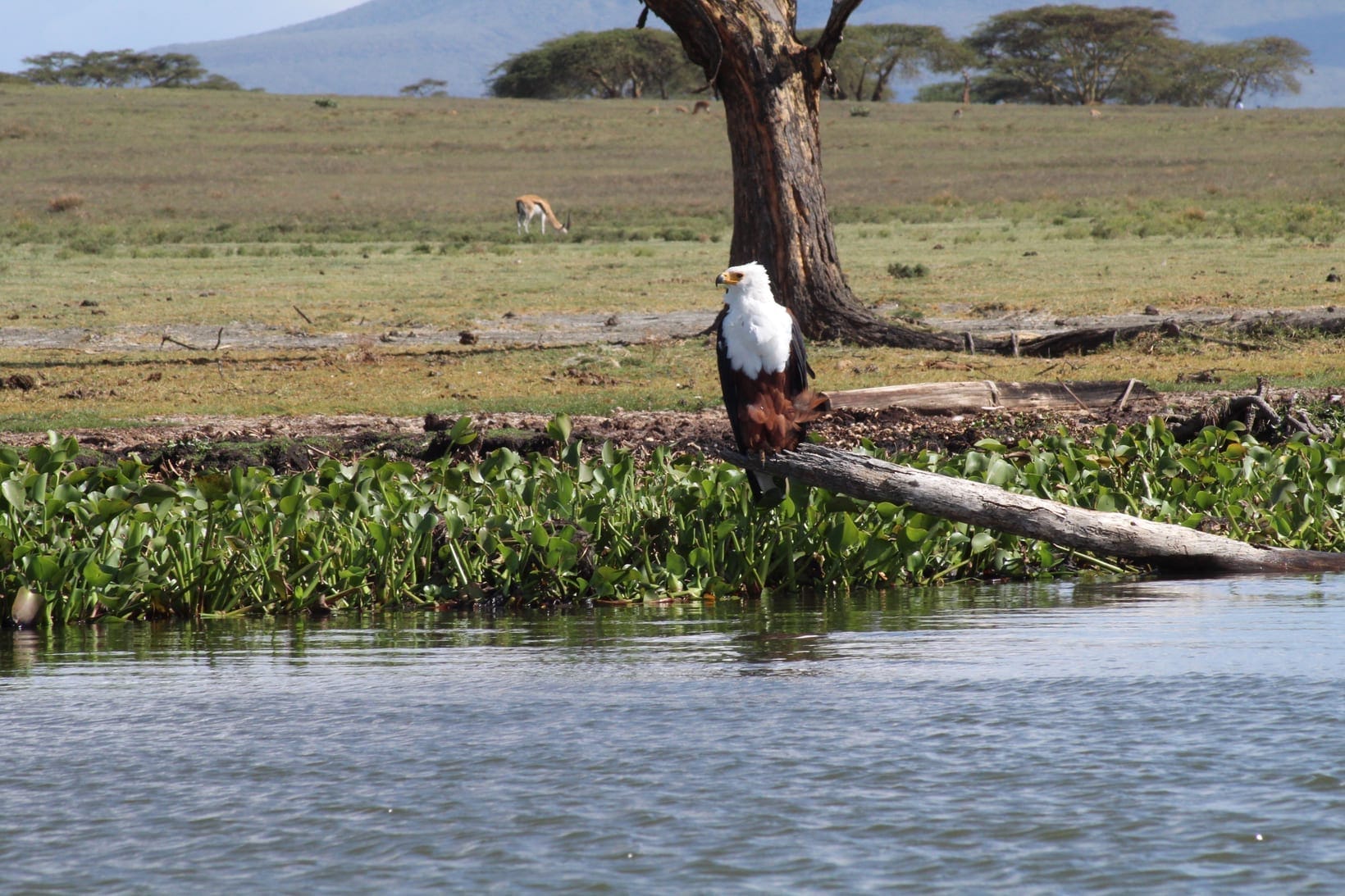
Short answerThe African fish eagle makes the ringing cry used in almost every film set in Africa. It is a sea eagle closely related to the bald eagle, with a white head, chestnut belly and a wingspan over two metres. You will see one on virtually every boat cruise in Uganda — the Kazinga Channel and the Nile at Murchison especially.
Most travellers hear this bird before they identify it, and most recognise the sound long before they arrive — it is used so relentlessly as cinematic shorthand for Africa that it has become the continent's unofficial soundtrack, frequently over footage of places the bird does not occur.
The voice of Africa
The call is a loud, ringing, gull-like cry, usually given as a series and often with the head thrown right back over the shoulders. Pairs duet, one answering the other, and the sound carries a long way across open water.
Its scientific name captures it exactly: Haliaeetus vocifer — the vocal sea eagle.
Identifying one
| Detail | |
|---|---|
| Scientific name | Haliaeetus vocifer |
| Group | Sea eagles — the same genus as the bald eagle |
| Head and breast | Brilliant white |
| Belly and shoulders | Rich chestnut |
| Wings and back | Black |
| Wingspan | Comfortably over 2 m |
| Sexes | Female noticeably larger, as in most raptors |
| Juveniles | Mottled brown, without the white head — often misidentified |
| IUCN status | Least Concern |
Adults are unmistakable. The regular error is the juvenile — a big streaky brown raptor near water, which people reasonably assume is a different species entirely.
How it fishes
The classic method is a shallow stoop from a perch: a glide down, feet thrown forward at the last moment, and a fish taken from at or just below the surface without the bird itself going in. Rough spicules on the soles of the feet grip a slippery fish.
If the fish is small it is carried off and eaten in flight or on a perch. If it is too heavy to lift, the eagle will sometimes row itself to shore across the surface with its wings rather than let go.
They are also unapologetic pirates. A fish eagle will harass a heron, stork or even another eagle into dropping a catch — behaviour called kleptoparasitism, and considerably less effort than fishing.
Pairs, territory and the duet
African fish eagles pair for life and hold waterfront territories, which they advertise by calling. Along a productive stretch of water like the Kazinga Channel, pairs are spaced out at intervals and you can watch territories change hands audibly as you move along.
Nests are large stick platforms in tall trees near water, reused and added to over years until they become substantial structures.
Where to see them in Uganda
| Where | Notes |
|---|---|
| Kazinga Channel, Queen Elizabeth | Excellent — pairs spaced along both banks, seen from the boat |
| Murchison Falls — the Nile | Both the falls launch and the delta cruise |
| Lake Mburo | Common; the boat trip brings you close |
| Lake Bunyonyi | Regularly seen from the shore and by canoe |
| Lake Victoria and Mabamba | Common; often the first raptor seen on a shoebill trip |
| Lake Kivu, Rwanda | Present along the shoreline |
Our boat safaris guide covers which cruises to prioritise, and the birding in Uganda guide puts this bird in the context of a 1,050-species country.
Photographing the strike
The fishing dive is one of the most photographed moments in African wildlife, and one of the hardest to get.
- Watch a perched bird, not the water. The strike begins with a posture change and a lean.
- Pre-focus on the water below the perch rather than trying to acquire focus mid-dive.
- Fast shutter — 1/2000 or faster to freeze water off the talons.
- Burst mode, and start before you think you need to.
- Ask about a private boat so the captain can hold position. On a shared cruise you cannot ask the boat to wait.
More on kit and technique in our safari photography tips, and on the continent's other large raptors in the strongest birds in Africa.
Tell us if birds are a priorityand we'll build the boat cruises and a specialist guide into the right places.
African fish eagles: common questions
What bird makes the famous African safari call? The African fish eagle. Its ringing, far-carrying cry is used so widely in film and television as shorthand for Africa that most people recognise it before they have ever been. It is often given in flight or from a perch, with the head thrown back.
Is the African fish eagle related to the bald eagle? Yes — both are sea eagles in the genus Haliaeetus, and the resemblance is obvious: a white head and dark body on a large fish-hunting raptor. The African fish eagle adds a chestnut belly and shoulders that the bald eagle lacks.
How big is an African fish eagle? A large raptor with a wingspan comfortably over two metres. As with most birds of prey the female is noticeably larger than the male — a difference of around a kilogram in body weight is typical.
What do African fish eagles eat? Mainly fish taken live from the surface, but they are opportunistic — waterbirds, including flamingo chicks and ducklings, carrion, and food pirated from other birds. They will harass herons and storks into dropping a catch rather than fishing themselves.
Where can you see African fish eagles in Uganda? Along almost any substantial water. The Kazinga Channel in Queen Elizabeth, the Nile at Murchison Falls, Lake Mburo, Lake Bunyonyi and the shores of Lake Victoria all hold them, and the boat cruises are the best way to see them at close range.
Are African fish eagles endangered? No — the species is widespread across sub-Saharan Africa and classified as Least Concern. It is one of the more reliably visible large raptors on an East African safari, and one of the few big birds most visitors will see every single day near water.
Sources
- BirdLife International — Haliaeetus vocifer (African Fish Eagle) — species factsheetAccessed 28 Jul 2026