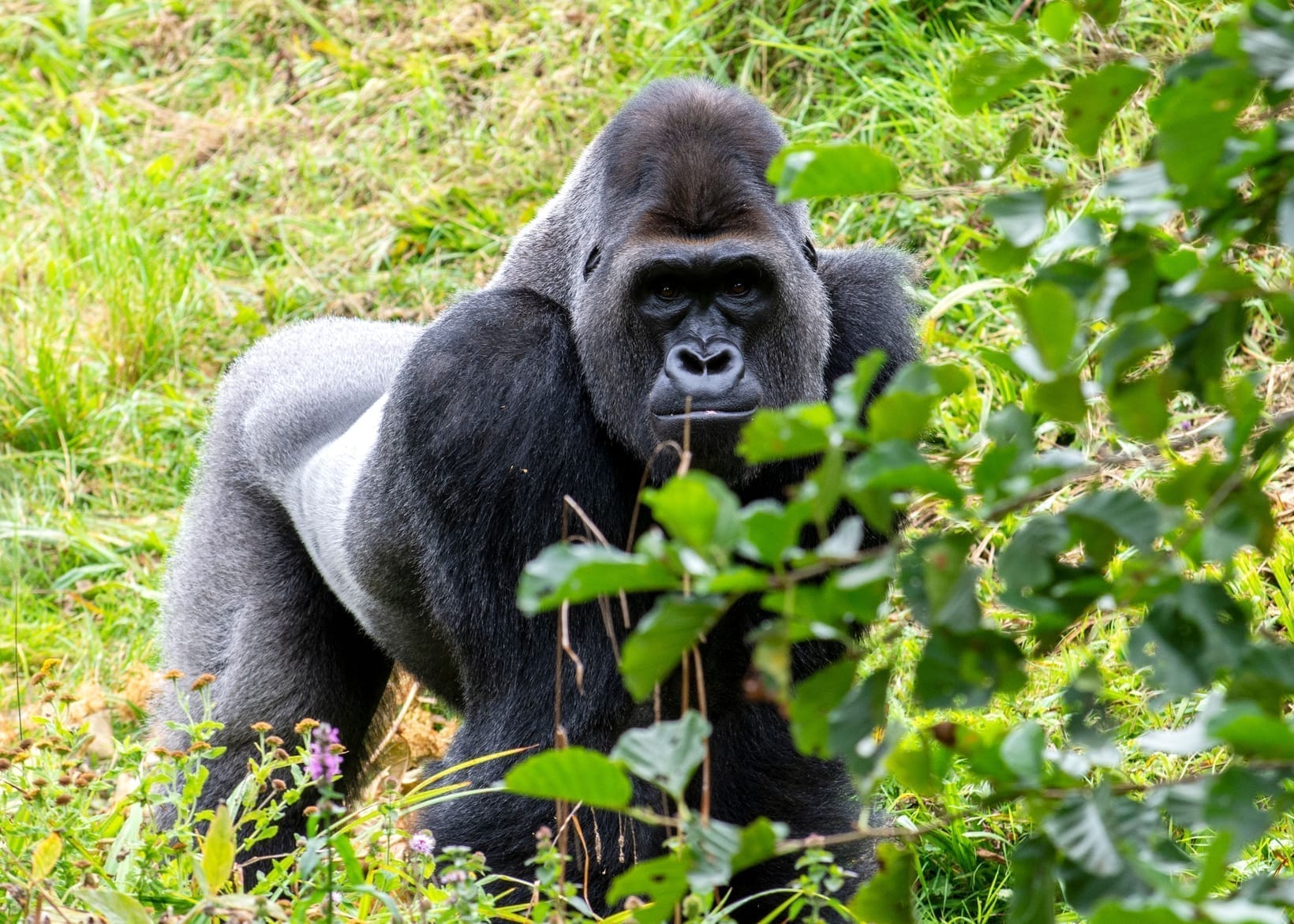
Short answerA silverback is an adult male gorilla who has grown the silver saddle across his back and hips at around 12–15 years old. It is a life stage, not a species. Wild mountain gorillas live typically 35–40 years, males weigh roughly 140–180 kg, and the “ten times stronger than a man” claim is folklore.
The silverback is the animal people picture when they picture a gorilla, and a surprising amount of what circulates about him is wrong — starting with the assumption that he is a particular kind of gorilla.
What a silverback actually is
A male gorilla develops the distinctive band of silver-grey hair across his back and hips as he matures, at around 12–15 years. Before that he is a blackback. There is no silverback species — every one is a mountain, eastern lowland or western gorilla who has grown up.
Our post on whether a silverback is a species goes further into the taxonomy, and is a gorilla a monkey settles the other question people arrive with.
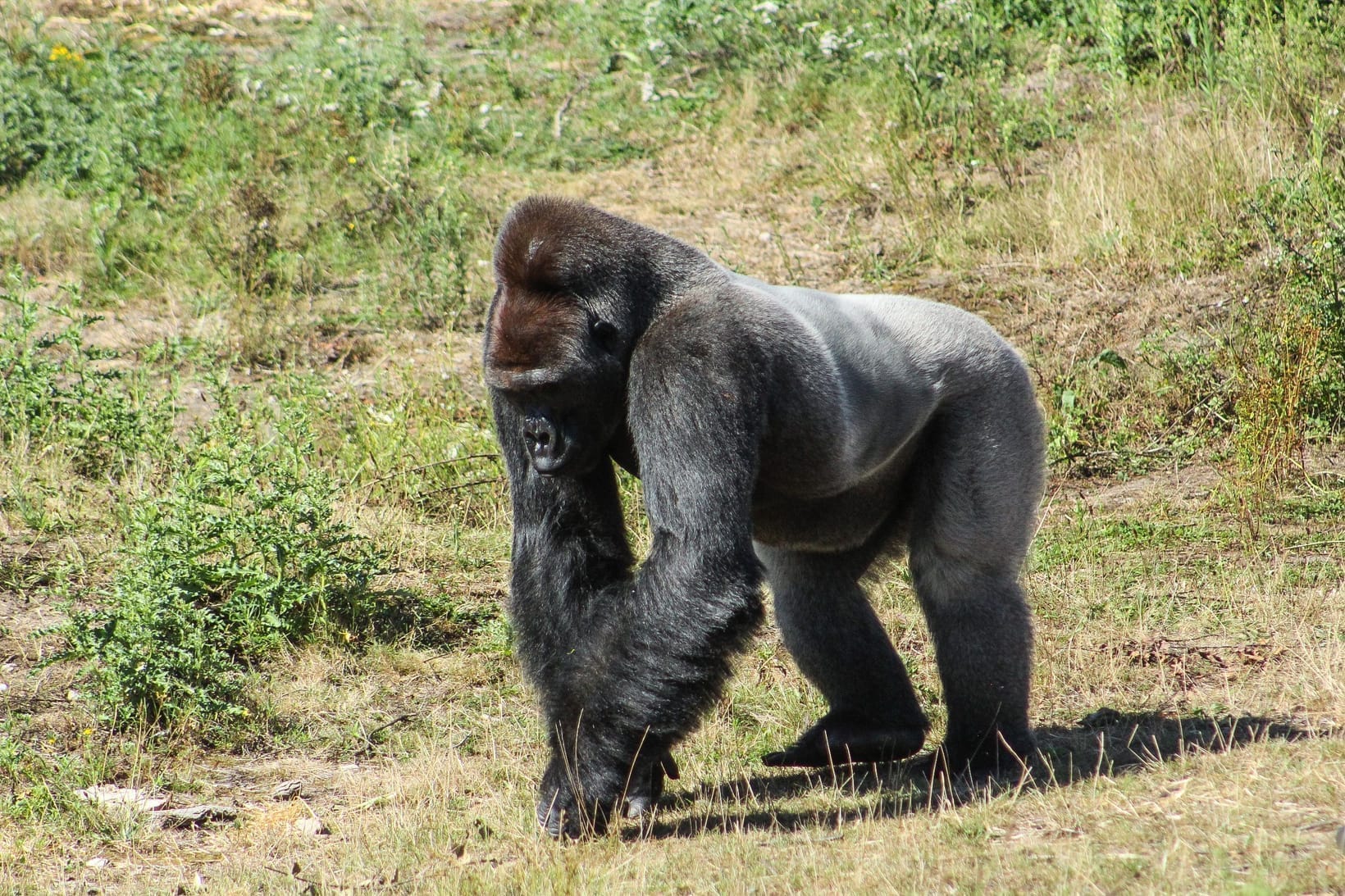 The silver saddle appears at around twelve years old, when a male matures
Silverback facts at a glance
| Detail | |
|---|---|
| What it is | An adult male gorilla, not a species |
| Silver saddle appears | 12–15 years |
| Male weight (wild mountain gorilla) | Around 140–180 kg |
| Height upright | Roughly 1.6–1.7 m |
| Arm span | Considerably greater than standing height |
| Female weight | Roughly half the male's |
| Lifespan in the wild | typically 35–40 years |
| Diet | Overwhelmingly plant matter — leaves, stems, shoots, pith |
| Group role | Usually one dominant male leading a family |
| Mountain gorillas remaining | 1,063 |
For the size question in depth — including how a silverback compares with a person and with other apes — see how big is a silverback gorilla.
How long silverbacks live
Wild mountain gorillas typically live typically 35–40 years. A male reaching silverback status at 12–15 years therefore spends perhaps two decades as one, though the period actually leading a family is usually much shorter.
What the silverback does
He is the centre of the group in a fairly literal sense. The family organises itself around him, and his decisions determine where it feeds, when it moves and where it nests.
- Leads and decides. Foraging routes and daily movement.
- Defends. Against rival males, and against predators or perceived threats.
- Mediates. Disputes within the group are frequently settled by his intervention.
- Fathers.The dominant male sires most of the group's offspring.
- Parents. Silverbacks tolerate and play with infants to a degree that surprises most first-time observers.
That last point is the one people remember from a trek. The animal described everywhere as fearsome spends much of the hour you are with him lying on his back while juveniles climb over him.
The strength claims, honestly
You will see figures — six times, ten times, twenty times stronger than a human. We are not going to repeat them as fact, because there is no well-established experimental basis for any of them.
| Claim | Status |
|---|---|
| Silverbacks are extremely strong | Well established |
| They break and bend vegetation no person could | Observed routinely |
| Muscle mass is far higher relative to body weight than in humans | Well established |
| 'Ten times stronger than a man' | Folklore — no reliable measurement behind it |
| Specific bench-press or lifting figures | Not credible; not measured |
Chest-beating and communication
The chest beat is made with cupped hands, not fists, which is what produces the hollow knocking sound rather than a thud. It carries a long way through dense forest.
It is a display rather than an attack signal — a broadcast of size, condition and position to rivals, to the family, and to anything else nearby. Research indicates the sound honestly conveys body size, meaning a listening gorilla can judge how big the beater is without seeing him.
Gorillas also use a wide vocal repertoire, including the contented rumbling that guides call “belch vocalisations” — the sound of a relaxed feeding group, and the one you are most likely to hear.
Seeing one in the wild
There is only one way: trekking to a habituated family in Uganda, Rwanda or DR Congo. Around 1,063 mountain gorillas remain, all of them wild.
| Detail | |
|---|---|
| Time with the family | 1 hour |
| Minimum distance | 10 metres |
| Group size | 8 visitors |
| Minimum age | 15 years |
| Where | Bwindi and Mgahinga (Uganda), Volcanoes (Rwanda), Virunga (DRC) |
If a silverback is what you came for, our guides to the gorilla families of Bwindi and Mgahinga and how to book gorilla permits cover the practical side, and fitness and difficulty covers whether you can manage the walk.
Tell us your dates and we will secure the permit and build the trip around it.
Silverback gorillas: common questions
What is a silverback gorilla? An adult male gorilla that has developed a saddle of silver-grey hair across his back and hips, which happens at around 12 to 15 years old. It is a life stage rather than a species — every silverback is a mountain, eastern lowland or western gorilla who has simply matured.
How long do silverback gorillas live? Wild mountain gorillas typically live 35 to 40 years. Captive gorillas of other subspecies have lived considerably longer, into their fifties and beyond, which is why zoo figures are a poor guide — no mountain gorilla has ever survived long in captivity.
How big is a silverback gorilla? A wild adult male mountain gorilla typically weighs around 140 to 180 kilograms and stands roughly 1.6 to 1.7 metres upright, with an arm span considerably greater than his height. Females are around half the weight.
How strong is a silverback gorilla? Genuinely very strong, but the specific multipliers you see online — 'ten times stronger than a man' and similar — are folklore rather than measurement. There is no well-established experimental figure. What is documented is that they routinely handle vegetation and break branches no person could manage.
Why do silverbacks beat their chests? It is a display and a signal, not usually a prelude to attack. The cupped-hand beat carries a long way through forest and communicates size, condition and location — to rival males, to the family, and to anything else nearby. Research suggests the sound itself conveys body size honestly.
How many silverbacks are in a gorilla group? Usually one dominant silverback leading the family, though some groups contain several adult males living together relatively peacefully. Mgahinga's Nyakagezi family in Uganda has historically been notable for exactly that.
Sources
- International Union for Conservation of Nature — Gorilla beringei beringei (Mountain Gorilla) — species assessmentAccessed 29 Jul 2026
- Dian Fossey Gorilla Fund — Mountain gorilla biology and behaviourAccessed 29 Jul 2026