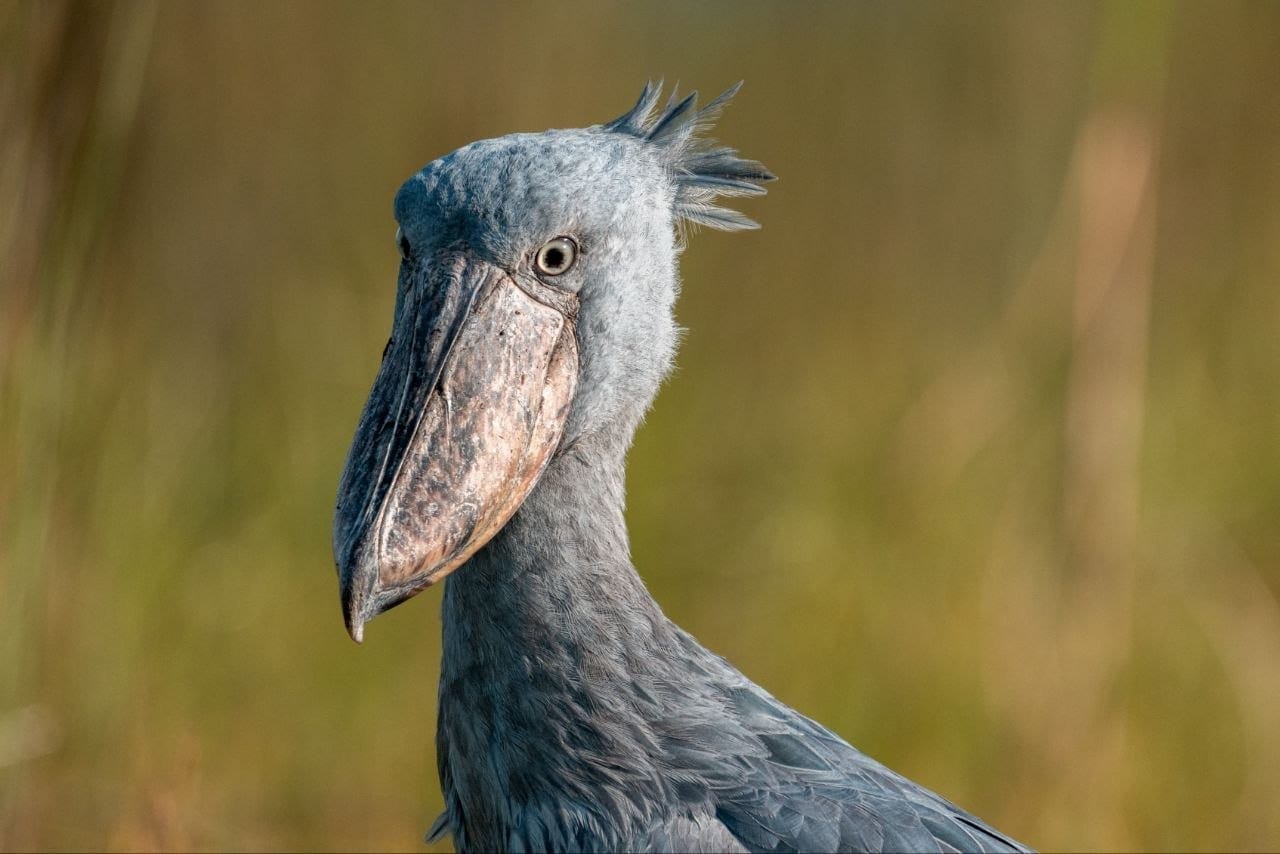
Short answerMabamba Bay is a papyrus wetland on Lake Victoria, within reach of Entebbe, and the most reliable place in Uganda to see a shoebill. You search the channels by boat and dugout canoe with local guides. Go at first light, allow a half day, and treat it as an arrival-day or departure-day morning rather than squeezing it before a flight.
The shoebill is the bird people come to Uganda for without necessarily realising it exists first. It stands over a metre tall, it has a bill like a wooden clog, and it stands perfectly still for so long that first-time observers frequently ask whether it is real.
Mabamba is where most people find one. Our post on whether the shoebill is a dinosaur covers the bird itself; this covers the morning you spend looking for it.
What Mabamba is
Mabamba Bay is a large papyrus swamp on the northern shore of Lake Victoria, west of Entebbe, and a designated Ramsar wetland of international importance. It is not a park or a reserve in the usual sense — it is a working wetland where local people fish and cut papyrus, and the shoebill guiding is a community enterprise layered on top of that.
That matters, because the guides are fishermen who know the channels and watch the birds daily. The money from a visit goes directly into the community that has an interest in the swamp staying intact, which is roughly the best conservation argument tourism can make.
How the morning actually runs
| Stage | What happens |
|---|---|
| Pre-dawn | Leave Entebbe. You want to be on the water at first light. |
| Arrival | Meet local guides at the landing site; boats and life jackets sorted. |
| Open water | A motorised boat runs you out across the bay to the swamp edge. |
| The channels | Transfer to a smaller boat or dugout to work quietly through the papyrus. |
| The search | Two to three hours moving between known feeding areas. |
| Return | Back across the bay and on to Entebbe, usually by late morning. |
Getting the timing right
- First light, always. Shoebills feed most actively early, the water is calm, and the light is better.
- Allow a half day. Two to three hours in the swamp plus transfers.
- Any season works. Water levels shift which channels are navigable but the birds are resident year-round.
- Arrival or departure day. This is the natural slot — see where to stay in Entebbe for how those days usually work.
What else you'll see
Mabamba is a serious birding site in its own right and would be worth the morning even without the headline act. Expect papyrus specialists and a long list of waterbirds — Goliath and purple heron, African jacana, malachite and pied kingfishers, papyrus gonolek, blue-breasted bee-eater, African marsh harrier, and often African water rail.
Sitatunga — a swamp-dwelling antelope with splayed hooves adapted to walking on floating vegetation — are present and occasionally seen. For the broader picture of Uganda's birdlife, see our guide to Africa's largest and most powerful birds and to the grey crowned crane, Uganda's national bird.
Other places to try for a shoebill
| Site | Access | Notes |
|---|---|---|
| Mabamba Bay | Half day from Entebbe | The standard choice. Most reliable, best organised. |
| Murchison Falls — Nile delta | Boat trip within the park | Seen from the delta cruise. A genuine second chance if you're going anyway. |
| Ziwa Rhino Sanctuary | Canoe trip within the sanctuary | Overlooked. Convenient if you're stopping for the rhinos. |
| Lake Mburo area wetlands | Local guiding | Occasional, not a primary site. |
That last point is how we approach it: if the shoebill genuinely matters to you, we put Mabamba on the arrival day and the Murchison delta cruise or Ziwa later in the trip, so you have two independent attempts.
Practical notes
- Life jackets are provided and should be worn. The swamp is shallow but the open-water crossing is not.
- Sun. There is no shade on the water. Hat, sunscreen, long sleeves.
- Binoculars matter more here than almost anywhere else on a Uganda trip.
- Camera reach. The birds are often distant across papyrus. See our safari photography tips on lens choice.
- Tip the boat guides. This is community-run and the guiding is the income.
| Tier | Properties we book |
|---|---|
| Luxury | Protea Hotel by Marriott Entebbe · Lake Victoria Serena Golf Resort · Hotel No.5 Entebbe |
| Mid-range | Best Western Premier Garden Hotel · Boma Hotel Entebbe · 2 Friends Beach Hotel |
| Budget | Airport Guest House · ViaVia Entebbe · Elementis Guesthouse |
We build Mabamba into birding itineraries and add it to arrival or departure days on request. Tell us your flight timesand we'll say whether it fits.
Mabamba and shoebills: common questions
What is the best place to see a shoebill in Uganda? Mabamba Bay, a papyrus wetland on Lake Victoria within reach of Entebbe, is the most reliable and most visited shoebill site in the country. You search the papyrus channels by motorised boat and then dugout canoe with local guides who know where the birds have been feeding.
How likely are you to see a shoebill at Mabamba? Good, but never guaranteed — it is a wild bird in a large wetland. Going early in the morning, allowing enough time rather than rushing back for a flight, and using guides who work the swamp daily all improve the odds considerably.
How long does a Mabamba shoebill trip take? Allow a half day from Entebbe, including the road transfer, the boat crossing and two to three hours in the swamp itself. Rushing it is the main reason people miss the bird.
When is the best time of day to look for shoebills at Mabamba? Early morning. The birds are most active feeding at first light, the water is calm, and the light is far better for photography. By late morning the heat builds, the birds settle deeper into the papyrus, and your chances drop.
Can you visit Mabamba Swamp on your arrival or departure day? Yes, and it is one of the best uses of those otherwise dead days. It works well as a first morning after an overnight in Entebbe, or as a way to fill the day before a late-night international departure.
What is a shoebill and why is it such a big deal? A very large grey wading bird with an enormous clog-shaped bill, standing well over a metre tall, that hunts lungfish by standing motionless for long periods. It looks genuinely prehistoric, it is the only living member of its family, and it is classified as vulnerable — which is why birders travel a long way for it.
Sources
- Ramsar Convention on Wetlands — Mabamba Bay Wetland SystemAccessed 28 Jul 2026
- BirdLife International — Shoebill Balaeniceps rex — species factsheetAccessed 28 Jul 2026