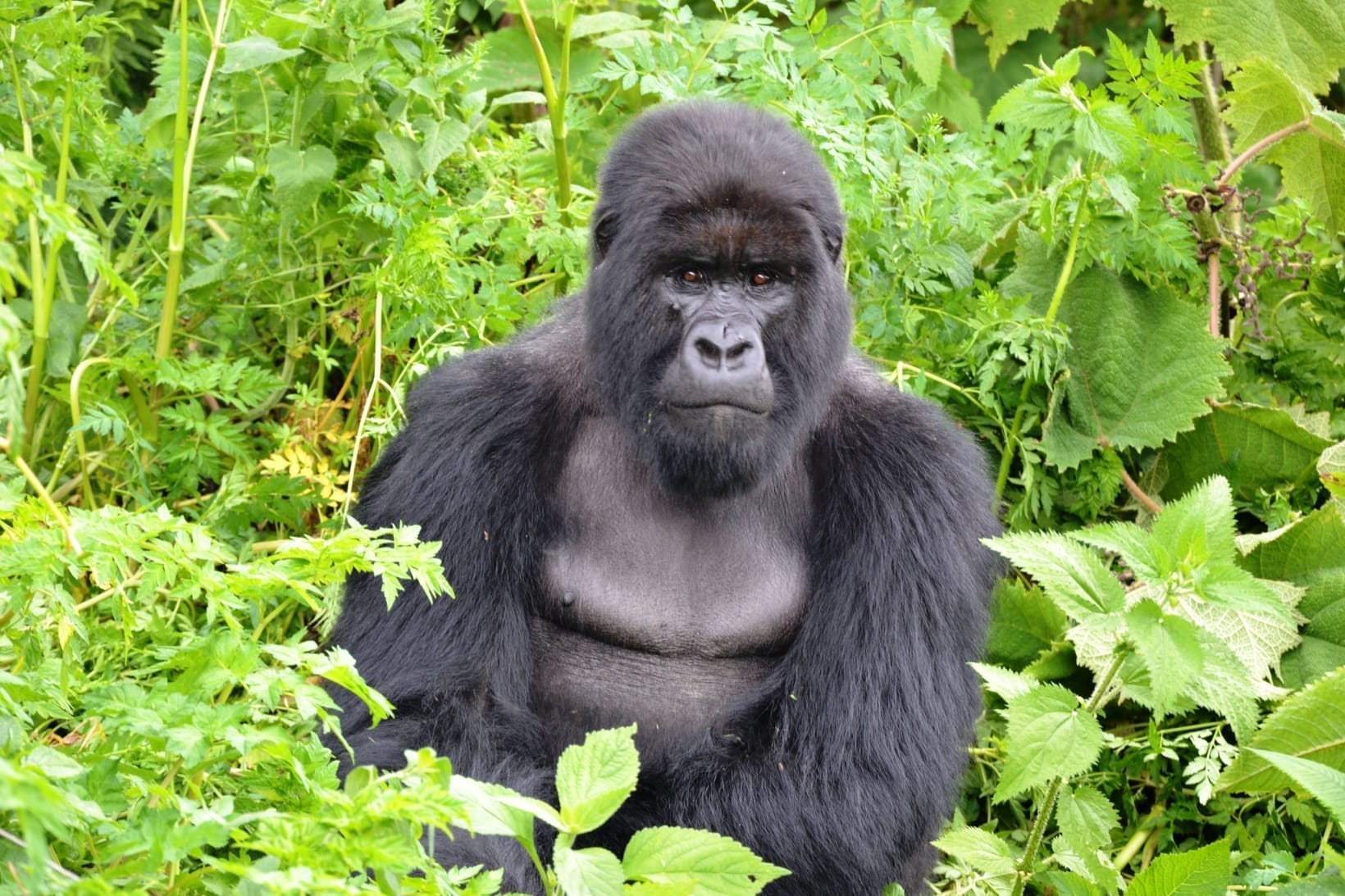
Short answerBwindi has more than a dozen habituated gorilla families spread across its four sectors, plus one at Mgahinga. You cannot reliably choose which one you visit — families are allocated at the briefing on the morning of the trek, based on group size, declared fitness and where the gorillas were last tracked. Choose your sector; the family chooses itself.
Search for gorilla families and you will find long lists of names with exact member counts attached, presented as though you were choosing a hotel room. Those numbers are almost always out of date, and the choosing does not work that way.
What is genuinely worth knowing is which families live in which sector, because that is the decision you actually make — it determines where you sleep and what your trek is likely to be like. This guide is organised around that.
What a habituated family actually is
Habituation is the process of accustoming a wild gorilla group to human presence, and it takes two to three years of researchers and trackers visiting daily. At the end of it the gorillas tolerate a small number of people at a distance for a short period each day, and otherwise ignore them entirely.
They remain completely wild. They are not fed, not confined, and not managed. They forage where they choose, which is precisely why nobody can promise you a short walk.
| Rule | Detail |
|---|---|
| Visitors per family per day | 8 visitors |
| Time with the family | 1 hour |
| Minimum distance | 10 metres |
| Minimum age | 15 years |
Buhoma sector families
Buhoma in the north is where Bwindi's gorilla tourism began, and its families are the longest-established.
- Mubare — the original. The first Bwindi group opened to tourism, and the family whose fortunes are most closely followed; it has shrunk and recovered more than once over the decades.
- Habinyanja — a large, long-habituated group named for the swamp where it was first found.
- Rushegura — split from Habinyanja in the early 2000s and known for ranging close to the Buhoma lodges, occasionally walking through their grounds.
Ruhija sector families
Ruhija sits high on Bwindi's eastern side — cooler, quieter, and the sector serious birders choose.
- Bitukura — habituated relatively quickly, and often described as unusually relaxed around visitors.
- Oruzogo — a popular Ruhija family, known for having had a good run of juveniles, which makes for lively viewing.
- Kyaguliro — long used as a research group rather than a tourism one.
Rushaga and Nkuringo families
The southern sectors hold the largest number of habituated families of any part of Bwindi, which is why Rushaga in particular carries so much of Uganda's permit supply — and why the Gorilla Habituation Experience is offered here and nowhere else.
- Nkuringo — the family that gave the sector its name, habituated in the mid-2000s. Nkuringo treks have a reputation for being the most physically demanding in Bwindi.
- Nshongi, Mishaya, Bweza, Kahungye, Busingye, Bikingi, Mucunguzi — the Rushaga cluster. Several of these originated as splits from Nshongi, once one of the largest groups ever habituated.
| Sector | Character of the trek | Habituation permits |
|---|---|---|
| Buhoma | The most developed sector, widest lodge choice | No |
| Ruhija | High, cool, quiet; excellent birding | No |
| Rushaga | Most habituated families in Bwindi | Yes |
| Nkuringo | Highest trailhead, steepest reputation | Yes |
Mgahinga: Nyakagezi
Mgahinga has a single habituated family, Nyakagezi, and it is unusual in two ways: it has historically contained several silverbacks living together relatively peacefully, and it ranges across the Virunga Massif — meaning it can and does cross into Rwanda or DR Congo.
When it does, Mgahinga gorilla trekking is suspended until it returns. That is why we treat Mgahinga as a golden monkey and volcano destination with gorillas as a bonus, as covered in where to stay at Mgahinga.
Can you choose your family?
Not really, and understanding why saves a lot of disappointment.
Permits are issued for a sector. On the morning of the trek, at the briefing, rangers divide everyone present into groups of 8 visitors and assign each group a family. They do this using where the trackers reported the gorillas at dawn, how many people are present, and what those people say about their fitness.
When a family splits
Gorilla families are not fixed. A maturing male may leave and take females with him; a silverback may die and the group disperse or be absorbed. Because the individuals involved are already habituated, a split often produces two visitable families where there was one — which is how several of Rushaga's current groups came about.
This is also why any list of families with exact member counts is obsolete shortly after it is published, including, in time, this one. We have deliberately not printed member numbers here.
How much this should influence your planning
Honestly: less than the internet suggests. In order of what actually affects your trip:
- Which sector your permit is for. This decides where you sleep — see where to stay in Bwindi. It is the only one of these you truly control.
- Your honesty about fitness at the briefing. More influence over your day than any family name.
- Whether you hire a porter. Cheap, genuinely useful, and direct income to the surrounding community.
- The weather that morning.Entirely outside anyone's control.
- Which family you are given. Last, and not yours to decide.
For what the day itself is like, see what to expect on a gorilla trekking day, and for the population context, how many mountain gorillas are left.
We secure permits by sector and match your accommodation to the sector you are issued. Tell us your dates and we will tell you honestly what is available.
Gorilla families: common questions
How many gorilla families are in Bwindi? More than a dozen habituated families are open to tourism across Bwindi's four sectors, and the number changes as groups are habituated, split or merge. Each family takes a maximum of eight visitors per day, so the number of habituated families is what sets Uganda's daily permit supply.
Can you request a specific gorilla family? You can request, and it is sometimes accommodated, but you cannot rely on it. Families are allocated at the briefing on the morning of the trek, based on group size, visitor fitness and where the gorillas were last tracked. Anyone booking around a particular family should treat it as a preference, not a booking.
Which gorilla family is easiest to trek? There is no permanently easy family, because gorillas move. A group that was an hour's walk from the trailhead last week may be four hours away today. What is true is that rangers try to place visitors who declare limited fitness with the family currently ranging closest, so being honest at the briefing matters more than choosing a name in advance.
What is the oldest habituated gorilla family in Bwindi? Mubare, in the Buhoma sector, was the first family habituated for tourism in Bwindi and opened to visitors in the early 1990s. It has fluctuated considerably in size over the decades since.
How many gorillas are in a family? It varies enormously — habituated families range from small groups of half a dozen to large ones of twenty or more, and the numbers change as individuals are born, die, transfer between groups, or split off to form new ones. A family always centres on at least one silverback.
What happens when a gorilla family splits? A maturing male may leave and take females with him, forming a new group. Because both resulting groups are already habituated, this usually increases the number of families available to visit. Several of Bwindi's current tourism families originated as splits from older ones.
Sources
- Uganda Wildlife Authority — Gorilla tracking — habituated families and permit allocationAccessed 28 Jul 2026
- International Union for Conservation of Nature — Gorilla beringei beringei (Mountain Gorilla) — species assessmentAccessed 28 Jul 2026