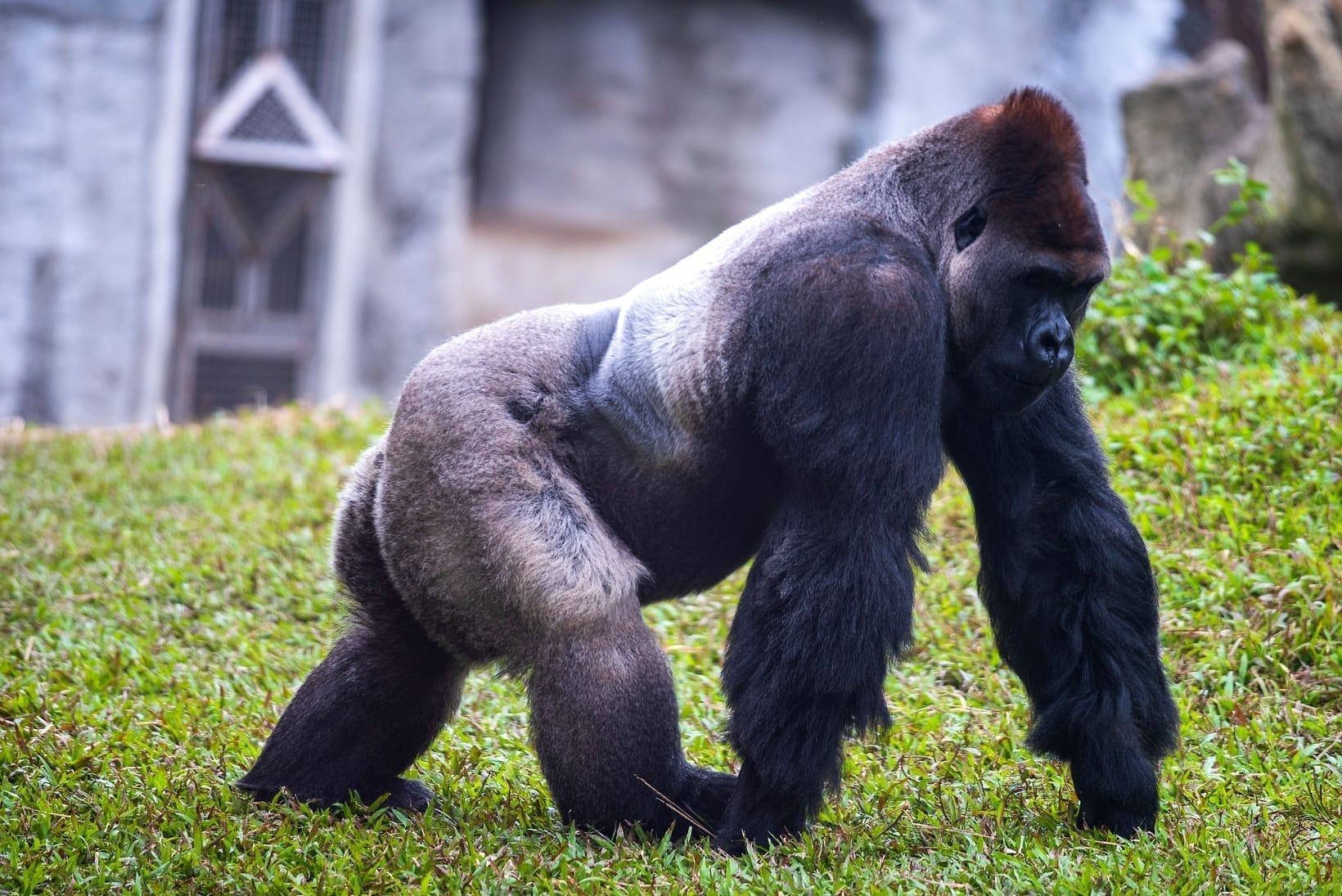
Short answerThere is not one mountain gorilla in captivity anywhere on earth, and there never has been a lasting captive population. Every gorilla in every zoo you have ever visited is a different animal — almost always a western lowland gorilla. The roughly 1,063 mountain gorillas alive are all wild, all in Uganda, Rwanda and the DRC, and trekking to them is the only way any human being sees one.
This surprises almost everyone. Gorillas are among the most familiar zoo animals in the world — most people in Europe and North America have stood in front of one. So the assumption that a mountain gorilla is somewhere on that circuit is a reasonable one. It is also completely wrong.
Not one, anywhere, ever
No zoo, safari park, sanctuary or research facility anywhere in the world holds a mountain gorilla. Not one animal. This is not a matter of current stock levels or a recent policy change — no captive population has ever been established, and every serious attempt to create one failed.
It is worth sitting with how unusual that is. Almost every large, charismatic mammal has a captive population somewhere: tigers, polar bears, elephants, rhinos, orangutans, chimpanzees. The mountain gorilla is a genuine exception among famous animals.
Which gorilla you actually saw
There are four recognised gorilla subspecies. They are not interchangeable, and only one of them is a zoo animal.
| Subspecies | In zoos? | Wild range |
|---|---|---|
| Western lowland gorilla | Yes — effectively all of them | Cameroon, Gabon, Congo, Central African Republic, Equatorial Guinea |
| Eastern lowland (Grauer's) gorilla | A handful, historically | Eastern DRC only — Kahuzi-Biéga and surrounding forest |
| Mountain gorilla | None. Never established. | Bwindi and the Virunga Massif — Uganda, Rwanda, DRC |
| Cross River gorilla | None | A tiny area on the Nigeria–Cameroon border |
So when someone says they have seen a gorilla at the zoo, they have — just not this one. The western lowland gorilla is a magnificent animal and a different species-level lineage, separated from the mountain gorilla by roughly a million years and the entire Congo basin.
Why captivity has never worked
Three things defeat it, and they compound.
Altitude and climate.Mountain gorillas live between roughly 1,400 and 3,800 metres in cool, wet, cloud-soaked forest. Their coats are noticeably longer and thicker than a lowland gorilla's precisely because of it. A temperate-zone zoo enclosure is the wrong temperature, the wrong humidity and the wrong air pressure at once, and a tropical one is worse.
Diet. An adult eats an enormous daily bulk of specific montane vegetation — wild celery, bamboo shoots, thistles, nettles, bedstraw — much of which grows nowhere outside that habitat and does not transport. This is not a fussy-eater problem that could be solved with substitutes; the animal is built around processing that particular mass of fibrous plant matter.
Disease. Mountain gorillas share around 98% of our DNA and have almost no resistance to human respiratory infections. A cold that inconveniences a keeper can kill a gorilla. In the wild this is managed by distance rules and mask requirements; in permanent close captivity it is far harder to control.
The attempts, and how they ended
In the early twentieth century, before the subspecies was understood or protected, collectors did try. Infants were taken — which in practice meant killing the adults defending them — and shipped to Europe and North America. They died. Not occasionally: essentially all of them, within weeks or months, of respiratory disease, malnutrition and what the records of the period describe as failure to thrive.
The arithmetic was appalling even by the standards of the time. Several adults died for each infant captured, and the infant then died anyway. By the time modern conservation began in the 1960s and 1970s — the era of Dian Fossey's work at Karisoke — the consensus had hardened completely: mountain gorillas are not to be taken from the wild, for any purpose.
That consensus has held for half a century, and today the population is rising. Context on that recovery is in how many mountain gorillas are left.
How the zoo animal differs from the wild one
If you have seen a western lowland gorilla in a zoo, here is honestly what changes when you stand in front of a wild mountain gorilla instead.
| Zoo (western lowland) | Bwindi or the Virungas (mountain) | |
|---|---|---|
| Barrier | Glass or a moat | None — open forest |
| Distance | Whatever the enclosure allows | 10 metres minimum, though the gorillas ignore it |
| Group with you | However many are at the window | 8 visitors maximum, plus rangers |
| Duration | As long as you like | 1 hour, strictly timed |
| The animal's behaviour | Habituated to a permanent human audience | Feeding, grooming, moving, arguing — doing what it would do anyway |
| Coat | Shorter — a lowland animal | Noticeably longer and denser, an adaptation to cold and wet |
| Effort to get there | A car park | One to six hours of steep, wet forest |
The difference people report most is not the animal — it is the absence of the barrier. Nothing stands between you and a 180-kilo silverback except a ranger and an agreement about distance that only one party has signed. That is a categorically different experience, and it is why the hour itself tends to stay with people for years.
The only way to see one
Because there is no captive option, the wild is not the premium choice — it is the only choice. Four parks issue permits, and three are realistic to plan around.
| Park | Country | Permit | Status |
|---|---|---|---|
| Bwindi Impenetrable Forest | Uganda | $800 peak / $600 low | Open. Most families and most permits. |
| Mgahinga Gorilla NP | Uganda | $800 peak / $600 low | Open, one family only |
| Volcanoes National Park | Rwanda | $1,500 | Open. Shortest transfers, highest price. |
| Virunga National Park | DR Congo | ~$400 | Closed to tourism since 2020 on security grounds |
For most first-time trekkers Uganda is the answer — the permit costs substantially less, far more are issued each day, and Bwindi holds the largest number of habituated families. The comparison in full is in Uganda vs Rwanda for gorilla trekking, and what the walk actually demands is in gorilla trekking fitness and difficulty.
What your permit money does
The usual objection to seeing animals in zoos is that the money supports captivity. Here the money does the opposite, and the mechanism is worth understanding rather than taking on trust.
- It funds the rangers. Permit revenue is the backbone of the budgets of the Uganda Wildlife Authority and the Rwanda Development Board — the tracker teams, the anti-poaching patrols and the veterinary response that between them turned the population around.
- A share goes to the communities. Both countries return a defined percentage of park revenue to the villages bordering the forest, which is what makes a live gorilla worth more locally than a dead one or a cleared field.
- It employs people directly. Guides, trackers, porters, lodge staff. Hiring a porter on trek day is a small sum that goes straight into the village at the trailhead.
We arrange gorilla treks in Uganda and Rwanda, buy the permits outright before you travel, and match the lodge to the sector the permit names. See how gorilla trekking works with us, or tell us roughly when you want to go and we will tell you what is still available.
Mountain gorillas in captivity: common questions
Are there mountain gorillas in zoos? No. There is not a single mountain gorilla in any zoo, wildlife park or captive facility anywhere in the world, and there never has been a self-sustaining captive population. Every gorilla you have seen in a zoo is a different subspecies — almost always a western lowland gorilla.
What kind of gorilla is in the zoo? Almost certainly a western lowland gorilla, the subspecies that makes up virtually the entire global zoo population of roughly 850 animals, most of them now captive-born. A handful of eastern lowland gorillas have been held historically. Mountain gorillas and Cross River gorillas have never been established in captivity.
Why are there no mountain gorillas in captivity? Early twentieth-century attempts to capture and hold them failed almost without exception — the animals died within weeks or months. They are adapted to cool, wet, high-altitude forest and a bulk diet of specific montane vegetation that is impractical to replicate. Since the 1970s the conservation consensus has been firmly against capture, and the subspecies is protected from it.
Can you see a mountain gorilla anywhere other than the wild? No. Trekking in Uganda, Rwanda or the DRC is the only way anyone — tourist, filmmaker or researcher — sees a mountain gorilla. There is no zoo, sanctuary or captive facility holding them, so the roughly 1,063 wild animals in Bwindi and the Virunga volcanoes are the entire accessible population.
How many mountain gorillas are left? Around 1,063 according to the most recent full census, split between the Virunga Massif and the Bwindi–Sarambwe forest block. It is the only great ape whose numbers are rising, and tourism revenue is a substantial part of why.
Is it cruel to trek gorillas rather than see them in a zoo? The choice does not exist, since no zoo has them. On its own terms, regulated trekking is the model conservationists back: group sizes are capped at eight, visits last one hour, a seven-metre distance applies, and permit revenue funds ranger salaries and community programmes in the villages around the parks.
Sources
- International Gorilla Conservation Programme — Which gorillas do you see in zoos?Accessed 29 Jul 2026
- Berggorilla & Regenwald Direkthilfe — Gorillas in zoosAccessed 29 Jul 2026
- IUCN Red List — Gorilla beringei beringeiAccessed 29 Jul 2026