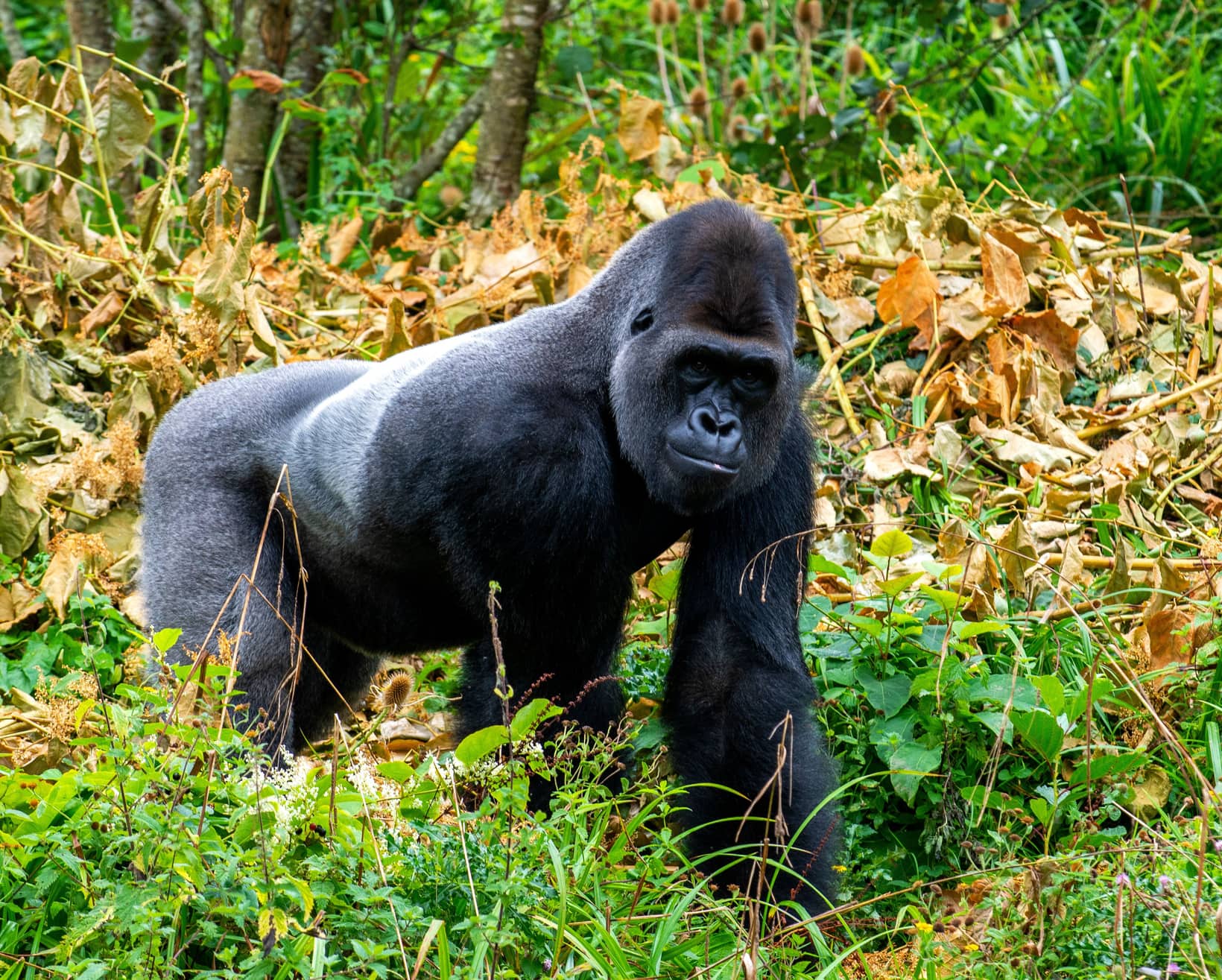
Short answerThere are no gorillas in South Africa — and none anywhere in southern Africa. Gorillas are equatorial forest animals; the nearest wild population to Johannesburg is around 3,000 kilometres north, in Uganda's Bwindi Impenetrable Forest and the Virunga volcanoes. Johannesburg is, however, one of the better hubs for reaching them — a four-hour flight to Entebbe or Kigali, which is why the two trips are so often combined.
This is one of the most common questions in African travel, and the reason is straightforward: for a great many people “African safari” means South Africa. If that is where the animals are, the gorillas should be there too. They are not, and the distance involved is larger than most people expect.
None — not in the whole region
No wild gorillas live in South Africa. Nor in Botswana, Namibia, Zimbabwe, Zambia, Mozambique, Lesotho or Eswatini. The entire southern third of the continent has none, and never has in any period relevant to travel.
Gorillas are animals of wet equatorial forest — either lowland tropical rainforest in the Congo basin and West Africa, or cool montane forest in the mountains of the Albertine Rift. Southern Africa is savanna, bushveld, desert and fynbos. There is no habitat for them, and no historical population.
Why people assume otherwise
Three things drive it, and none of them is silly.
South Africa is the default safari country. It has the best flight connections, the most developed tourism infrastructure and the highest marketing spend on the continent. If your mental map of African wildlife was formed by holiday brochures, it is a South African map.
Africa reads as one destination from far away. The continent is larger than China, India, the United States and most of Europe combined. Johannesburg to Bwindi is comparable to London to Nigeria — a distance nobody would casually assume away, but which vanishes on a small map.
Operators sell them together.“Gorilla trekking from South Africa” is a real and popular product, and the phrasing does not always make clear that the trekking part happens 3,000 kilometres away. The trip is usually fine; the label is doing work it should not.
What South Africa does have
| Species | In South Africa? | Where |
|---|---|---|
| Gorilla (any subspecies) | No | Equatorial Africa only — ten countries, none southern |
| Chimpanzee | No wild population | West and Central Africa; East Africa's Kibale and Gombe |
| Chacma baboon | Yes | Widespread — Kruger, the Cape Peninsula, the Drakensberg |
| Vervet monkey | Yes | Bushveld and coastal forest |
| Samango monkey | Yes | Indigenous forest patches in KwaZulu-Natal and Limpopo |
| Thick-tailed & lesser bushbaby | Yes | Nocturnal, widespread in the north-east |
South Africa is exceptional for other things — the Big Five in a single reserve, marine wildlife, and self-drive access that East Africa cannot match. It is simply not an ape destination.
Where the gorillas actually are
Around 1,063 mountain gorillas remain, confined to two forest blocks straddling the Uganda–Rwanda–DRC borders. Four parks issue permits; three are practical.
| Park | Country | Permit | From Johannesburg |
|---|---|---|---|
| Bwindi Impenetrable Forest | Uganda | $800 peak / $600 low | Fly to Entebbe (~4 hrs), then light aircraft |
| Mgahinga Gorilla NP | Uganda | $800 peak / $600 low | Entebbe or Kigali, then road to Kisoro |
| Volcanoes National Park | Rwanda | $1,500 | Fly to Kigali (~4 hrs), then about two hours by road |
| Virunga National Park | DR Congo | ~$400 | Closed to tourism since 2020 — not plannable |
Adding gorillas to a South Africa trip
The good news is that this is a well-worn route rather than an expedition. Johannesburg is a major African hub with direct services north, and both Entebbe and Kigali are around four hours away.
What it costs you in time: a minimum of five days added to the trip. That is one travel day up, two nights at the park with the trek in the middle, and one travel day back. Anything tighter and a delayed flight collides with a dated, non-refundable permit — which is the one risk on this itinerary worth engineering out.
How the flights work
Via Entebbe, for Uganda. Johannesburg to Entebbe direct, overnight there, then a scheduled light aircraft to Kihihi or Kisoro depending on which Bwindi sector your permit names. Trek, then return the same way. Five to six days door to door, and it is the cheaper option on permits.
Via Kigali, for Rwanda.Johannesburg to Kigali direct, then roughly two hours by road to Volcanoes National Park. It is the fastest version — you can be at the park the day you land — and the most expensive, because Rwanda's permit is roughly double Uganda's.
The version we prefer.Fly into Kigali, cross into Uganda's southern Bwindi sectors — the border is close and the drive short — trek on Uganda's cheaper permit, then continue north through Uganda or return to Kigali. The reasoning is set out in combining Uganda and Rwanda, and it saves real money without costing a day.
Uganda or Rwanda from Johannesburg
| Uganda | Rwanda | |
|---|---|---|
| Permit | $800 peak, $600 low season | $1,500 flat, year-round |
| Permits per day | Far more — easier to secure peak dates | Fewer, sells out earlier |
| Time from landing to park | Overnight plus a light aircraft | Same day, about two hours by road |
| Minimum days added | Five to six | Four to five |
| Habituation Experience | Yes — four hours, Rushaga sector | Not offered |
| Cost per day on the ground | Lower | Higher |
| Best if | You want value, or more than gorillas | Your time is tighter than your budget |
For a South African trip where the gorillas are the add-on rather than the point, Rwanda's speed often wins. Where the traveller has a week and wants chimpanzees or savanna alongside, Uganda is the better country and the cheaper permit. The full comparison sits in Uganda vs Rwanda for gorilla trekking.
We handle the northern half of trips like this all the time — permit bought and confirmed before you fly, lodge matched to the sector, and the buffer day built in rather than sold as an upgrade. See how our gorilla treks work, or tell us your South Africa dates and we will slot the trek around them.
Gorillas in South Africa: common questions
Are there gorillas in South Africa? No. There are no wild gorillas in South Africa, and none anywhere in the southern African region — not in Botswana, Namibia, Zimbabwe, Zambia or Mozambique either. Gorillas are equatorial forest animals, and the nearest wild population to Johannesburg is roughly 3,000 kilometres north.
Can you do gorilla trekking in South Africa? Not in South Africa itself. Trips advertised as gorilla trekking from South Africa are combination itineraries: you fly north to Uganda, Rwanda or the DRC for the trek. Johannesburg is a convenient hub for those flights, which is the real reason the two are so often sold together.
Are there gorillas in Kruger National Park? No. Kruger is savanna and bushveld — superb for the Big Five, entirely wrong for gorillas, which need wet montane or lowland tropical forest. Kruger's primates are chacma baboons and vervet monkeys, along with bushbabies at night.
How far is South Africa from the nearest gorillas? About 3,000 kilometres from Johannesburg to Uganda's Bwindi Impenetrable Forest. In practice it is a four-hour flight to Entebbe or Kigali, then a light aircraft or a road transfer to the park. Most travellers treat it as one travel day at each end.
Which African countries have wild gorillas? Ten, across all subspecies: Uganda, Rwanda, the Democratic Republic of Congo, the Republic of Congo, Gabon, Cameroon, the Central African Republic, Equatorial Guinea, Nigeria and Angola. Of those, only Uganda, Rwanda and the DRC offer organised mountain gorilla trekking.
Is it worth flying from South Africa to see gorillas? For most people who ask, yes — it is the one wildlife experience that cannot be substituted, since no zoo anywhere holds mountain gorillas and no southern African park has any gorillas at all. Adding four or five days to a South Africa trip covers it comfortably.
Sources
- IUCN Red List — Gorilla beringei beringei — range and populationAccessed 29 Jul 2026
- Uganda Wildlife Authority — Gorilla trekking permits and tariffsAccessed 29 Jul 2026
- South African National Parks — Kruger National Park — wildlifeAccessed 29 Jul 2026