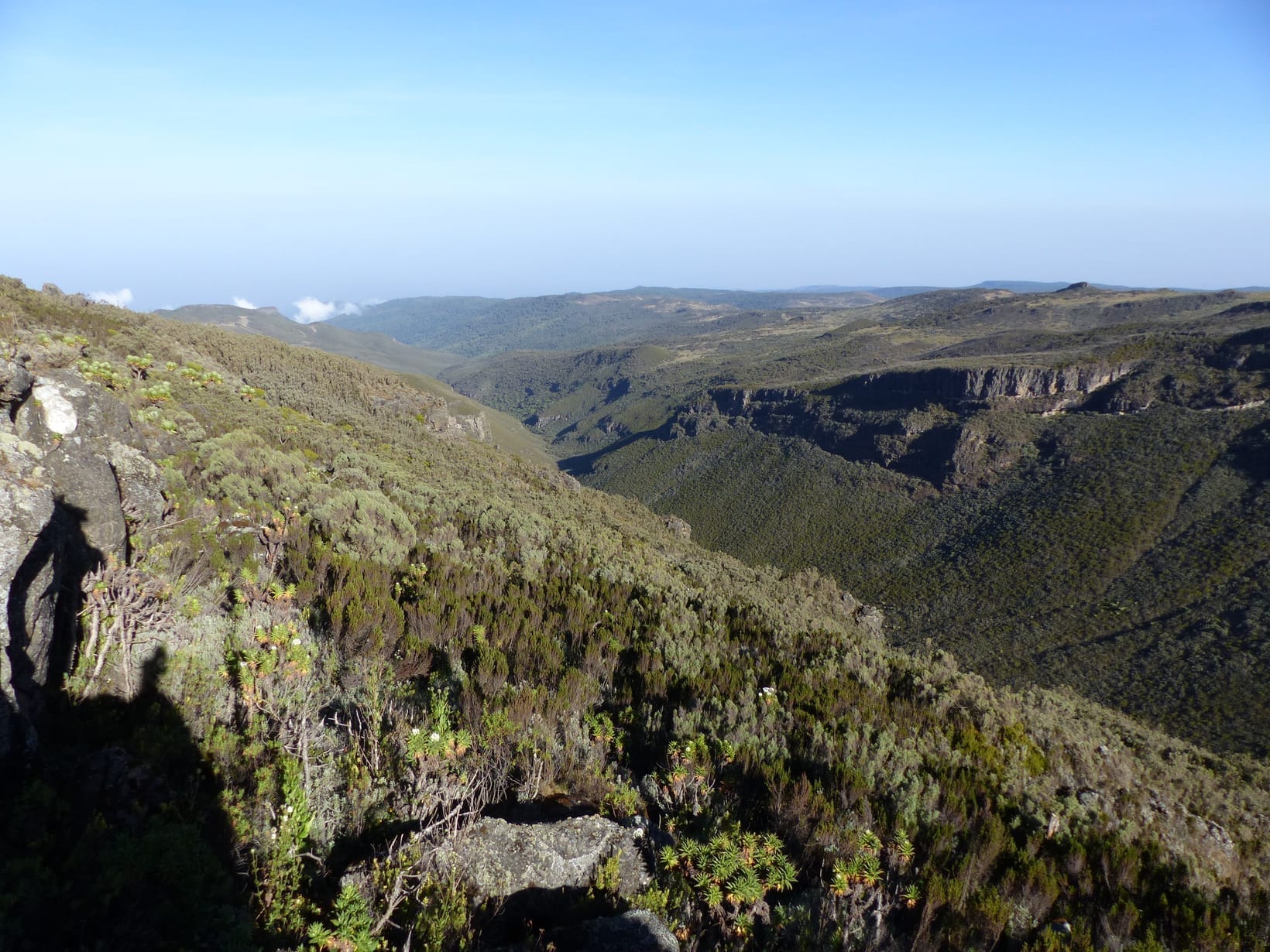
Short answerMount Elgon is an extinct volcano on the Kenyan border whose collapsed crater left a caldera roughly 40 km across — one of the largest on earth. The summit, Wagagai, is 4,321 m and the climb is a non-technical three-to-five-day trek. It is the cheapest serious mountain trek in East Africa and by far the quietest.
Almost nobody climbs Mount Elgon. That is the single most useful thing to know about it. Where Kilimanjaro processes tens of thousands of trekkers a year, you can spend four days crossing Elgon's moorland and meet nobody outside your own group.
It is not a lesser mountain for that. It is enormous, strange, and the caldera at the top is genuinely one of the more remarkable landscapes in Africa.
The mountain, and that caldera
Elgon is old — far older than Kilimanjaro — and long extinct. What was once a much higher peak collapsed in on itself, leaving a caldera you walk across rather than a cone you walk up. Inside it are hot springs, moorland, tussock grass, and stands of giant lobelia and groundsel that look like something from another planet.
The lower slopes are farmland and forest — this is intensively cultivated country, and the trek begins by walking up through smallholdings before the forest closes in. Higher, the vegetation zones shift through bamboo and heath into open Afro-alpine moorland.
The trekking routes compared
| Route | Character | Typical length |
|---|---|---|
| Sasa | The classic and steepest. Starts near Budadiri, shortest route to the summit, brutal first day. | 3–4 days |
| Sipi | The gentlest gradient and the longest. Starts near Sipi Falls, best scenery on the way up. | 4–5 days |
| Piswa | The gentlest of all, from the north-east. Longer, quieter, good for acclimatisation. | 4–5 days |
Elgon or the Rwenzoris?
Uganda has two serious mountain treks and they are very different propositions. Our Rwenzori Mountains trekking guide covers the other in depth.
| Mount Elgon | Rwenzoris | |
|---|---|---|
| Highest point reached | 4,321 m (Wagagai) | Over 5,000 m (Margherita) |
| Technical skills | None — walking only | Glacier travel and rope work for the summit |
| Typical duration | 3–5 days | 7–9 days |
| Conditions underfoot | Firm, moorland and rock | Notoriously wet, deep bog |
| Cost | Considerably lower | Substantially higher |
| Scenery | Vast caldera, moorland, giant lobelia | Glaciers, valleys, extraordinary vegetation |
| Suits | Fit hikers wanting a real mountain without technical demands | Experienced mountain trekkers |
The short version: if you want to walk up a big African mountain and come down again with good memories and dry feet, Elgon. If you want one of the hardest and most spectacular treks in Africa, the Rwenzoris.
How hard is it, honestly
Elgon is a hiking trek, not a climb. There is no equipment to learn, no exposure, and no glacier. What it does demand is several consecutive days of sustained uphill walking at altitude, carrying at least a day pack, sleeping in basic conditions, and being cold at night.
Altitude is the real variable. At 4,321 m, altitude sickness is a genuine possibility, and the shorter routes give less time to adjust. Anyone who has been affected at altitude before should take a longer route.
If you're not climbing it
Most visitors to the Elgon area never set foot on the mountain proper, and there is no shame in that — the lower slopes hold most of what makes the region enjoyable.
- Sipi Falls. Three waterfalls on the north-western slopes, with hikes, abseiling and coffee tours. See where to stay at Sipi Falls.
- Caves. Several on the mountain, some large enough that elephants historically entered them to mine salt from the walls.
- Coffee. Arabica grown on the slopes, with farm tours run by the growers themselves.
- Birding.Forest-edge and montane species, including Jackson's francolin and a range of turacos.
Where to stay
The trek itself is camped or in basic huts. Either side of it, Sipi is where most people base.
| Tier | Properties we book |
|---|---|
| Luxury | Sipi Heritage Lodge (formerly Sipi River Lodge) |
| Mid-range | Sipi Falls Lodge · Lacam Lodge |
| Budget | The Crow's Nest · Twilight Campsite |
Planning notes
- Guides are mandatory and porters are worth taking — they also make the trek a source of local income.
- Choose the route for acclimatisation, not for the shortest quote.
- Bring genuine cold-weather kit. The single most common Elgon mistake.
- Allow a recovery day afterwards. Sipi is the obvious place for it.
- Pair it with Jinja — the eastern loop makes sense as one leg. See where to stay in Jinja.
Elgon treks need lead time for permits, guides and porters. Talk to us early if you want to build one into a Uganda trip.
Mount Elgon: common questions
How high is Mount Elgon and how hard is it to climb? The summit, Wagagai, is 4,321 m. The climb is a non-technical multi-day trek — no ropes, ice or specialist equipment — but it is a serious hike at altitude with several long days. Anyone with good general fitness and hill-walking experience can do it; it is considerably less demanding than the Rwenzoris.
How many days do you need to climb Mount Elgon? Most routes take three to five days depending on which trail you use and whether you go all the way to Wagagai. Four days is the common choice for the summit via the Sasa trail. Shorter options exist for reaching the caldera rim without the full summit push.
What is Mount Elgon's caldera? Elgon is an extinct volcano whose crater collapsed, leaving a caldera roughly 40 kilometres across — among the largest intact calderas on earth. Reaching it is the real reward of the trek: a vast highland bowl of moorland, hot springs and giant lobelia, entirely unlike anything else in East Africa.
Is Mount Elgon cheaper than climbing Kilimanjaro or the Rwenzoris? Substantially. Elgon has none of Kilimanjaro's permit and crowd economics and none of the Rwenzoris' technical demands or specialist equipment requirements. For travellers who want a serious African mountain trek without the cost or the queue, it is the best value in the region.
Do you need a guide to climb Mount Elgon? Yes. Uganda Wildlife Authority guides are mandatory, and porters are available and worth taking. Independent trekking without a guide is not permitted.
What is there to do at Mount Elgon besides climbing? Sipi Falls sits on the mountain's north-western slopes and is the main non-trekking draw, with waterfall hikes, abseiling and coffee tours. There are also caves — Kitum Cave on the Kenyan side is famous for elephants that enter it to mine salt — and good forest-edge birding.
Sources
- Uganda Wildlife Authority — Mount Elgon National Park — trails, tariffs and informationAccessed 28 Jul 2026