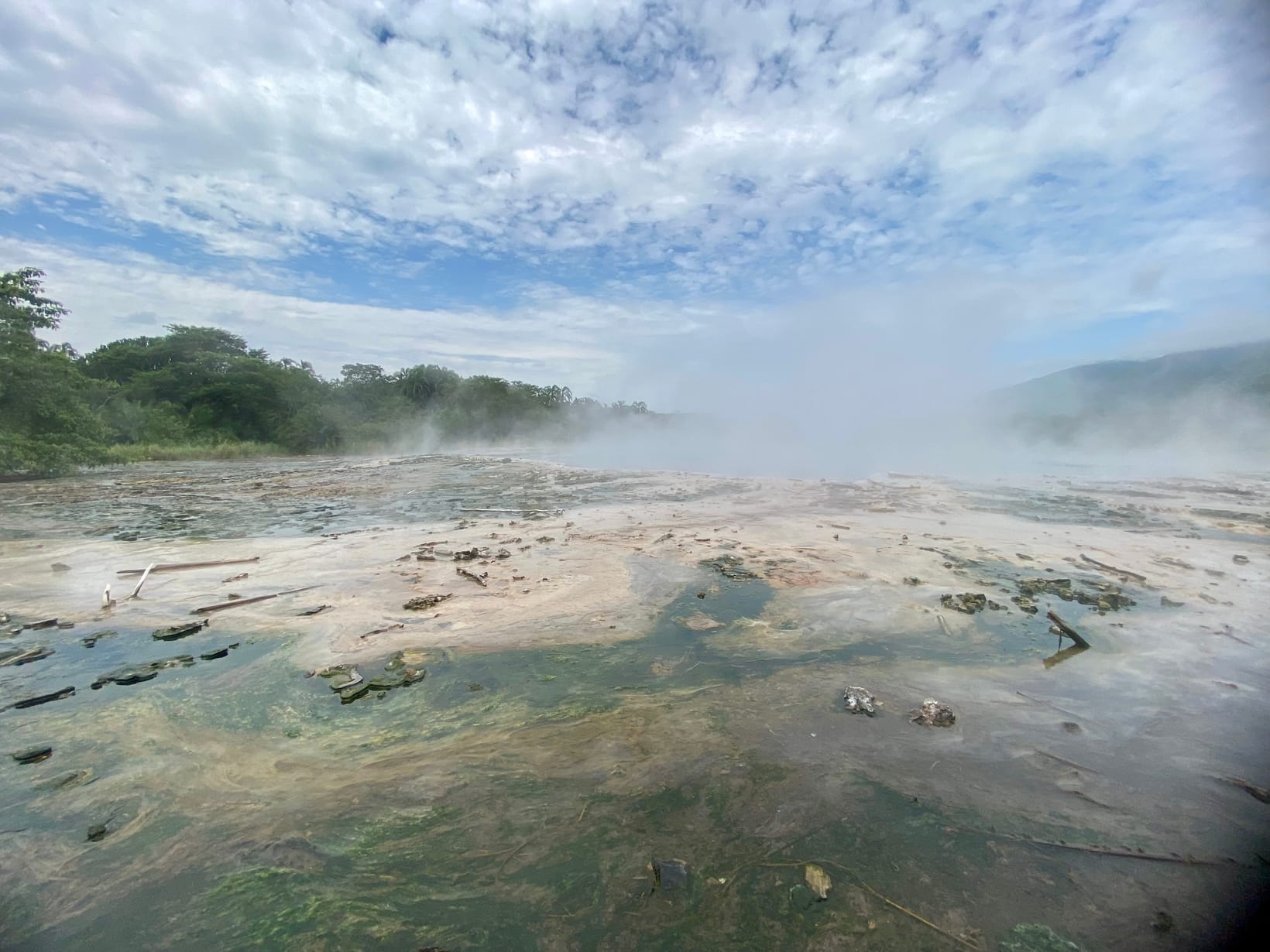
Short answerSemuliki is the eastern tip of the Congo's Ituri forest reaching into Uganda, which is why it holds lowland bird species found almost nowhere else in East Africa. Most visitors come for the Sempaya hot springs, where a jet of boiling water shoots several metres into the air. It is usually visited as a day trip from Fort Portal.
Semuliki is one of Uganda's least-visited national parks and one of its most biologically distinctive. Almost every other forest in the country is Albertine Rift montane forest. Semuliki is not: it is true Guinea-Congolian lowland rainforest, the far eastern edge of a forest system that stretches to the Atlantic.
For a birder that distinction is the entire point. For everyone else, the hot springs are the reason to come and the forest is the bonus.
A piece of the Congo, inside Uganda
The Semliki valley sits low — well below the Rwenzori escarpment you descend to reach it — and it is hot and humid in a way the Ugandan highlands are not. That lowland climate is what lets Congo-basin species persist here.
The Sempaya hot springs
There are two, and local tradition gives them genders. The female spring, Nyasimbi, is a wide steaming pool. The male spring, Bintente, is the spectacular one — a geyser jetting boiling water into the air, surrounded by a plume of steam that hangs in the forest canopy.
Guides will boil eggs and green bananas in the water while you watch, which sounds like a gimmick and is in fact a neat demonstration of quite how hot it is. A boardwalk keeps you at a safe distance; the ground around the springs is genuinely dangerous.
| Spring | Local name | What you see |
|---|---|---|
| Male | Bintente | A geyser jetting boiling water several metres up, heavy steam |
| Female | Nyasimbi | A broad, steaming pool in a clearing |
Why birders come a long way for this
Semuliki's bird list runs to roughly 440 species, but the raw number undersells it. What matters is which species: this is the only reliable place in Uganda — and often in East Africa — for a set of Congo-basin birds at the eastern limit of their range.
The Kirumia trail through the forest interior is the classic route. It is long, flat, hot and requires an early start, and it is where the serious birding happens. Uganda's wider birding case is made in our post on Africa's largest and most powerful birds, and the country's single most-wanted bird has its own guide — the shoebill.
Other wildlife, honestly assessed
Semuliki is not a game-viewing park and it would be misleading to sell it as one. Forest elephant and buffalo are present but rarely seen. There are several primate species — including grey-cheeked mangabey, red-tailed monkey and black-and-white colobus — and they are more often heard than watched.
For reliable large-mammal viewing, the adjacent Toro-Semliki Wildlife Reserve or the drive on to Queen Elizabeth National Park is the answer.
When to go
| Period | What to expect |
|---|---|
| Dry months | Best trail conditions; the Kirumia trail is manageable and access roads reliable |
| Wet months | Excellent birding but the valley floods in places and trails become hard going |
| Any time | Hot and humid — this is lowland forest, not the cool highlands |
Where to stay
| Tier | Properties we book |
|---|---|
| Luxury | Semliki Safari Lodge |
| Mid-range | Ntoroko Game Lodge · Mountains of the Moon Hotel |
| Budget | UWA Bandas, Semuliki · Fort Breeze Hotel |
The choice is small and mid-range and budget options fall back on Fort Portal properties above the escarpment — which is fine for the hot springs and unhelpful for dawn birding. Our guide to staying around Kibale and Fort Portal covers those in detail.
Does Semuliki fit your trip?
- Yes, if you are a birder. It is one of the two or three most distinctive birding sites in Uganda and worth building days around.
- Yes, as a half-day from Fort Portal if you are already staying there for Kibale chimpanzee trekking and want a different kind of morning.
- No, on a first two-week Uganda trip where gorillas, chimpanzees and the big savanna parks are the priority. Semuliki is a second-visit park for most travellers.
We include Semuliki on birding itineraries and as an add-on from Fort Portal. See which of our trips visit it, or ask us whether it earns a day on yours.
Semuliki: common questions
What is Semuliki National Park known for? The Sempaya hot springs and its birds. Semuliki is an eastern extension of the Congo's Ituri forest, so it holds lowland Congo-basin species found almost nowhere else in East Africa. For serious birders it is one of the most sought-after sites in Uganda; for general visitors the hot springs are the draw.
Are the Semuliki hot springs worth visiting? Yes, and they are genuinely unusual — the larger of the two shoots a jet of boiling water several metres into the air, and guides routinely boil eggs and plantain in it for visitors. The boardwalk approach through the forest is short and easy, which makes this one of the more accessible sights in western Uganda.
Is Semuliki good for birdwatching? It is one of Uganda's premier birding destinations, holding around 440 species including a long list of Congo-basin specials at the eastern edge of their range. Birders travel specifically for species like the Nkulengu Rail, Congo Serpent Eagle and various hornbills that are extremely difficult to see elsewhere in East Africa.
How do you get to Semuliki National Park? By road from Fort Portal, descending the Rwenzori escarpment into the Semliki valley. It is a manageable drive and Semuliki is most often visited as a day trip from Fort Portal rather than as an overnight stop, though staying nearby gives you the early morning that birding requires.
Is Semuliki the same as Toro-Semliki Wildlife Reserve? No, and the similar names cause constant confusion. Semuliki National Park is the forest with the hot springs. Toro-Semliki Wildlife Reserve is a separate, larger savanna reserve nearby with game drives, a chimpanzee community and Lake Albert shoreline. Some itineraries visit both; some quote one and deliver the other.
Sources
- Uganda Wildlife Authority — Semuliki National Park — park informationAccessed 28 Jul 2026