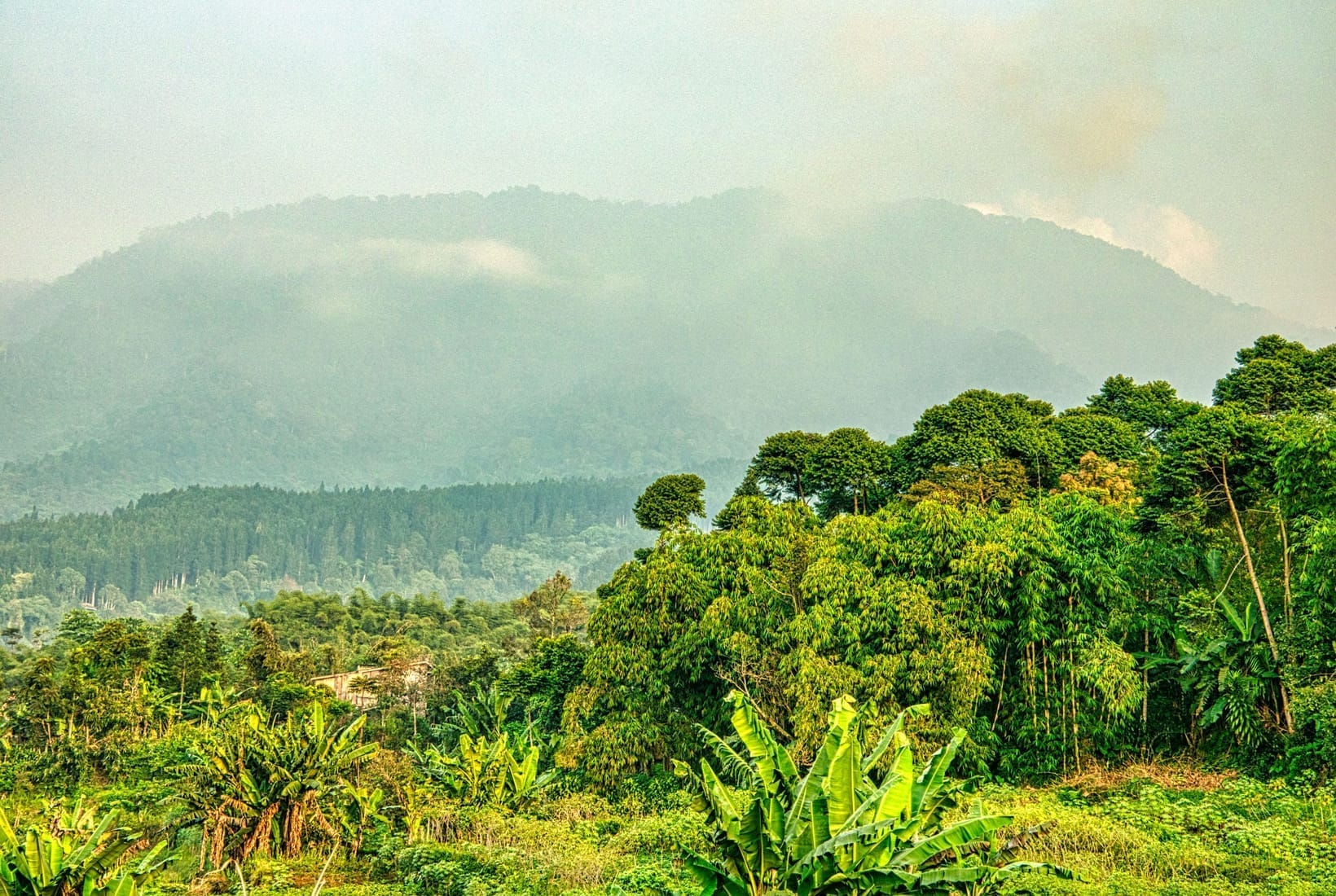
Short answerBwindi Impenetrable Forest is a 321 km² montane rainforest in south-western Uganda, a UNESCO World Heritage Site, and home to roughly 459 mountain gorillas — about 40% of every one left alive. It has four trekking sectors, more habituated families than anywhere else on earth, and a permit price of $800. The name is literal: the forest really is close to impassable off the trails.
Bwindi is the reason most people first look at a map of Uganda. A wall of ancient, tangled rainforest draped over steep hills in the country’s far south-west, it holds the greatest concentration of mountain gorillas left on earth — and the trek to reach them is one of the most physically and emotionally intense experiences in African travel.
What Bwindi actually is
Bwindi Impenetrable National Park covers 321 km²of south-western Uganda, ranging in altitude from roughly 1,160 to 2,607 metres — a swing that packs lowland and montane rainforest into a single park. It has been a UNESCO World Heritage Site since 1994.
The detail that matters biologically: Bwindi is old. It is one of the few African forests that survived the last ice age, when most of the continent’s rainforest contracted to isolated refuges. Species persisted here that vanished elsewhere, and then had 25,000 years to diverge. That is why a forest of this modest size holds so much found nowhere else.
And the name is not marketing. Bwindi is a near-vertical tangle of undergrowth, vines and fallen timber on broken hill country. Off the cut trails, progress is measured in metres.
The gorillas — and how many
Bwindi protects around 459 mountain gorillas against a world total of about 1,063. One forest, roughly 40% of the species. More than twenty families are habituated for trekking, which is why Bwindi issues far more permits per day than anywhere else and why peak-season dates are obtainable here when they are gone in Rwanda.
The trek itself is unpredictable by design: you are following animals that moved overnight, so it can take under an hour or most of the day. When you reach them the rules are fixed — a group of no more than eight, one hour, and a minimum distance the gorillas themselves routinely ignore. Detail in what to expect on the day and how hard the trek really is.
Population context is in how many mountain gorillas are left, and the families themselves in the gorilla families of Bwindi and Mgahinga.
The four sectors, compared
Bwindi has four trailhead areas. They are hours apart on rough mountain roads, and confusing them is the single most expensive planning error people make here.
| Sector | Where | Terrain | Best for |
|---|---|---|---|
| Buhoma | North | Gentlest of the four | First-timers, the widest lodge choice, the original sector |
| Ruhija | East, high and cool | Moderate, at altitude | Birders — this is the Albertine Rift endemic hotspot |
| Rushaga | South | Varied, some long treks | The most habituated families, and the only Habituation Experience |
| Nkuringo | South-west, remote | The most demanding — steep in and steeper out | Fit trekkers, big views, fewer people |
Permits and what they cost
| Item | Foreign non-resident |
|---|---|
| Gorilla permit, high season | $800 |
| Gorilla permit, low season (April, May, November) | $600 |
| Gorilla Habituation Experience (Rushaga only) | $1,800 |
| Park entrance | $40 — but included on your trekking day |
| Porter | A small sum at the trailhead, and worth every cent |
The booking mechanics, including who is allowed to buy direct, are in can you book a gorilla permit yourself and how to book gorilla permits.
Beyond the gorillas
Gorillas are the headline, and most itineraries give Bwindi exactly one night and one trek. That is a shame, because the forest rewards a longer look.
- Birding. 348 recorded species, including around 90% of all Albertine Rift endemics. The Mubwindi Swamp trail at Ruhija is among the best birding walks in Africa — see birding in Uganda.
- Other primates.Chimpanzees in small numbers, black-and-white colobus, L’Hoest’s and blue monkeys, plus nocturnal pottos and bushbabies.
- Forest and waterfall walks. The Munyaga waterfall trail at Buhoma is a gentle half-day and a good acclimatisation walk.
- Batwa community experiences.The forest’s original inhabitants, evicted when the park was gazetted — a history we treat carefully in the Batwa, forest people of Uganda.
When to go
Bwindi is trekked year-round and the gorillas do not migrate. What changes is the walking. The drier months — roughly June to September and December to February — give firmer trails, which matters a great deal on this terrain. The wet months are green, quiet, and cheaper: the permit drops to $600 in April, May and November, and lodges discount alongside it.
Month by month in the best time to visit Uganda.
Getting there
Bwindi is genuinely remote, and that is the trade-off for the forest being what it is.
By road from Entebbe or Kampalatakes most of a day — commonly eight to ten hours depending on sector, usually broken with an overnight at Lake Mburo or Lake Bunyonyi rather than driven in one push.
By air, scheduled light aircraft reach Kihihi (for Buhoma and Ruhija) and Kisoro (for Rushaga and Nkuringo) in a little over an hour. It costs more and saves the better part of two days.
Via Kigaliis the routing most travellers never hear about: Rwanda’s capital is far closer to Bwindi’s southern sectors than Entebbe is, and flying into Kigali and crossing the border removes an entire day of driving. The logic is in combining Uganda and Rwanda.
Mistakes people make
- One night at Bwindi. A delayed flight or a washed-out road then collides with a dated, non-refundable permit. Two nights.
- Booking the lodge before the permit. Covered above, and it is the expensive one.
- Skipping the porter to save a small sum, on the steepest trail of the trip.
- Packing for a game drive. This is wet montane forest — long sleeves, waterproof boots with ankle support, gaiters and gloves. See what to pack.
- Treating Bwindi as a day trip from a savanna park. It is not near anything.
- Trekking with a cold. Gorillas catch human respiratory infections and they die of them. Rangers will turn you back, and they are right to.
We match sector to fitness and lodge to permit, buy the permit outright before you travel, and build in the buffer night rather than selling it as an upgrade. See how our gorilla treks work, or tell us your dates and we will check what is still available.
Bwindi Impenetrable Forest: common questions
What is Bwindi Impenetrable Forest? A 321 km² montane rainforest in south-western Uganda, a UNESCO World Heritage Site since 1994, and home to roughly 459 mountain gorillas — around 40% of the world population. It is one of the oldest forests in Africa, having survived the last ice age, which is why its biodiversity is so unusually rich.
Why is it called Impenetrable? Because it is. The name is a literal description rather than branding — the forest is a steep, dense tangle of undergrowth, vines and fallen timber on broken hill country, and moving through it off-trail genuinely requires rangers cutting a path.
How many gorillas live in Bwindi? Around 459 at the last census, which is roughly 40% of every mountain gorilla alive. More than twenty families are habituated for trekking, spread across the park's four sectors.
Which Bwindi sector is best? Buhoma for the gentlest terrain and the widest choice of lodges, Ruhija for birding and cooler high forest, Rushaga for the most habituated families and the only Habituation Experience, Nkuringo for the most demanding trek and the best views. In practice your permit names the sector, so book the permit first and the lodge second.
How much is a gorilla permit for Bwindi? $800 per person for foreign non-residents in high season and $600 in the low-season months of April, May and November, set by the Uganda Wildlife Authority. Park entrance is included on your trekking day. Foreign non-residents must book through a licensed Ugandan tour operator.
How fit do you need to be for Bwindi? Reasonably fit, and prepared for anything from one to six hours of steep, muddy walking at altitude before you reach the family. It is the terrain rather than the distance that makes it hard. Hiring a porter makes a substantial difference and is money that goes straight into the community at the trailhead.
Is Bwindi worth visiting beyond gorilla trekking? Yes, though most people give it only the trek. Bwindi has 348 recorded bird species including around 90% of all Albertine Rift endemics, several other primates, waterfall and forest walks, and Batwa community experiences. Birders in particular should give it two or three days rather than one.
Sources
- UNESCO World Heritage Centre — Bwindi Impenetrable National ParkAccessed 29 Jul 2026
- Uganda Wildlife Authority — Conservation Tariff July 2026 – June 2028Accessed 29 Jul 2026
- IUCN Red List — Gorilla beringei beringeiAccessed 29 Jul 2026