Short answerToro-Semliki is a savanna and woodland reserve on the Lake Albert shore — not to be confused with Semuliki National Park, which is rainforest. It offers game drives, shoebill viewing by boat at $100, and savanna-dwelling chimpanzees at the Mugiri research site. Almost nobody goes.
One of the least-visited protected areas in Uganda that has any tourism infrastructure at all, and the one most often confused with somewhere else entirely.
First: it is not Semuliki National Park
They are near neighbours in the same corner of western Uganda, which is why itineraries sometimes visit both — but they deliver entirely different days.
What the reserve is
Open savanna, woodland and grassland dropping to the shore of Lake Albert on the floor of the Albertine Rift, with the escarpment rising behind. It is hot, low and dry — a marked contrast with the forested highlands most Uganda itineraries spend their time in.
| Detail | |
|---|---|
| Entrance (foreign non-resident) | $35 |
| Game drive (3 hrs) | $25 |
| Birding and nature walk | $25 |
| Boat cruise | $20 |
| Shoebill viewing by boat | $100 |
| Ntoroko boat hire | $100 |
| Primate walk, Mugiri research centre | $40 |
The shoebill boat at Ntoroko
The most interesting thing here for most visitors. Shoebill viewing by boat on Lake Albert, priced at $100 for three people.
Uganda's shoebill tourism is concentrated almost entirely on Mabamba Swamp near Entebbe, which is convenient and correspondingly busy. Toro-Semliki is the opposite: harder to reach, far quieter, and priced as a boat trip rather than a per-head canoe fee.
The Mugiri research chimpanzees
Toro-Semliki holds a chimpanzee community that lives in savanna and woodland rather than closed forest. That makes them genuinely unusual: most chimpanzees studied anywhere are forest animals, and savanna communities behave differently in ranging, diet and grouping.
A guided primate walk at the Mugiri research centre costs $40. This is research access rather than habituated tracking — set expectations accordingly, and read it alongside Kibale, where the habituated Kanyanchu community has a sighting rate UWA puts at over 90%.
Game drives and the Rift floor
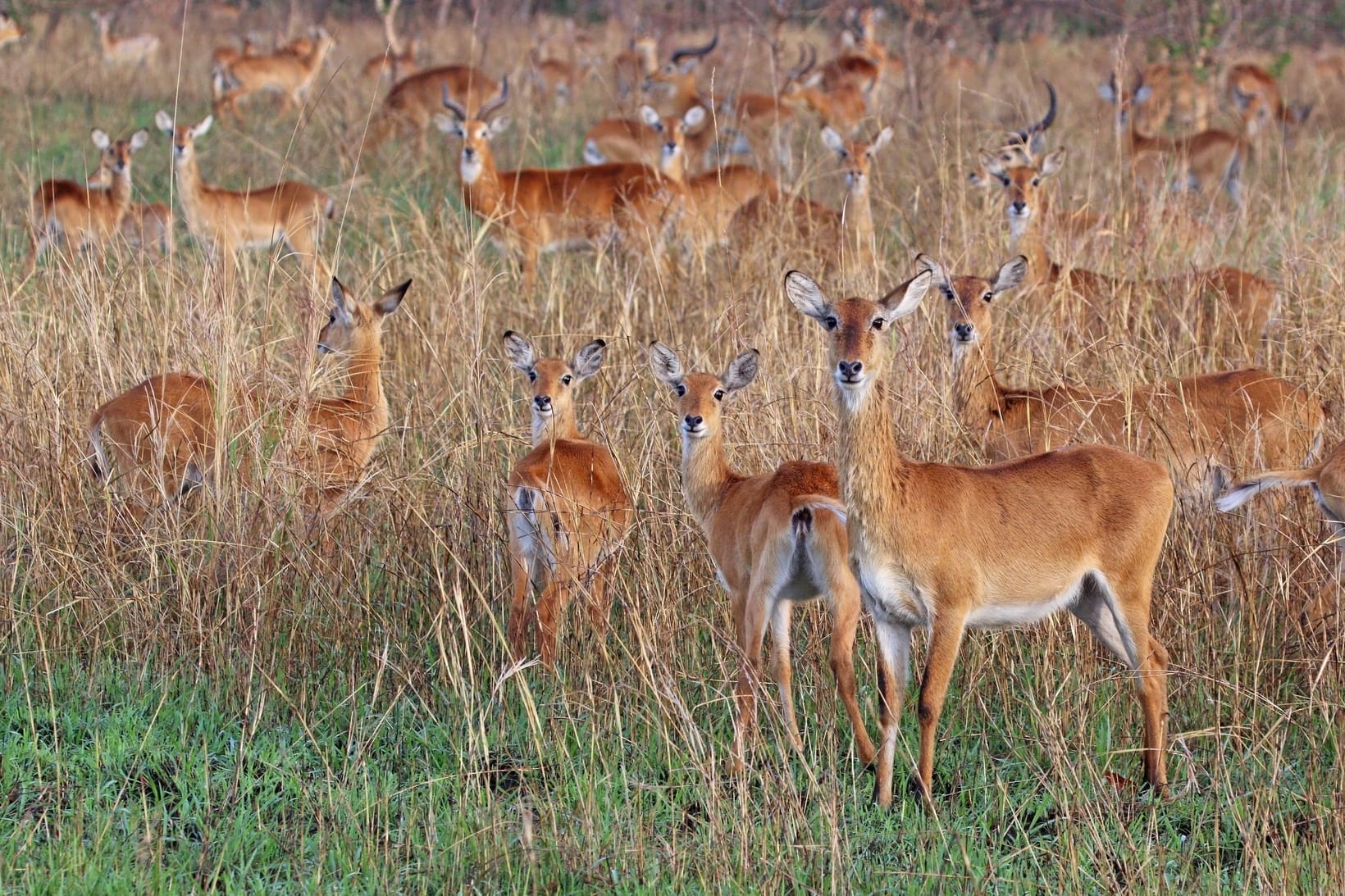
Three-hour game drives run in the reserve at $25. The wildlife is thinner than Murchison or Queen Elizabeth — this is a reserve rather than a flagship park, and it has had a harder history — but Uganda kob, waterbuck, buffalo, warthog and elephant occur, and you will very likely have the tracks to yourself.
The birding is the stronger draw. Rift floor, lakeshore and woodland species in one reserve, with almost no other vehicles. Our antelope field guide covers what you are looking at on the plains.
Planning a visit
- Know which place you have booked. Semuliki National Park and Toro-Semliki Wildlife Reserve are different.
- Use your free gorilla-permit day.A gorilla permit includes a day's free entrance here, valid within a month either side of tracking. Activity fees still apply.
- Combine it with Semuliki and Fort Portal. See Fort Portal and the crater lakes.
- Pack for heat. The Rift floor is far hotter than the highlands you have come from.
- Book the boat ahead. Minimum numbers apply.
- Treat it as a second-visit park. Excellent if you have the days; not at the expense of gorillas or Murchison on a first trip.
| Tier | Properties we book |
|---|---|
| Luxury | Semliki Safari Lodge |
| Mid-range | Ntoroko Game Lodge · Mountains of the Moon Hotel |
| Budget | UWA Bandas, Semuliki · Fort Breeze Hotel |
Accommodation is thin and shared with Semuliki National Park, falling back on Fort Portal properties above the escarpment — the same constraint our Semuliki guide describes. For everything the reserve charges for, see Uganda's park fees and activity costs.
Ask us whether it fits — on a two-week western circuit it often does, and almost nobody suggests it.
Toro-Semliki: common questions
What is the difference between Toro-Semliki Wildlife Reserve and Semuliki National Park? They are two separate protected areas with confusingly similar names. Semuliki National Park is lowland Congo-basin rainforest with the Sempaya hot springs. Toro-Semliki Wildlife Reserve is a larger savanna and woodland reserve on the Lake Albert shore, with game drives, a chimpanzee research site and shoebill boat trips.
Can you see shoebills at Toro-Semliki? Yes. The reserve offers shoebill viewing by boat on Lake Albert at $100, which covers three people with $20 per additional person. It is one of the least-visited shoebill sites in Uganda and a genuine alternative to Mabamba near Entebbe.
Are there chimpanzees at Toro-Semliki? Yes — a savanna-dwelling chimpanzee community studied at the Mugiri research site, where a guided primate walk costs $40. These chimps live in far more open, drier habitat than the forest communities at Kibale, which makes them scientifically distinctive.
Is Toro-Semliki worth visiting? For second-time visitors, birders and anyone who wants somewhere genuinely empty, yes. It has game drives, boats, chimpanzees and shoebills in one reserve at Category B entrance rates. For a first Uganda trip with limited days, the headline parks will deliver more.
How much does it cost to enter Toro-Semliki? $35 for foreign non-resident adults — Category B in the UWA tariff, the same band as Semuliki, Mount Elgon and the Rwenzoris. Activities are charged separately: game drives $25, birding and nature walks $25, the boat cruise $20 and shoebill viewing by boat $100.
Do gorilla permit holders get free entry to Toro-Semliki? Yes. The UWA tariff states each gorilla permit holder is entitled to a day's free entrance to Mount Elgon and Toro-Semliki, usable within one month before or after tracking. Activity fees in those areas are still payable.
Sources
- Uganda Wildlife Authority — Conservation Tariff July 2026 – June 2028, pp.12, 23Accessed 29 Jul 2026