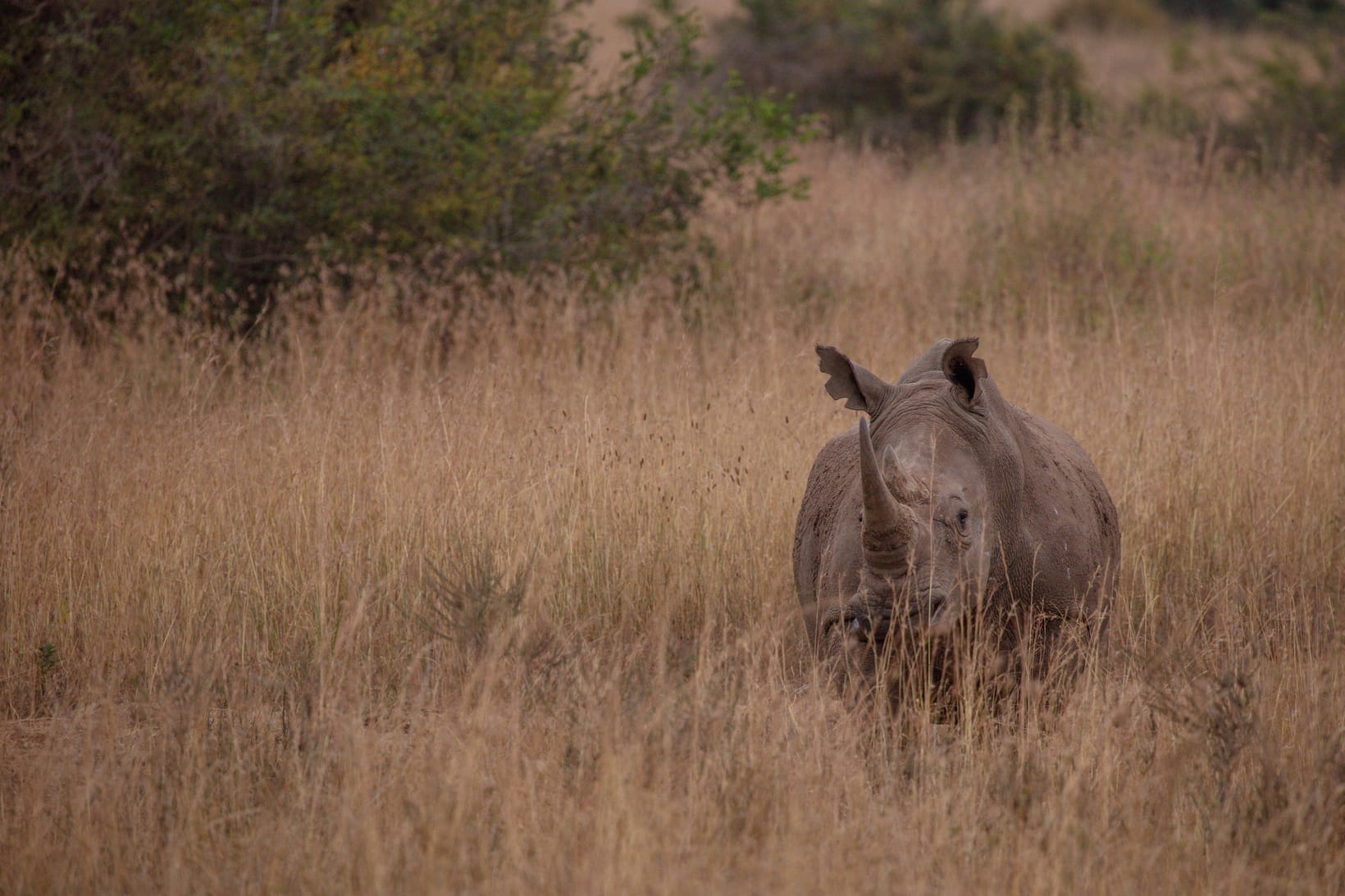
Short answerZiwa is a private sanctuary holding Uganda's only wild rhino population, on the main road north from Kampala to Murchison Falls. You track the rhinos on foot with rangers — one to two hours on flat ground, far easier than gorilla or chimpanzee trekking, and one of very few places in East Africa where you approach a rhino on foot.
Almost every Uganda itinerary heading to Murchison Falls drives past Ziwa's gate, and a good number stop. It is the only place in the country to see a rhino, and the way you see it — walking — makes it genuinely memorable rather than merely a box ticked.
Why Uganda had no rhinos at all
Uganda once held both black and white rhino. Poaching and the instability of the 1970s and 1980s eliminated them entirely — not reduced, but eliminated. By the mid-1980s there were no wild rhinos left anywhere in the country.
Ziwa was established to change that: a fenced, patrolled sanctuary breeding southern white rhino with armed rangers on the animals around the clock, with the long-term intention of restocking the national parks. Every rhino in Uganda today descends from that founding group.
It is worth understanding this before you go, because it reframes the visit. You are not seeing a remnant population; you are seeing a deliberate rebuild, and the entrance fee funds the protection. Our post on Uganda's recent history gives the context for why the rhinos disappeared in the first place.
What rhino tracking on foot is actually like
You arrive, you are briefed, and you go out with rangers who already know roughly where the animals are — they are monitored continuously. Then you walk, on flat grassland and through patches of scrub, until you find them.
The approach is the part people remember. Rhinos are much larger in person than photographs suggest, and standing thirty or forty metres from one with nothing between you and it is a different order of experience from watching one from a vehicle.
| Rhino tracking | Gorilla trekking | Chimpanzee trekking | |
|---|---|---|---|
| Duration on foot | 1–2 hours | 1–6+ hours | 1–4 hours |
| Terrain | Flat grassland | Steep forest, mud, altitude | Forest, mostly flat |
| Fitness needed | Low | High | Moderate |
| Cost | Low | Very high | High |
| Certainty of sighting | Very high | High | Good |
| Minimum age | Low | Higher | Higher |
The Big Five question
The Big Five — lion, leopard, elephant, buffalo, rhino — is a hunting-era list that has become a checklist. Uganda has four of them in its national parks and no wild rhino outside Ziwa.
So an itinerary that includes Ziwa plus Murchison Falls or Queen Elizabeth can reasonably claim all five, with the honest caveat that the rhino was in a sanctuary rather than a park. Our guide to African safari animals covers the rest of what you will actually see.
When to go, and how long it takes
Ziwa works in any season — the rhinos do not move far and the tracking does not depend on weather in the way a forest trek does. Early morning is better than midday, simply because walking on open grassland in the middle of the day is hot.
Budget two to three hours for the visit including the briefing. Most itineraries stop on the drive north and continue to Murchison the same day; some stay overnight at the sanctuary, which allows a dawn tracking walk and a night at a genuinely quiet spot.
The shoebill nobody mentions
Ziwa also runs a canoe trip on a swamp within the sanctuary where shoebills are regularly seen, and it is one of the more overlooked opportunities in Uganda. Most travellers plan their shoebill attempt at Mabamba near Entebbe and never realise there is a second chance here.
If your Mabamba morning was clouded out or unlucky, this is a genuine second bite — see our post on the shoebill stork for why the bird is worth the effort.
Fitting Ziwa into a Murchison trip
- Stop on the way north, not on the way back — you want the morning, and the return leg is usually a push for Entebbe.
- Go early. Open grassland at midday is unpleasant.
- Allow three hours, not one.
- Add the shoebill canoe if you have the time and missed it at Mabamba.
- Consider an overnight if you want a dawn walk and a shorter driving day into Murchison.
Ziwa is on most of our northern-circuit itineraries because it costs almost nothing in driving time. See which trips include it, or ask us to add it.
Ziwa Rhino Sanctuary: common questions
What is Ziwa Rhino Sanctuary? A private sanctuary in central Uganda that holds the country's only wild rhino population. Uganda's rhinos were wiped out entirely by the 1980s; Ziwa was established to breed southern white rhino under armed protection, with the long-term aim of reintroducing them to the national parks.
Can you track rhinos on foot at Ziwa? Yes, and it is the whole point of visiting. You go out on foot with rangers who know where the animals are, and approach to a safe but genuinely close distance. It is one of very few places in East Africa where you walk up to a rhino rather than viewing one from a vehicle.
Is rhino tracking at Ziwa safe? Yes, with the rangers. They monitor the animals continuously, know each individual's temperament, and position the group with an escape route and the wind in the right direction. The rules — stay together, stay quiet, do not get between a mother and calf — are not decorative and should be followed exactly.
How long does rhino tracking take at Ziwa? Usually one to two hours on foot, on flat ground. It is far less demanding than gorilla or chimpanzee trekking and suits travellers who could not manage those — though it does involve walking on uneven grassland in the heat.
Where is Ziwa Rhino Sanctuary and how do you get there? It sits on the main road north from Kampala towards Murchison Falls, which makes it a natural stop rather than a detour. Almost every itinerary that drives to Murchison passes the gate.
Are there rhinos in Uganda's national parks? Not currently in the wild. Ziwa holds the country's only wild-living population. This is why a Uganda safari cannot complete the traditional Big Five inside a national park, and why Ziwa is included on itineraries that want to.
Sources
- Uganda Wildlife Authority — Rhino conservation and reintroduction in UgandaAccessed 28 Jul 2026