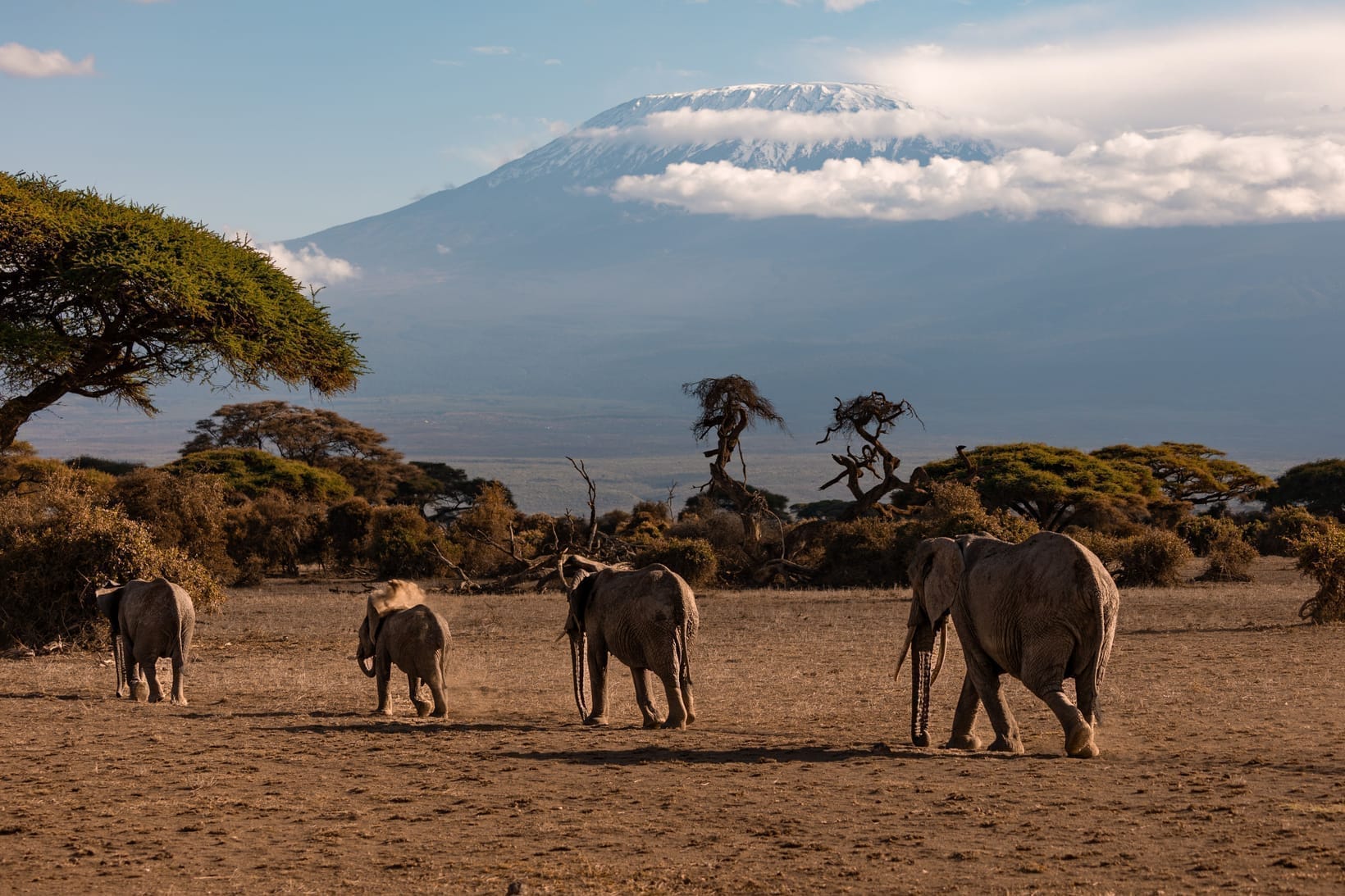
Short answerAmboseli is an elephant park with a mountain behind it — 392 km² of open country and permanent swamps fed by Kilimanjaro meltwater, holding some of the most studied elephants in the world. It is not a Big Five park; there are no rhino. Go for elephants at close range and, cloud permitting, the most famous backdrop in Africa.
Amboseli is a specialist park and better for it. It does one thing supremely well, and travellers who arrive expecting a Maasai Mara with a mountain attached tend to be disappointed for the wrong reasons.
The elephants
Amboseli's elephants have been studied continuously for decades, making them among the best-documented wild elephant populations anywhere. Individual animals are known by name, family lineages are tracked across generations, and the research has shaped much of what is understood about elephant social structure.
For a visitor, the practical consequences are that the herds are relaxed around vehicles, the terrain is open enough that nothing is hidden, and big old bulls with heavy tusks — increasingly rare across Africa — are still present here.
Our African elephant facts post covers the animal itself.
 Amboseli's draw is this view — elephants in the foreground, Kilimanjaro behind
The mountain, and when you'll actually see it
Kilimanjarosits just across the Tanzanian border and dominates Amboseli's southern horizon — when it is not in cloud, which it frequently is.
| When | Likelihood |
|---|---|
| Dawn to around 9am | Best — the mountain is most often clear at first light |
| Middle of the day | Poor — cloud typically builds over the summit |
| Late afternoon to sunset | Good — cloud often clears again |
| Jun–Oct | The clearest season overall |
| Jan–Feb | Also very good, and hot |
| Mar–May | Long rains — the mountain is often hidden for days |
Why the swamps matter
Amboseli looks arid and largely is — but rain and snowmelt from Kilimanjaro percolates underground and surfaces in the park as permanent swamps. That water is the reason the wildlife concentrates here in the dry season while surrounding country empties out.
It is also why the elephants are so visible: they spend hours in the swamps feeding and bathing, in the open, in good light. The name itself derives from a Maasai word referring to the dusty, salty basin.
What else is there
| Species | Notes |
|---|---|
| Elephant | The reason to come. Large herds, relaxed, at close range. |
| Buffalo | Common, often in the swamps |
| Lion | Present but not abundant — see lion facts |
| Cheetah | Occasional on the open pan |
| Leopard | Present, rarely seen |
| Spotted hyena | Common |
| Giraffe, zebra, wildebeest | Abundant |
| Rhino | Absent — Amboseli is not a Big Five park |
| Birds | Excellent — over 400 species, with flamingo on the pans after rain |
When to go
- June–October — dry, clear mountain, concentrated wildlife at the swamps. The best overall window.
- January–February — dry and hot, with good mountain visibility and fewer visitors than the peak.
- November–December — short rains. Green, good birding, mountain less reliable.
- March–May — long rains. Cheapest and quietest; Kilimanjaro often invisible for days at a time.
Where to stay
| Tier | Properties we book |
|---|---|
| Luxury | Tortilis Camp · Amboseli Serena Safari Lodge |
| Mid-range | Ol Tukai Lodge |
| Budget | Amboseli Sopa Lodge |
The thing to ask about is orientation. A room or terrace facing Kilimanjaro is a materially different stay from one that does not, and it is not always obvious from a brochure. Ask specifically which way the property looks.
Planning notes
- Two nights is usually right, three if you want the photograph.
- Be out at dawn. The mountain and the light are both best in the first hour.
- Ask which way your room faces.
- Pack a wide lens, not only a telephoto.
- Protect your kit from dust.
- Pair it with the Maasai Mara for predators, since Amboseli will not deliver them — see our Maasai Mara guide.
See our Kenya itineraries, or tell us what you want to photograph and we will build the days around the light.
Amboseli: common questions
What is Amboseli National Park famous for? Large elephant herds photographed against Mount Kilimanjaro. Amboseli's elephants are among the most studied in the world thanks to decades of continuous research, and the park's open terrain and permanent swamps make them exceptionally easy to see at close range.
Can you see Kilimanjaro from Amboseli? Yes, and it dominates the southern horizon — but only when the cloud allows. The mountain is frequently hidden through the middle of the day. Early morning and late afternoon are the reliable windows, and June to October and January to February are the clearest months.
How big is Amboseli? 392 km², which is small by Kenyan standards and part of why the game viewing is so productive — the animals concentrate around permanent swamps fed by meltwater from Kilimanjaro, and the open terrain means very little is hidden.
Can you see the Big Five in Amboseli? No. Amboseli has elephant, buffalo and leopard, and lion are present though not abundant, but there are no rhino. It is not a Big Five park and does not pretend to be — it is an elephant park, and the best one in East Africa for that.
How many days do you need in Amboseli? Two nights is enough for most visitors — one full day covers the park comfortably given its size. Photographers chasing the Kilimanjaro shot often add a third night to give themselves more chances at a clear mountain.
How far is Amboseli from Nairobi? It sits south of Nairobi towards the Tanzanian border and is a comfortable half-day drive, which makes it one of the easier Kenyan parks to add to an itinerary. Light aircraft flights also serve the park.
Sources
- Kenya Wildlife Service — Amboseli National ParkAccessed 29 Jul 2026