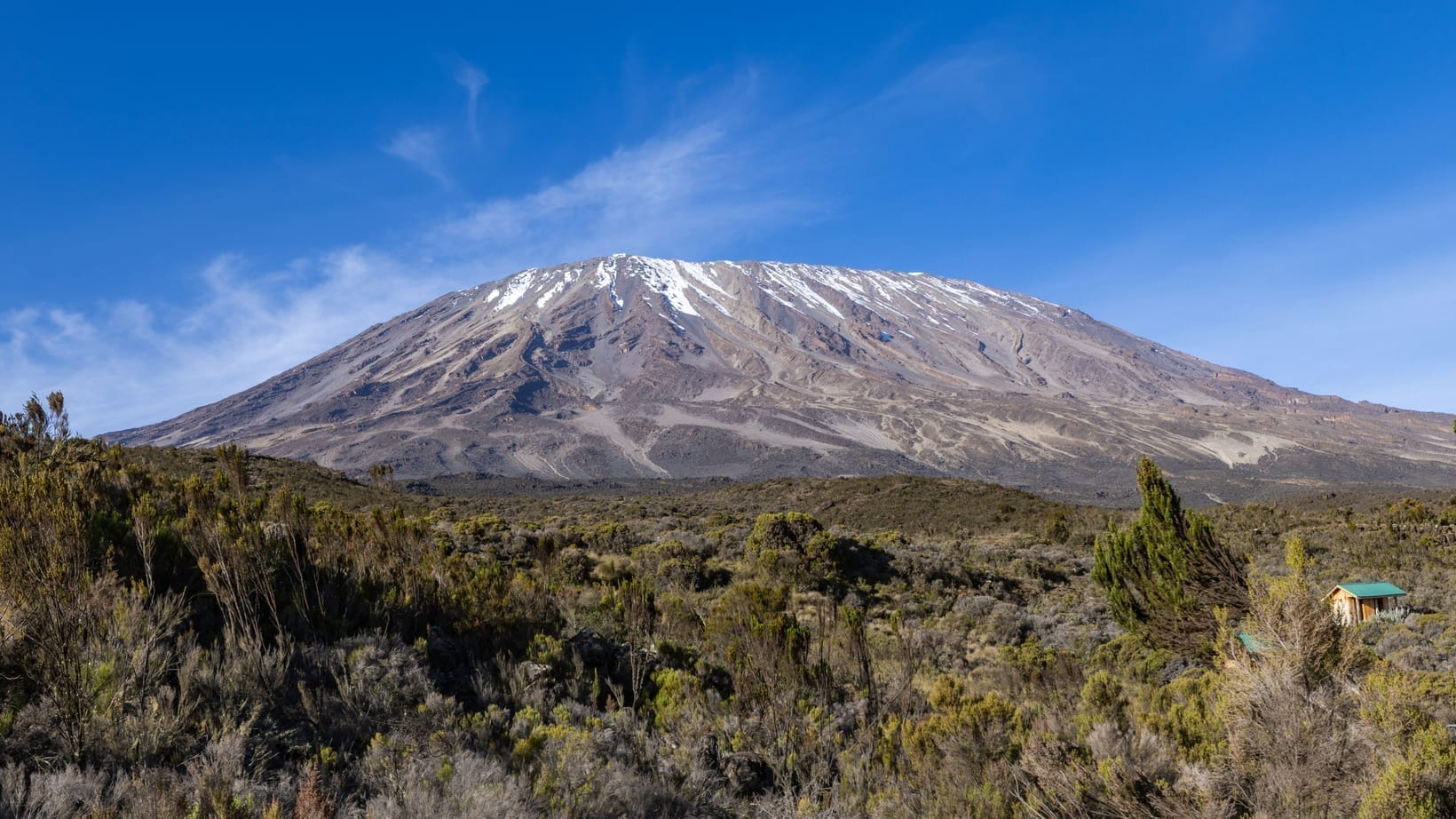
Short answerKilimanjaro is a walk, not a technical climb — no ropes, no mountaineering skill. The difficulty is altitude, and the single biggest determinant of whether you summit is how many days you take. Uhuru Peak is 5,895 m. Take the longer route; the extra days are the cheapest insurance available.
More people fail on Kilimanjaro for a preventable reason than on almost any other big mountain, and the reason is nearly always the same: they booked the short itinerary because it was cheaper, and their bodies ran out of acclimatisation before the summit night.
The mountain
Kilimanjaro is a dormant volcano rising straight out of the plains of northern Tanzania — free-standing, which is why it looks so improbable from Amboseli across the border in Kenya.
The walk takes you through a sequence of climate zones that is part of the appeal: farmland, then rainforest, then heath and moorland with giant lobelia and groundsel, then alpine desert, then the ice and rock of the summit. It is like walking from the equator to the arctic in five days.
The routes compared
| Route | Days | Character |
|---|---|---|
| Lemosho | 7–8 | Excellent acclimatisation, scenic, quieter start. One of the best success rates. |
| Northern Circuit | 9 | The longest route and the highest success rate. Circles the mountain; very few people. |
| Machame | 6–7 | The popular choice. Scenic, good 'climb high sleep low' profile, busy. |
| Rongai | 6–7 | Approaches from the north. Drier, gentler, quieter — good in the wetter months. |
| Marangu | 5–6 | Huts instead of tents, cheapest, poorest acclimatisation profile and lowest success rate. |
| Umbwe | 6 | Steep, direct, hard. For experienced trekkers only. |
Why more days means more summits
Your body needs time to produce more red blood cells and adjust to thinner air. That process is measured in days and cannot be shortcut by fitness, willpower or expensive kit.
Every extra day on the mountain is another day of adaptation, which is why an eight-day Lemosho consistently outperforms a five-day Marangu despite ending at the same place. Good itineraries also build in “climb high, sleep low” days that gain altitude during the day and drop back to sleep.
Altitude is the whole difficulty
At Uhuru Peak there is roughly half the oxygen available at sea level. The walking itself is not technically hard at any point on the standard routes — the summit night is simply a long, slow, cold plod in the dark at an altitude where everything feels several times harder than it is.
Summit night typically begins around midnight so you reach the crater rim at sunrise. It is the coldest and hardest part of the trip by a wide margin.
How fit do you need to be?
Reasonably fit, and no more. If you can walk six to eight hours a day for several consecutive days on hills, you have the physical base. The preparation that transfers:
- Long hill walks, back to back on consecutive days.
- Break in your boots properly. Non-negotiable.
- Practise walking slowly. The Swahili instruction you will hear constantly is pole pole — slowly, slowly. Going slowly is a skill, and impatient walkers fail.
- Test your cold-weather kit. Summit night is well below freezing.
If you want an African mountain without Kilimanjaro's cost or crowds, compare it with Mount Elgon and the Rwenzoris in Uganda — both are dramatically quieter and considerably cheaper.
When to climb
| Period | Conditions |
|---|---|
| Jan–Mar | Warmer, clearer, quieter than the peak months. Some snow on the summit. |
| Jun–Oct | The main season. Dry, cold at altitude, busiest. |
| Apr–May | Long rains. Wet, slippery, much quieter. Rongai copes best. |
| Nov | Short rains. Fewer climbers, variable conditions. |
Combining Kilimanjaro with a safari
This is the standard trip, and the geography makes it easy: the trailheads are near Moshi and Arusha, and Arusha is the gateway to the northern safari circuit — Ngorongoro, the Serengeti and Tarangire.
Climb first, safari after. Two reasons: you arrive on the mountain fresh rather than tired from early game-drive starts, and a safari is a far better recovery than a mountain is. Several clients have described the first game drive after coming down as the best day of the trip.
Allow at least one full rest day between summiting and starting the safari. Zanzibar afterwards is the other classic addition, and works extremely well as a third act. The full logistics of pairing the climb with a Serengeti safari — recovery time, drive and flight connections, and realistic day counts — are in Combining Kilimanjaro and the Serengeti.
Tell us how many days you have and we will be straight with you about which route fits — including when the honest answer is that you should add two days or not go.
Climbing Kilimanjaro: common questions
How high is Kilimanjaro? Uhuru Peak stands at 5,895 m, making it the highest point in Africa and the tallest free-standing mountain in the world — it rises from open plains rather than sitting in a range. It was inscribed as a UNESCO World Heritage Site in 1987.
Do you need climbing experience for Kilimanjaro? No. Kilimanjaro is a walk, not a technical climb — no ropes, no ice axes and no mountaineering skills required on the standard routes. What it demands is several consecutive days of sustained walking and the ability to cope with high altitude, which is a different challenge entirely.
How many days does it take to climb Kilimanjaro? Five to nine days depending on route. Longer is emphatically better — success rates rise substantially with more days because acclimatisation, not fitness, is what determines whether most people summit. Five-day itineraries have notably lower success rates.
Which Kilimanjaro route is best? Lemosho and the Northern Circuit for the highest success rates and best acclimatisation profiles. Machame is the popular compromise — scenic and well-trodden. Marangu is the cheapest and uses huts rather than tents, but has a poor acclimatisation profile and a correspondingly lower success rate.
What is the success rate on Kilimanjaro? It varies enormously by route and duration rather than being a single figure. Short routes have markedly lower summit rates than longer ones on the same mountain, because the difference is acclimatisation time. Choosing an extra day or two is the single most effective thing you can do to improve your odds.
Can you climb Kilimanjaro and go on safari on the same trip? Yes, and it is the standard combination. The Kilimanjaro trailheads are near Moshi and Arusha, which is also the gateway to Tanzania's northern safari circuit. Most people climb first and go on safari afterwards, which puts the rest days on the right end.
Sources
- UNESCO World Heritage Centre — Kilimanjaro National ParkAccessed 29 Jul 2026
- Tanzania National Parks (TANAPA) — Kilimanjaro National ParkAccessed 29 Jul 2026