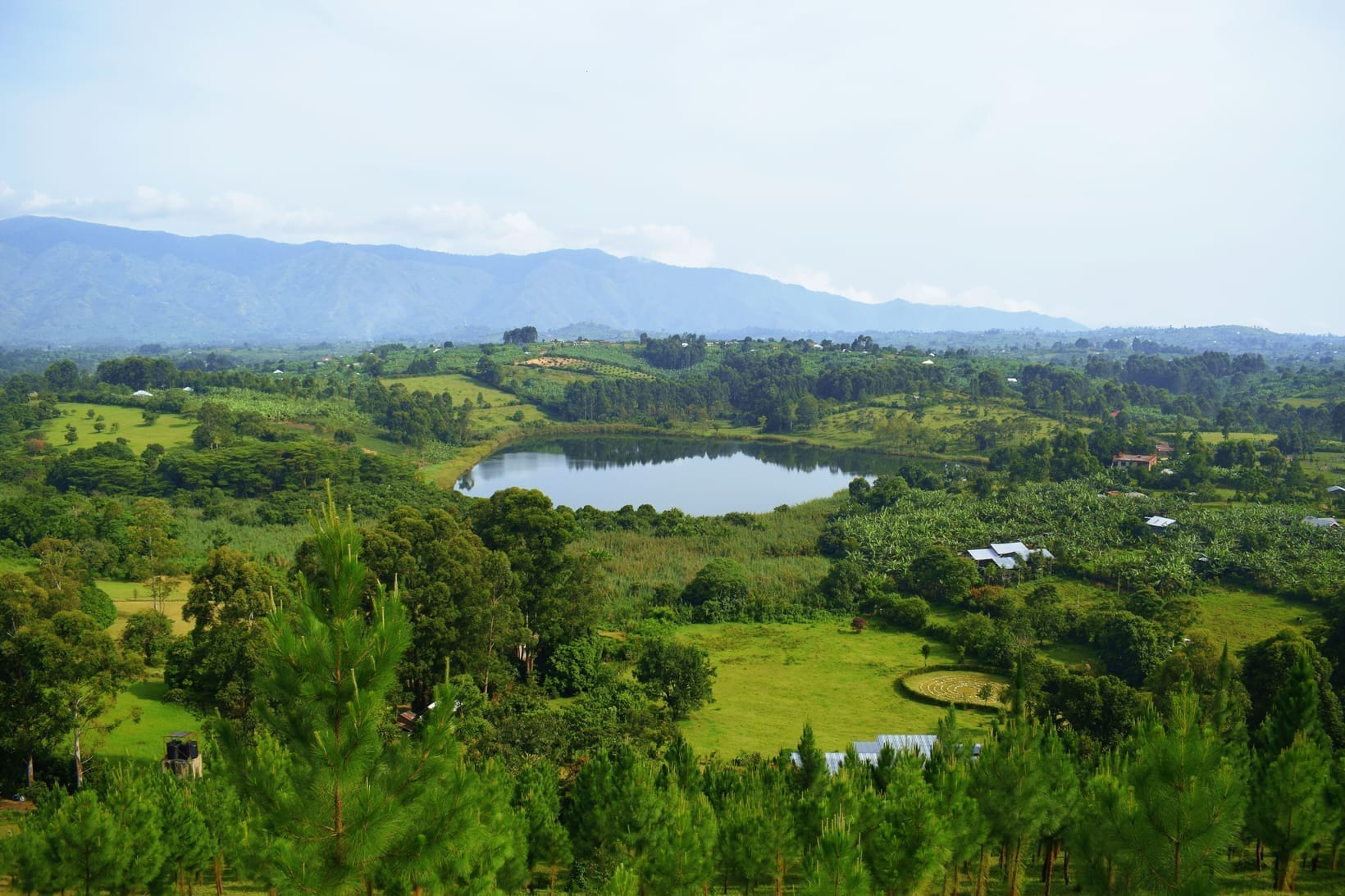
Short answerFort Portal is the base for western Uganda — within reach of Kibale's chimpanzees, Semuliki, the Rwenzori foothills and Queen Elizabeth, with a field of volcanic crater lakes on its doorstep. Several of those lakes are swimmable, which almost nowhere else in Uganda is. Come for the surroundings, not the town.
Fort Portal sits in tea country beneath the Rwenzori Mountains, and on a clear morning the snow line is visible from the road — which for a town almost on the equator never quite stops being surprising.
Most itineraries pass through it without stopping. That is a reasonable choice on a short trip and a missed one on a longer one, because the country immediately around the town is among the most attractive in Uganda.
The town itself
Fort Portal is the seat of the Tooro Kingdom, one of Uganda's surviving traditional kingdoms — the palace sits on a hill above the town and the kingdom's history is covered in our post on the kingdoms of Uganda.
Practically, the town gives you a market, fuel, a bank, a genuinely good cafe or two, and the last reliable supplies before Semuliki or the Rwenzori trailheads. It is small, walkable and unusually pleasant.
Just outside are the Amabere Ga Nyina Mwiru caves — limestone formations behind a small waterfall, with a local legend attached that the guides will tell you with some relish.
The crater lakes
South and west of the town is a crater field: dozens of steep-sided volcanic bowls, most now holding deep water, scattered across farmland and forest. Some are a few hundred metres across. Several have lodges perched on their rims, and the walk between them is one of the better half-days in Uganda.
| Detail | |
|---|---|
| Swimming | Possible in several — generally free of bilharzia, hippos and crocodiles |
| Walking | Rim walks and village paths between lakes; guides available locally |
| Birding | Good — forest edge, water and farmland species in a small area |
| Monkeys | Black-and-white colobus at several lakes, notably around Lake Nkuruba |
| Accommodation | Lodges on the rims, spanning budget bandas to high-end |
| Best light | Late afternoon, from a rim terrace |
What to do from Fort Portal
- Chimpanzee trekking at Kibale — the main reason most people are in the area. See chimpanzee trekking in Kibale Forest.
- Bigodi Wetland Sanctuary — a community-run swamp walk with excellent birding, near Kibale.
- Semuliki and the Sempaya hot springs — a day trip down the escarpment. See our Semuliki National Park guide.
- Rwenzori foothills — day walks from Ruboni and Kilembe without committing to the full Rwenzori trek.
- Tea estates — the plantations around the town run tours.
- Crater lake walking — the best unstructured half-day in the region.
Fort Portal as a hub
Its real value is positional. Almost everything in western Uganda is within reach.
| Destination | Relationship |
|---|---|
| Kibale Forest | Close — the standard chimpanzee trekking base alternative |
| Semuliki National Park | Day trip down the escarpment |
| Rwenzori Mountains | Trailheads within reach via Kasese |
| Queen Elizabeth National Park | On the road south |
| Murchison Falls | On the road north-east |
| Crater lakes | Immediately south and west |
Where to stay
| Tier | Properties we book |
|---|---|
| Luxury | Kyaninga Lodge · Papaya Lake Lodge · Crater Safari Lodge |
| Mid-range | Mountains of the Moon Hotel · Tooro Fairway Hotel · Ataco Country Resort |
| Budget | Fort Breeze Hotel · Kluge's Guest Farm · Fort Heights Homestay |
The crater-rim properties are the distinctive ones and include some of the most attractively sited lodges in Uganda. Town properties are functional and cheaper and make sense for a single transit night. Our guide to staying at Kibale weighs the crater lakes against the forest edge for chimpanzee trekking specifically.
How long to give it
- One night — a transit stop, usually en route to or from Kibale. Fine, but you see nothing.
- Two nights — chimpanzee trekking plus a crater lake afternoon. The standard.
- Three nights — adds Semuliki or Bigodi, or simply a genuine rest day, which by the middle of a Uganda trip is worth more than most people expect.
We use Fort Portal and the crater lakes as the mid-trip breather on most western-circuit itineraries. Tell us how your trip is shapedand we'll say where the rest day belongs.
Fort Portal and the crater lakes: common questions
Is Fort Portal worth visiting? As a base, absolutely — it sits within reach of Kibale's chimpanzees, the Rwenzori foothills, Semuliki and the crater lakes, and it is the most pleasant town in western Uganda to spend an evening in. As a destination in itself it is modest; the surroundings are the reason to come.
What are the crater lakes near Fort Portal? A field of dozens of volcanic crater lakes scattered south and west of the town, formed by explosive eruptions and now filled with deep water in steep-sided bowls. Several have lodges on their rims. Lake Nkuruba, Lake Nyinambuga and Lake Nyabikere are among the best known.
Can you swim in the crater lakes? In several of them, yes — they are generally considered free of bilharzia, hippos and crocodiles, which sets them apart from the big lakes. Ask your lodge which specific lake they recommend rather than assuming all are equivalent.
How far is Fort Portal from Kibale Forest? Close enough that Fort Portal is a common base for chimpanzee trekking, though it adds 30 to 60 minutes each way to the Kanyanchu briefing point compared with staying at the forest edge. That matters for a morning trek and much less for an afternoon one.
What is there to do in Fort Portal town? Not a great deal, and that is fine — it is a base rather than a sight. There is a good market, a growing cafe scene, the Tooro Kingdom palace on a hill above the town, and the Amabere Ga Nyina Mwiru caves just outside with their waterfall and local legend.
Sources
- Uganda Tourism Board — Fort Portal and the Tooro region — visitor informationAccessed 28 Jul 2026