Short answerKeep 10 metres away, do not touch a gorilla even if it touches you, no flash photography, and do not trek if you have a cold. If a silverback charges, stand still, look down and away, and do not run — almost all charges are bluff. The health rules are the serious ones: human respiratory infections can kill an entire family.
You will hear these rules at the briefing, and they will be delivered briskly to a group of people who are excited and not fully listening. Reading them beforehand means you actually absorb them — and understand why they exist, which makes them far easier to follow when a juvenile gorilla walks straight up to you.
The rules, and what each is for
| Rule | The reason |
|---|---|
| Keep 10 metres away | Disease transmission risk falls sharply with distance |
| Maximum 1 hour with the family | Limits cumulative stress and exposure on the animals |
| Maximum 8 visitors per family per day | Same reason — total human contact is capped, not just yours |
| Minimum age 15 years | Children carry more transmissible infections and are less predictable at close range |
| Never touch a gorilla | Disease in both directions; and it must not become normal behaviour |
| No flash photography | Startles and stresses the animals |
| Don't trek if you're ill | The single most important rule on this list |
| Keep your voice low | Reduces stress and keeps the group calm |
| No eating or drinking near the gorillas | Food waste and disease risk |
| Bury or pack out all waste | Contamination risk in the family's range |
| Do not use a drone | Prohibited in the parks; extremely stressful to wildlife |
Why the health rules are the serious ones
Mountain gorillas share the great majority of their DNA with us, and that includes enough immunological similarity that our infections cross over. A human common cold can become a fatal respiratory outbreak in a gorilla family. Documented die-offs have been traced to human-origin respiratory viruses.
With around 1,063 mountain gorillas alive — see how many mountain gorillas are left for the full picture — a single family lost to an outbreak is a measurable proportion of the global population.
What to do if a gorilla approaches or charges
Both happen. They are different situations.
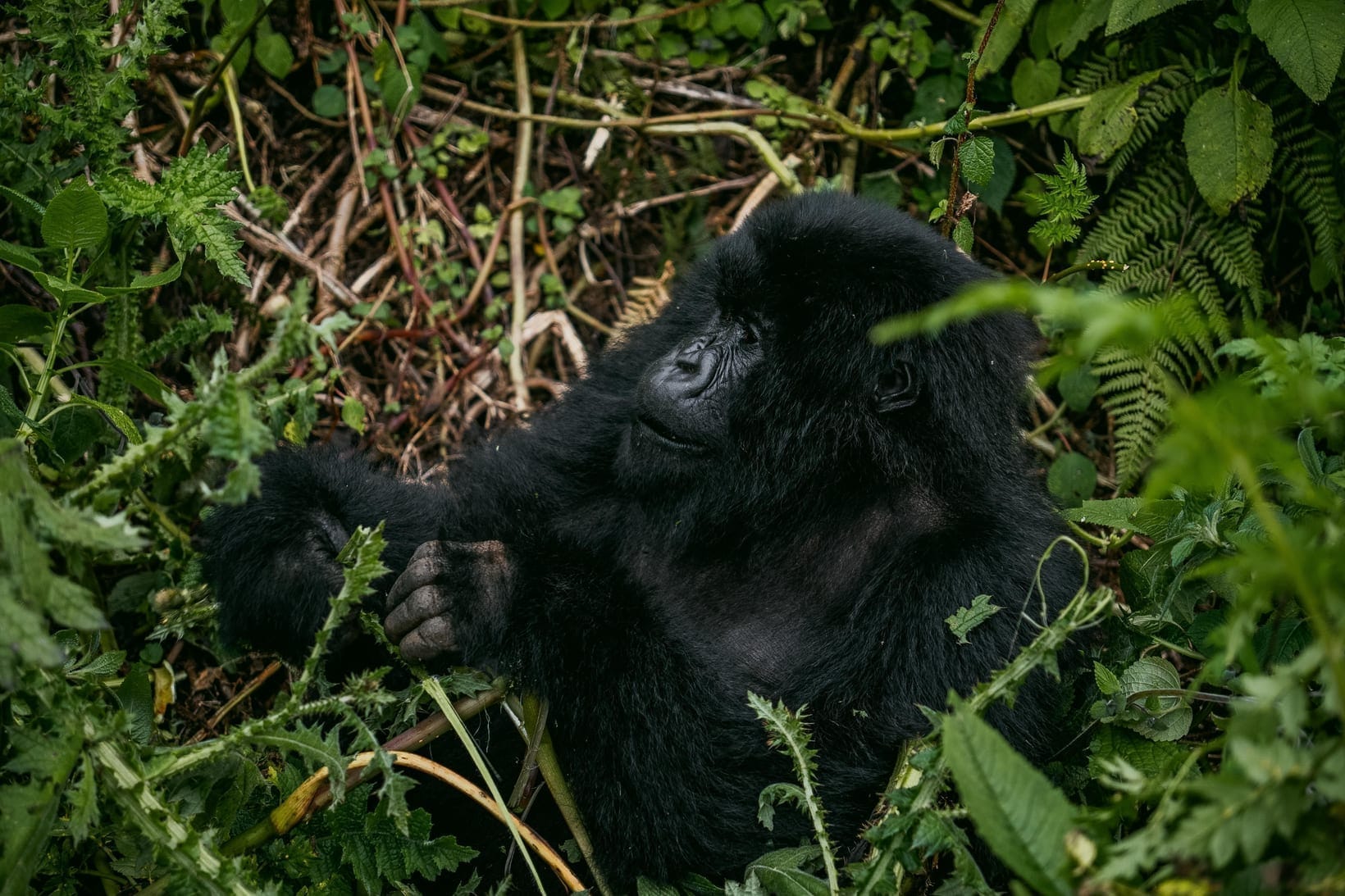
If a gorilla walks towards you — usually a juvenile, usually curious — move back slowly if there is room. If there is not, stay still, keep your voice down, and let it pass. Do not reach out. The seven-metre rule binds you, not them, and rangers accept that gorillas close the distance routinely.
If a silverback charges, the guidance is specific and counter-intuitive:
- Do not run. Running triggers pursuit and you cannot outrun a gorilla in forest.
- Stand your ground.
- Look down and away. Direct eye contact reads as a challenge.
- Crouch slightly to appear smaller and submissive.
- Stay quiet and wait for it to end.
- Follow your ranger. They have seen this many times and will tell you what to do.
Almost all charges are bluff displays — a silverback asserting himself, stopping short. For context on the animal doing the charging, see how big a silverback gorilla actually is.
Photography rules
- No flash. Non-negotiable. Turn off auto-flash before you set out, not when you arrive.
- Low-light capability matters more than reach. The forest floor is dark and you are close. A fast lens beats a long one here — our safari photography tips go into kit.
- Phones are fine. Plenty of people get usable images on a phone, though 10 metres is further than it sounds.
- No drones. Prohibited, and would be deeply stressful to the animals.
- Commercial filming needs separate permission and a different fee — arrange it well in advance if it applies to you.
- Put the camera down at some point. You have one hour. The people who look back most fondly are the ones who spent part of it just watching.
Things people get wrong
| People think | Actually |
|---|---|
| The 7 m rule means gorillas stay 7 m away | It binds you. They come closer whenever they like. |
| If a gorilla touches you, you can touch back | No. Stay still and let it happen; do not reciprocate. |
| Charges mean you're in danger | Almost all are bluff. Running is what creates danger. |
| You can negotiate more than an hour | No — the clock starts when the family is located. |
| Masks are a leftover from the pandemic | They're about gorilla health, and requirements have come and gone since. |
| A cold is no big deal | It is the single biggest disease risk you personally control. |
| Bright clothing is fine | Neutral colours are expected; bright ones and camouflage are both discouraged. |
Why the rules are worth following
Mountain gorillas are the one great ape whose numbers have gone up rather than down, and that recovery is not an accident — it is the direct result of exactly this apparatus of permits, distance limits, group caps, health screening and armed protection, funded largely by what visitors pay.
The rules feel restrictive during your one hour. They are the reason there is an hour to have. If you want the fuller argument, our post on what a gorilla permit actually pays for follows the money, and what to expect on the day covers the practical shape of the trek.
We brief every client on this before departure rather than leaving it to the trailhead. See our gorilla trekking trips or talk to a planner.
Rules and etiquette: common questions
How close can you get to gorillas on a trek? Visitors must keep at least 10 metres away, per the Uganda Wildlife Authority. The gorillas are under no such obligation and frequently come much closer — juveniles in particular are curious. If one approaches you, the correct response is to move back slowly if you can do so safely, and otherwise to stay still and calm.
Can you touch a gorilla? No, under any circumstances, even if the gorilla initiates contact. The prohibition is about disease transmission in both directions and about not reinforcing behaviour that could put the animals at risk with less scrupulous humans later.
What happens if a gorilla charges you? Stand your ground, look down and away rather than making eye contact, crouch slightly to appear smaller and submissive, and do not run. Most charges are bluff displays by a silverback asserting his position. Running triggers pursuit, and you cannot outrun a gorilla in a forest. Your ranger will tell you exactly what to do and you should do it.
Do you have to wear a face mask for gorilla trekking? Mask requirements have been introduced, relaxed and reintroduced at different times in both Uganda and Rwanda, driven by disease risk to the gorillas rather than to visitors. Assume you will need one, bring your own, and check the current requirement close to travel.
Can you go gorilla trekking if you have a cold? No, and you should declare it. Gorillas share enough of our physiology that human respiratory infections can and do kill them — a common cold in a person can become a fatal outbreak in a family. If you are ill on the day, tell the rangers rather than hiding it.
Can you use flash photography with gorillas? No. Flash is prohibited because it startles and stresses the animals. Bring a camera that performs well in low light instead — the forest understorey is dark and this is the single most common reason people are disappointed with their gorilla photographs.
Should you stand still if a gorilla charges you? Yes. Stand still, drop your gaze, crouch slightly to look smaller and submissive, and do not run. Almost every charge is a bluff display by a silverback asserting his position, and it stops when you show no threat. Running is the one thing that turns a display into a pursuit, and you cannot outrun a gorilla. Your ranger will be beside you and will tell you exactly what to do.
Sources
- Uganda Wildlife Authority — Gorilla tracking rules and regulationsAccessed 28 Jul 2026
- International Union for Conservation of Nature — Gorilla beringei beringei (Mountain Gorilla) — species assessmentAccessed 28 Jul 2026