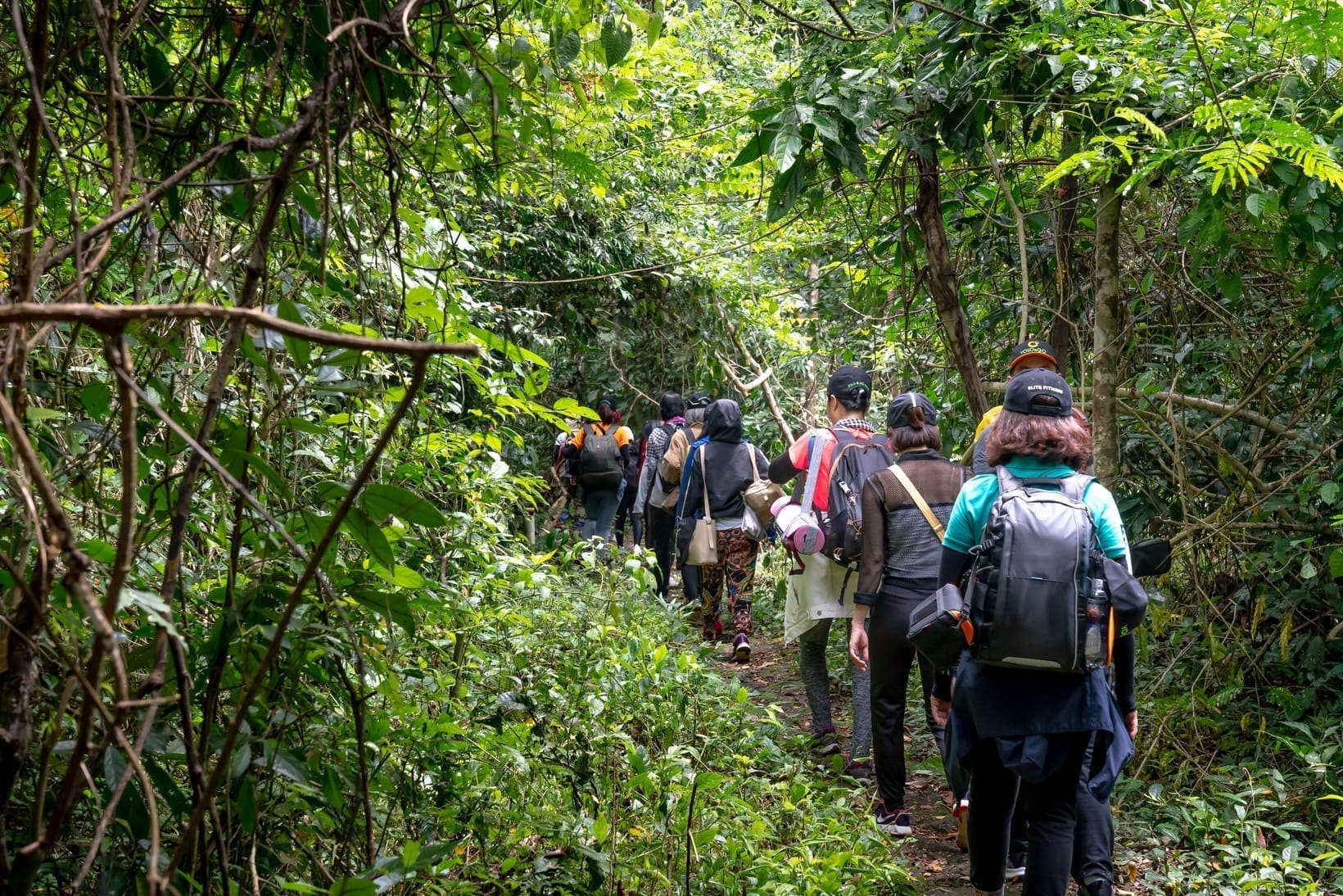
Short answerGorilla trekking is a hike, not a climb — one to six hours each way on steep, muddy ground at altitude, carrying a day pack. If you can walk uphill for two hours without needing frequent stops, you can very likely do it. The minimum age is 15 years; there is no upper limit, and people in their eighties trek every year.
This is the question people are most anxious about and least honestly answered on. Operator pages tend to say “moderate fitness required” and leave it there, which tells you nothing, because a gorilla trek can be a ninety-minute stroll or a genuinely hard day and nobody knows which until the morning.
So here is the honest version, along with what you can actually do to stack the odds.
How hard is it, honestly
The walking itself is not technical. There is no scrambling, no exposure, no equipment to learn. What there is:
- Steepness. Bwindi is draped over very steep hills. Gradients are sustained and often relentless.
- Mud. It is a rainforest. Footing is frequently slippery, and descents are where people struggle most.
- Off-path walking. Once the trackers locate the family, you leave the trail and follow them through undergrowth. Rangers cut a way with machetes; it is still awkward going.
- Altitude. Roughly 1,500–2,600 m depending on sector. Not dangerous, but noticeably harder work than at sea level.
- Duration uncertainty. You cannot know in advance whether it is two hours or eight.
| Activity | Relative difficulty |
|---|---|
| Rhino tracking at Ziwa | Much easier — flat, 1–2 hours |
| Chimpanzee trekking at Kibale | Easier — forest but mostly flat |
| Golden monkey trekking at Mgahinga | Easier — shorter and lower |
| Gorilla trekking | A demanding day hike on steep, muddy ground |
| Gorilla Habituation Experience | Harder — four hours with the family, longer day overall |
| Mount Elgon trek | Harder — multi-day, but firmer underfoot |
| Rwenzori trek | Much harder — multi-day, wet, technical near the summit |
What actually makes a trek hard
In descending order of impact — and note that only two of these are within your control:
- Where the gorillas are that morning.Entirely outside anyone's control, and by far the biggest factor.
- Rain in the preceding days. Wet ground roughly doubles the effort of a descent.
- Whether you hired a porter. Yours to decide.
- Whether you declared your fitness at the briefing. Also yours.
- Your sector. Nkuringo has the hardest reputation — see Bwindi's sectors compared.
- Your footwear. More important than your fitness on mud.
Training that helps
If you have two or three months, this is what actually transfers:
| Do this | Why |
|---|---|
| Hill walking, ideally with a pack | The most specific training there is |
| Stair climbing | Good substitute if you have no hills |
| Downhill practice | Descents cause more trouble than ascents; quads and knees need it |
| Break in your boots | New boots on a six-hour muddy trek is a preventable disaster |
| Walk in the rain at least once | So wet, cold and slippery is familiar rather than alarming |
| General cardio | Helpful, but less specific than hills |
Kit matters as much as fitness. Our gorilla trekking tips and safari packing guide cover what to bring — the short version is waterproof boots with ankle support, gaiters, gardening gloves and a rain jacket.
Porters, sticks and stretchers
Portersare available at every trailhead for a modest fee. They carry your day pack, take your hand on bad ground, and push or pull you up steep sections without being asked twice. Many are former poachers or come from households directly affected by the park's existence, and the income is a real part of why local communities tolerate and protect the gorillas.
Walking sticks are usually available free at the trailhead. Take one. Your own trekking poles are better if you have them.
Sedan chairs — sometimes called stretchers or African helicopters — can be arranged in advance at some sectors for travellers who cannot walk the distance. A team of porters carries you. It is expensive, must be booked ahead rather than requested on the day, and it does make the trek possible for people who could not otherwise do it.
What if you can't finish
Tell your ranger. That is the whole procedure. They will arrange for you to be escorted back to the trailhead, and you wait for the group there. It happens regularly and nobody treats it as a failure.
Trekking with a medical condition
General guidance, not medical advice — talk to your own doctor about anything significant.
- Knee and hip problems. Very common among successful trekkers. Poles, a porter, a gentler sector, and declaring it at the briefing.
- Heart or respiratory conditions. Altitude and sustained exertion both apply. This needs a real conversation with your doctor.
- Pregnancy. Generally advised against, and some operators and authorities decline outright. Check current rules.
- Recent illness. You will be asked not to trek if you have a cold or flu — gorillas are highly susceptible to human respiratory infection, and this rule protects them, not you.
- Mobility limitations. The sedan chair option exists and should be arranged well in advance.
Age limits, at both ends
The minimum is 15 years in both Uganda and Rwanda, and it is enforced with passport checks at the briefing. Families travelling with under-15s should plan around this — our guide to family safaris in Uganda covers what younger children can do instead, and rhino tracking at Ziwa is usually the best substitute.
There is no upper limit. Trekkers in their seventies and eighties do this every year, and the ones who succeed are almost always the ones who hired a porter and were honest at the briefing.
Should you do it?
If you can walk uphill for two hours on uneven ground without needing frequent long stops, yes — with a porter and a stick, you will very likely be fine. If that describes a bad day rather than a normal one, it is still probably yes, but book a gentler sector, hire a porter, and say so at the briefing.
If you genuinely cannot walk that far, look at the sedan chair option early or consider whether chimpanzee trekking would give you more of what you want for less.
We talk this through honestly with every client before booking a permit, because the permit is expensive and non-transferable. Tell us your situation and we will give you a straight answer.
Fitness and difficulty: common questions
How fit do you need to be for gorilla trekking? Reasonably fit, but not athletic. The trek can be anything from one to six hours each way on steep, muddy ground at altitude, carrying a day pack. If you can walk uphill for a couple of hours without stopping every few minutes, you can almost certainly do it — particularly with a porter.
What happens if you can't complete a gorilla trek? Tell your ranger. They will arrange for you to return to the trailhead, usually escorted, and you rejoin the group afterwards. It is not unusual and nobody will make a scene about it. Refund policy for an incomplete trek is at the wildlife authority's discretion and should not be assumed.
Is there a minimum age for gorilla trekking? Yes — 15 years in both Uganda and Rwanda. It is strictly enforced and passports are checked at the briefing. There is no upper age limit; people in their seventies and eighties trek successfully every year, usually with porters.
Can you hire a porter for gorilla trekking? Yes, at every trailhead, and you should. Porters carry your pack, help you over difficult ground, and are hired from the surrounding communities — which makes it one of the most direct ways trekking money reaches households near the park. Bring cash and hire one even if you feel you don't need one.
Can you go gorilla trekking with a knee or back problem? Often yes, with preparation. The main hazards are steep descents and uneven ground rather than sustained climbing. Trekking poles, a porter, declaring the issue at the briefing so rangers assign you a closer family, and choosing a gentler sector all help substantially. Discuss anything significant with your doctor first.
Can you use a walking stick on a gorilla trek? Yes, and you should. Wooden sticks are usually available at the trailhead and your own trekking poles are fine. On steep, wet descents they make a real difference to both stability and knee load.
How difficult is gorilla trekking? Moderately to seriously hard, and genuinely unpredictable — the walk can take one hour or six, because you are following animals that moved overnight. The difficulty comes from the terrain rather than the distance: steep, muddy, trackless forest at altitude, often in rain. Most reasonably mobile people manage it, and a porter makes a substantial difference.
How do you train for gorilla trekking? Walk hills, not flat ground, and do it in the boots you will trek in. Six to eight weeks of regular uphill walking — ideally an hour or more, on uneven ground, carrying a daypack — prepares you far better than gym cardio. Downhill practice matters as much as uphill, because descending steep wet slopes is what tires knees and causes falls.
How do you prepare for a gorilla trek? Three things: train on hills for six to eight weeks beforehand, break in waterproof boots with ankle support, and pack for wet forest — long sleeves and trousers, gaiters, gardening gloves for grabbing vegetation, and a dry bag for your camera. On the day, arrange a porter at the trailhead, carry more water than feels necessary, and do not go if you have a cold, because gorillas catch human respiratory infections.
Sources
- Uganda Wildlife Authority — Gorilla tracking rules and visitor guidelinesAccessed 28 Jul 2026