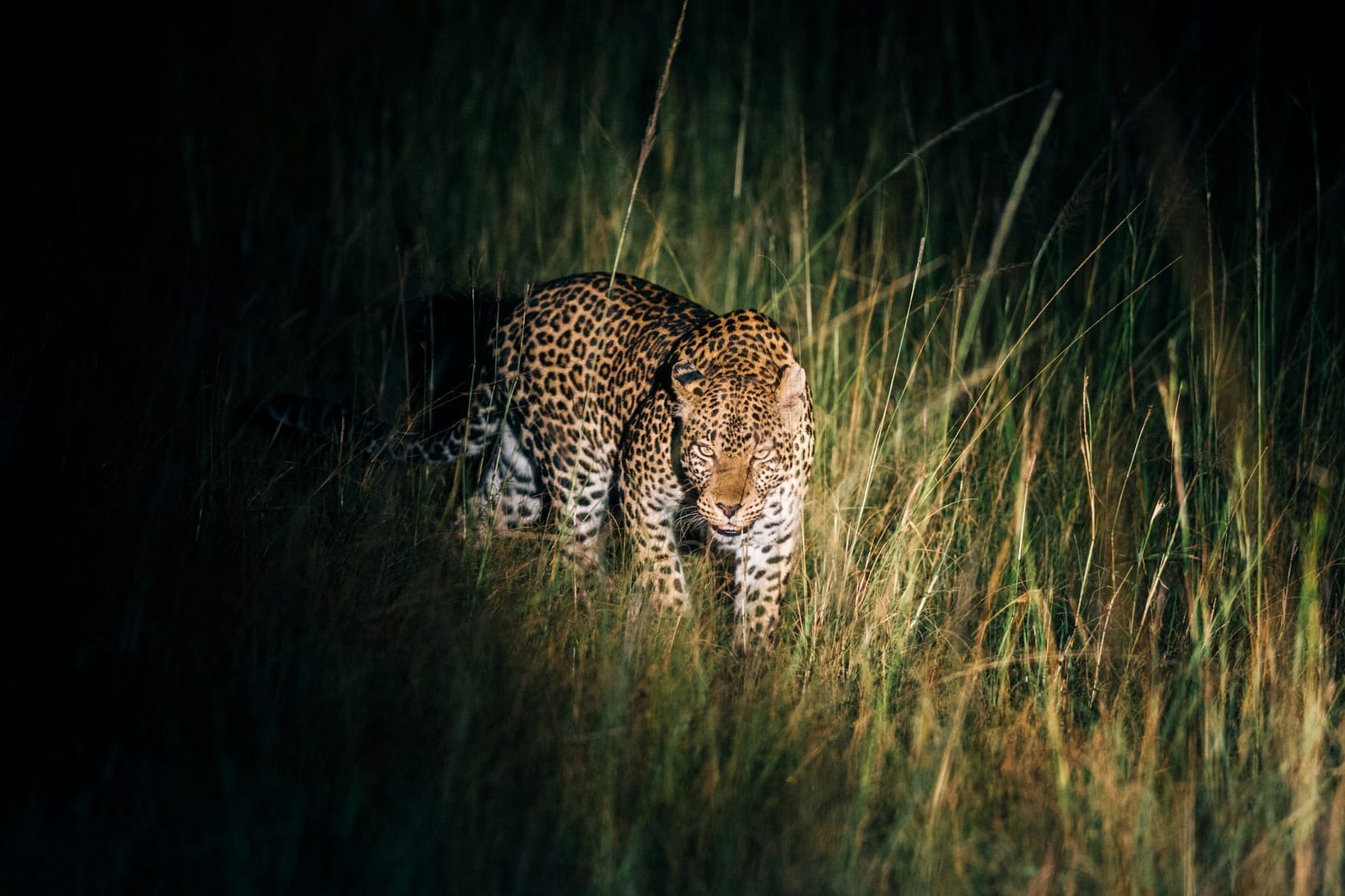
Short answerUganda permits walking safaris and night drives in only a handful of parks, and Lake Mburo is the standout for both — it has no elephants and few large predators, which is exactly why walking is allowed there. Night drives show you a different set of animals entirely: bushbabies, genets, civets, and a much better chance of leopard.
Most safari time is spent in a vehicle, in daylight, which covers perhaps half of what is actually out there. Getting out of the vehicle, or going out after dark, are the two ways of reaching the other half — and in Uganda both are more restricted than in Kenya or Tanzania.
Why Uganda restricts both
Not bureaucracy — biology. Uganda's big savanna parks hold high densities of elephant and buffalo, which are the two animals that make walking genuinely dangerous. Buffalo in particular are responsible for more injuries to people on foot than any predator.
So walking is permitted where those animals are absent or scarce, and night driving is permitted where rangers can manage it. The restriction is why the places that do allow it are worth seeking out deliberately rather than hoping it will be on offer wherever you happen to be.
Walking safaris: where and what they're like
| Park | What the walking is like |
|---|---|
| Lake Mburo | The main walking park. Open grassland among zebra, impala, eland, topi and buffalo. No elephants. |
| Kidepo Valley | Ranger-guided walks in designated areas of the Narus Valley. Remote and superb. |
| Murchison Falls | The top-of-the-falls hike, and guided walks in parts of the park. |
| Semuliki | Forest trails including the long Kirumia trail — birding rather than big game. |
| Rwenzori foothills | Day walks from Ruboni and Kilembe without committing to the full trek. |
| Bigodi Wetland | Community-run swamp boardwalk near Kibale. Primates and excellent birding. |
What a walking safari actually gives you is a change of scale. In a vehicle you are looking for large animals at distance. On foot the guide is showing you tracks in the dust, which dung belongs to what, why a particular tree is scarred at that height, what bird is making that call. You cover perhaps two kilometres and see more.
Night game drives
A night drive is not a game drive in the dark. It is a different set of animals.
Nocturnal species you have essentially no chance of seeing by day come out: bushbabies moving through the acacias, genets, civets, white-tailed mongoose, porcupines, nightjars sitting on the warm track. Leopard and hyena, both far more active after dark, become genuinely likely rather than a matter of luck.
| Day | Night | |
|---|---|---|
| Typical sightings | Plains game, elephant, lion at rest | Bushbaby, genet, civet, mongoose, nightjar |
| Leopard | Uncommon | Much better odds |
| Hyena | Occasional | Active and vocal |
| Lion | Usually sleeping | Hunting |
| Photography | Good | Very difficult — a spotlight is not a flash |
| Duration | 2–4 hours | Usually 2 hours |
The other on-foot experiences
Uganda's most famous wildlife activities are all on foot — they are simply not described as walking safaris.
- Gorilla trekking. Entirely on foot, several hours, in steep forest — see fitness and difficulty.
- Chimpanzee trekking in Kibale.
- Rhino tracking at Ziwa — the gentlest on-foot large-animal encounter in the country.
- Golden monkey trekking at Mgahinga.
- The Batwa Trail, guided by Batwa community members.
Safety, honestly
Walking safaris in Uganda are conducted with an armed ranger, in parks selected because they lack the animals that make walking hazardous. The risk is low and managed, and it is not zero.
The rules exist for a reason: single file, stay behind the ranger, keep quiet, no sudden movement, and do exactly what you are told if an animal is encountered. Buffalo are the animal to respect most — solitary old bulls are unpredictable and are the reason the ranger carries a rifle.
Night drives carry essentially no risk to you; you remain in the vehicle throughout.
Building them into a trip
- Give Lake Mburo two nights if either activity appeals. One night gets you neither properly.
- Book both when you book the room. Ranger availability is finite and cannot always absorb a request on the day.
- Stay inside the park for night drives — a gate to clear afterwards makes for a late, cold return.
- Do the walk in the morning and the drive at night, on the same full day.
- Bring a warm layer for the night drive. Open vehicles after dark are colder than people expect.
- Confirm current rules. Which parks permit what does change.
See how many days a Uganda safari needs for where a Lake Mburo stop fits, or tell us what you want to doand we'll build the nights around it.
Walking and night safaris: common questions
Where can you do a walking safari in Uganda? Lake Mburo is the main one — it has no elephants and a low predator density, which is why guided walking is permitted there and rarely elsewhere. Kidepo, Murchison and Semuliki also offer ranger-guided walks in designated areas. Rules vary by park and change, so confirm current options when booking.
Are night game drives allowed in Uganda? In a small number of parks only, with a ranger and in designated areas — Lake Mburo and Queen Elizabeth are the ones most commonly offered. Independent night driving is not permitted anywhere. Availability changes, so confirm with the park or your operator rather than assuming.
What will you see on a night game drive? Species you have almost no chance of seeing by day — bushbabies, genets, civets, white-tailed mongoose, nightjars and porcupines, plus a genuinely better chance of leopard and hyena, which are far more active after dark. It is a different fauna, not the same one in the dark.
Is a walking safari safe? With an armed ranger, yes. The parks that permit walking are chosen precisely because they lack the animals that make walking dangerous — Lake Mburo has no elephants and very few large predators. The ranger sets the rules: stay in single file, stay quiet, and do exactly what you are told if an animal is encountered.
Can you walk among gorillas or chimpanzees? Yes — gorilla and chimpanzee trekking are both entirely on foot, and are the most popular on-foot wildlife experiences in Uganda. They are guided treks to a specific habituated group rather than open walking safaris, and they have their own rules and permits.
Which is better, a walking safari or a night drive? They deliver completely different things. A walking safari changes your relationship to the ordinary — tracks, dung, birdsong, plants — and gets you close to plains game on their terms. A night drive shows you an entirely different set of animals. If you are at Lake Mburo with two nights, do both.
Sources
- Uganda Wildlife Authority — Park activities — guided walks and night drivesAccessed 28 Jul 2026