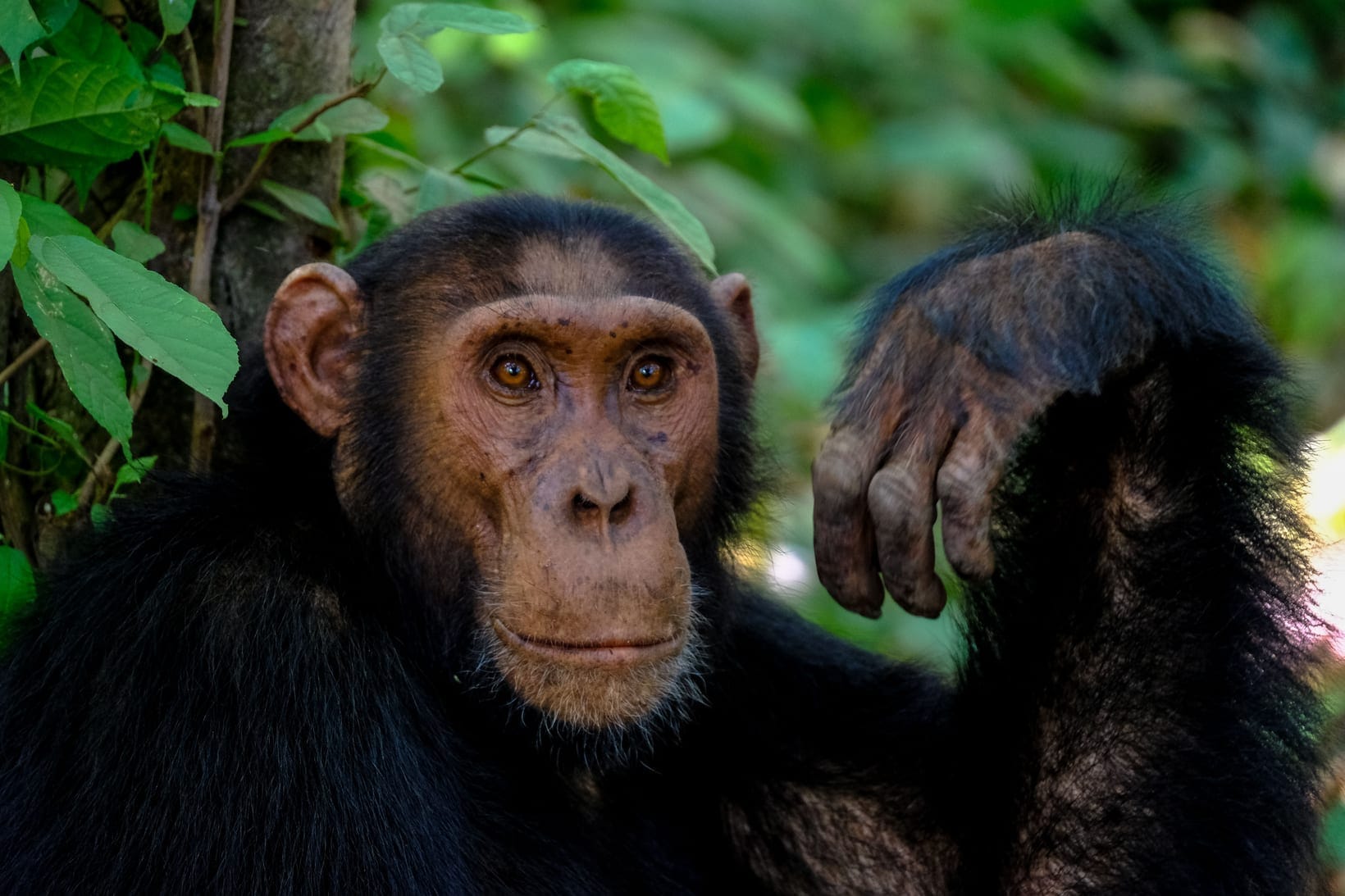
Short answerGorilla trekking is a harder walk to a calm family you sit with quietly for an hour. Chimpanzee trekking is an easier walk to a fast, loud community you follow through the forest. The animals differ far more than the treks do — and if you can only do one, gorillas is the hour people remember.
Both are “trekking to see an ape” and they are almost nothing alike. Travellers who book chimpanzees expecting a cheaper version of the gorilla experience are usually surprised — sometimes disappointed, sometimes delighted, rarely neutral.
This compares them honestly. For the animals themselves, see gorilla vs chimpanzee.
Two completely different animals
A mountain gorilla family is a stable group centred on a silverback, moving slowly, feeding for much of the day, largely indifferent to your presence. The dominant impression is calm and enormous physical presence.
A chimpanzee community is a fission-fusion society — parties form and break up through the day. They are loud, fast, arboreal much of the time, and socially intense. The dominant impression is noise and motion.
The trek compared
| Gorilla trekking | Chimpanzee trekking | |
|---|---|---|
| Where (Uganda) | Bwindi, Mgahinga | Kibale, Kyambura, Budongo, Kalinzu |
| Terrain | Steep, muddy, at altitude | Mostly flat forest (Kibale) |
| Typical walk | 1–6+ hours each way | 1–4 hours |
| Time with the animals | 1 hour | One hour |
| Group size | 8 visitors | Usually 6–8 |
| Minimum age | 15 years | 12 years |
| Permit cost | $800 peak | $250 at Kibale |
| Sighting reliability | High | High in Kibale, variable elsewhere |
| Viewing | Close, at ground level | Often high in the canopy |
| Photography | Dark but static subjects | Dark and fast — much harder |
What the encounter is actually like
Gorillas. The trackers have found the family before you arrive. You leave the trail, push through undergrowth, and then you are simply there — a silverback ten metres away, a mother with an infant, a juvenile who wants to look at you. Nobody talks. The hour goes fast and the overwhelming feeling afterwards is quiet.
Chimpanzees. You hear them first, often from a long way off — screaming, drumming on buttress roots. Then you are moving to catch up. When you find them they may be feeding high in a fig tree, in which case you are looking almost straight up, or on the ground, in which case they walk past you at speed. It is exhilarating and much less serene.
Our accounts of a gorilla trekking day and chimpanzee trekking in Kibale go through both in detail.
Cost, and what you get for it
A gorilla permit is $800 in peak season and $600 in the low season. A Kibale chimpanzee permit is $250, dropping to $200 in April, May and November — so chimpanzee tracking costs roughly a third of a gorilla trek.
The chimpanzee habituation experience — a full day with researchers rather than an hour — is $400, and is covered in the chimpanzee habituation guide.
Which should you do?
| If you… | Choose |
|---|---|
| Can only afford one permit | Chimpanzees, and spend the rest on more days |
| Want the encounter you'll remember for life | Gorillas |
| Can't manage a steep, muddy hike | Chimpanzees — Kibale is largely flat |
| Are travelling with under-15s | Chimpanzees — gorillas have a 15 minimum |
| Are fascinated by social behaviour | Chimpanzees |
| Want to photograph an ape well | Gorillas — static subjects beat fast ones |
| Have limited days | Gorillas, and skip the chimps |
| Are a repeat visitor | Chimpanzee habituation — a full day, far fewer people |
Doing both
Most Uganda itineraries include both, and the geography makes it easy: Kibale and Bwindi sit on the same western circuit with Queen Elizabeth between them. Seven days covers it; ten is comfortable.
Order matters slightly. We usually put chimpanzees first — the easier trek, earlier in the trip, building towards the gorillas rather than peaking on day two. It also means the harder walk comes when you have been on your feet for a week, which helps more than people expect. See how many days a Uganda safari needs.
For everything else with a tail or without one, see our guide to Uganda's primates.
Tell us which matters more to youand we'll build the trip around that rather than around a template.
Chimps vs gorillas: common questions
What's the difference between chimpanzee and gorilla trekking? Gorilla trekking is a harder walk to a calm, slow-moving family that mostly ignores you — an hour of quiet observation at close range. Chimpanzee trekking is an easier walk to a fast, noisy, constantly moving community that you follow rather than sit with. The animals differ more than the walks do.
Is chimpanzee trekking easier than gorilla trekking? Generally yes. Kibale's terrain is largely flat forest, against Bwindi's steep muddy hills at altitude. Chimp trekking is usually shorter too. The exception is Nyungwe in Rwanda and Kyambura Gorge, both of which involve steeper ground.
Which is better value, chimpanzee or gorilla trekking? Chimpanzee trekking costs a fraction of a gorilla permit, so per pound it is far better value. But most travellers who do both say the gorilla hour is the one they would pay for again — it is quieter, closer, and more affecting. Value and impact are different questions here.
Can you do chimpanzee and gorilla trekking on the same trip? Yes, and most Uganda itineraries do. Kibale for chimpanzees and Bwindi for gorillas sit on the same western circuit, with Queen Elizabeth between them. Seven days covers both comfortably.
Are chimpanzees more dangerous than gorillas? Chimpanzees are more unpredictable. They are strong, fast, socially volatile and have injured people in some contexts. On a habituated trek with rangers, both are safe. The rules differ slightly in emphasis: with gorillas the concern is disease and disturbance, with chimps it is also keeping a respectful distance from an excitable animal.
If I can only do one, which should it be? Gorillas, if the budget allows and you are fit enough for a steep muddy hike. It is the rarer animal, the closer encounter and the more memorable hour. Choose chimpanzees if cost is the binding constraint, if you cannot manage a hard hike, or if behaviour and social drama interest you more than sheer presence.
Sources
- Uganda Wildlife Authority — Gorilla and chimpanzee tracking — permits and guidelinesAccessed 28 Jul 2026