Short answerUganda holds around 20 species of primate, and is the only country where you can trek mountain gorillas, chimpanzees and golden monkeys on a single trip. Kibale Forest alone holds 13 species — the highest density in Africa. Four species can be trekked with a permit; the rest you meet along the way.
Kenya and Tanzania are cat-and-herd countries. Uganda is a primate country, and it is the single strongest argument for coming here rather than somewhere with more famous savanna.
This guide covers what lives here, where each species is, and which ones you can actually walk out and find.
Why Uganda is the primate country
Geography. Uganda sits where the Congo basin rainforest, the East African savanna and the Albertine Rift montane forest all meet, so it collects species from three biogeographic zones that overlap almost nowhere else.
The result is a country of modest size holding around 20 species, alongside over 1,050 species of bird — see our birding in Uganda guide for that side of it.
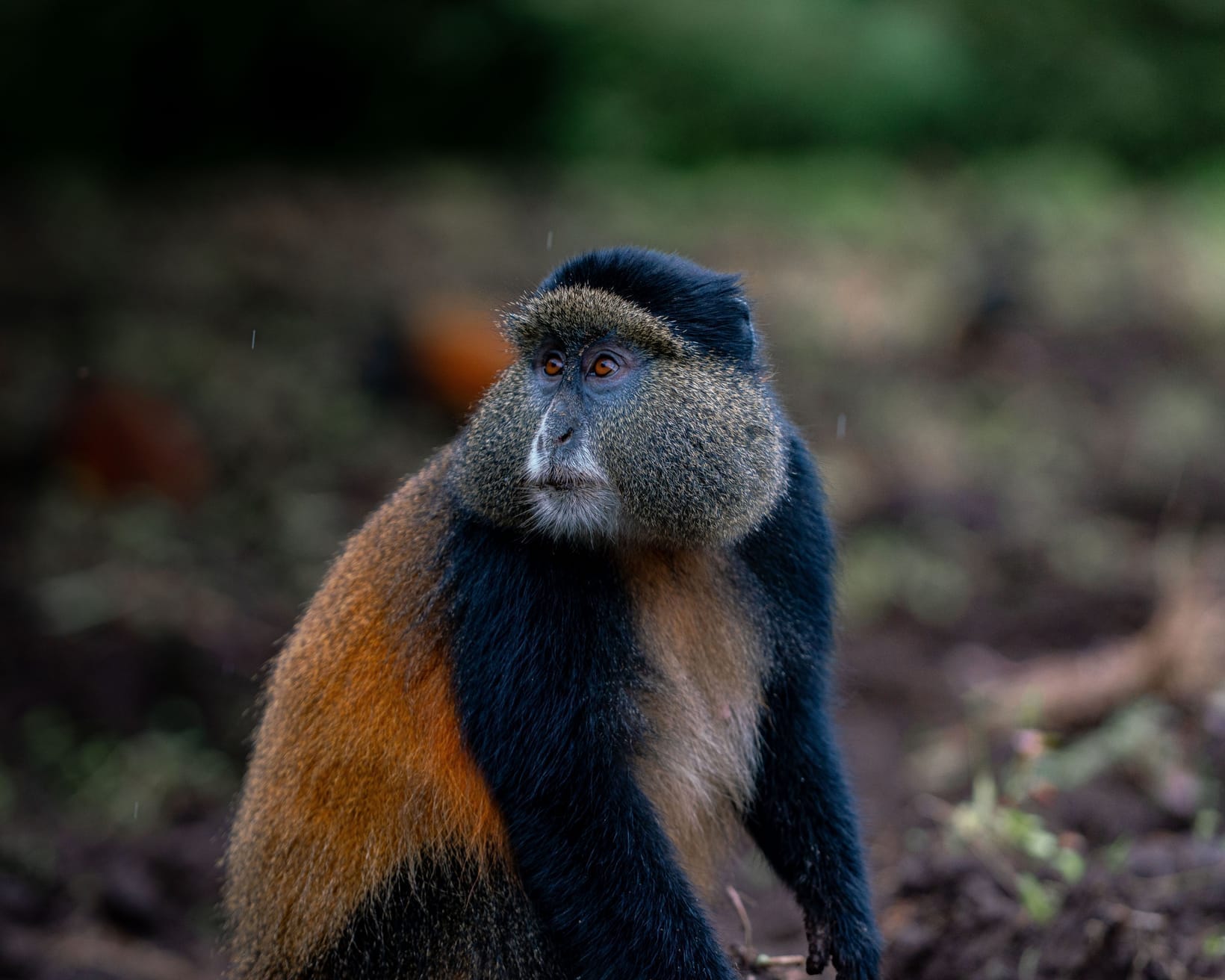 Golden monkeys are found only in the Virunga volcanoes
The great apes
Mountain gorilla.The reason most people come. Around half the world's population lives in Bwindi, with the rest in the Virungas. Endangered, and the only great ape whose numbers are rising. See how many mountain gorillas are left and how big a silverback actually is.
Chimpanzee. Our closest living relative, and in temperament nothing like a gorilla — noisy, fast, socially volatile, constantly moving. Kibale has the highest density in Africa. The comparison is covered properly in gorilla vs chimpanzee.
The monkeys
| Species | Where | Notes |
|---|---|---|
| Black-and-white colobus | Kibale, Bwindi, Semuliki, crater lakes | The one with the long white cape and tail. Common and unmistakable. |
| Red colobus | Kibale | Uganda red colobus is endangered; Kibale is the stronghold. |
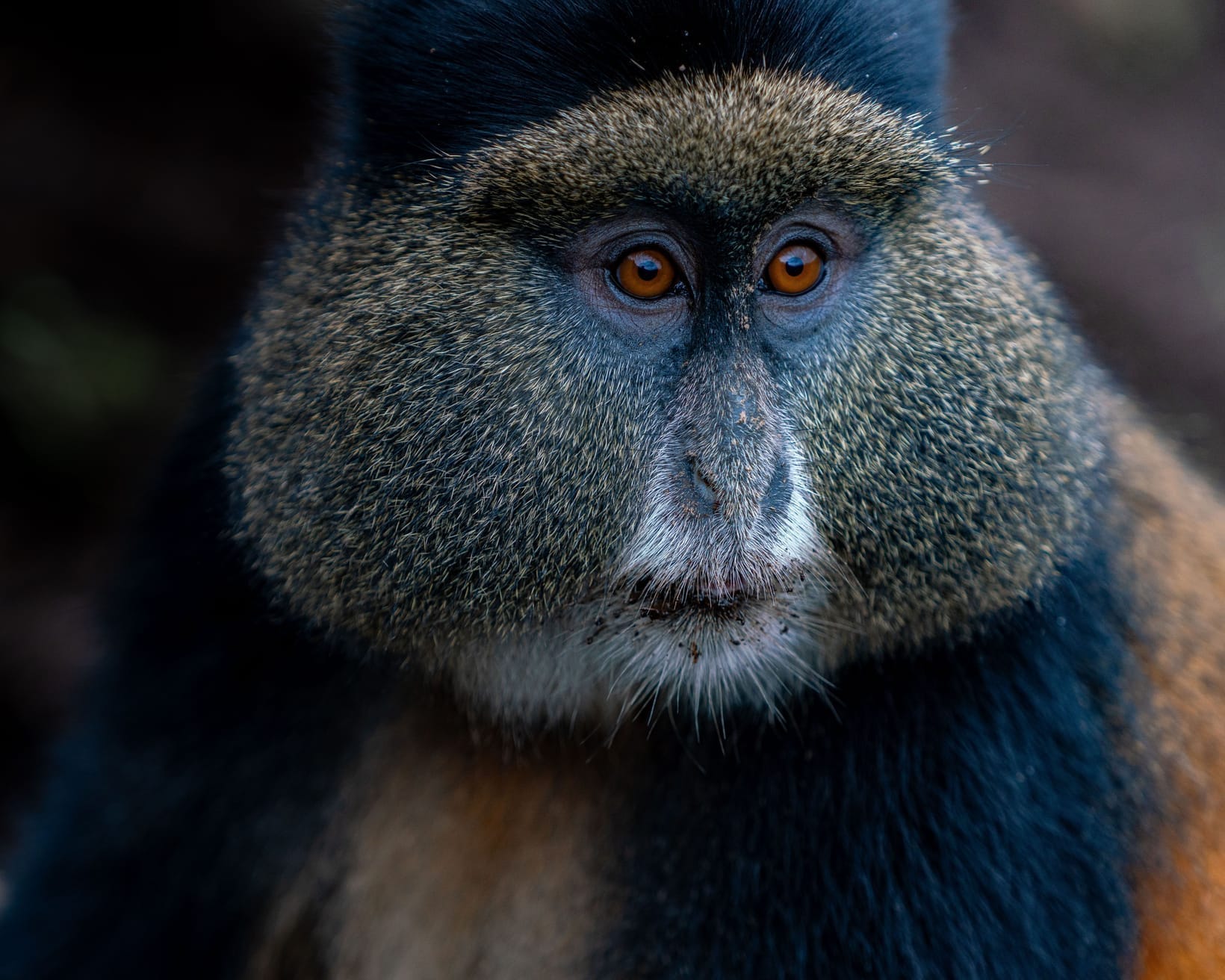
| Golden monkey | Mgahinga only (Uganda) | Endangered, Virunga-endemic, trekked with a permit. |
| Grey-cheeked mangabey | Kibale, Semuliki | Shaggy, dark, loud. Heard more than seen. |
| L'Hoest's monkey | Bwindi, Kibale, Maramagambo | Albertine Rift endemic. Often on the ground. |
| Red-tailed monkey | Kibale, Bwindi, Budongo | White nose spot, chestnut tail. Very common. |
| Blue monkey | Kibale, Bwindi, Semuliki | Dark and elusive. Golden monkeys are a subspecies. |
| Vervet monkey | Savanna parks throughout | The ubiquitous one around lodges. |
| Patas monkey | Kidepo, Murchison north | Long-legged, fast, savanna-dwelling. |
| Olive baboon | Almost everywhere | Abundant. Keep vehicle windows shut. |
| De Brazza's monkey | Mount Elgon, Semuliki | White beard, orange brow. Genuinely hard to see. |
The ones you'll only see at night
Uganda's nocturnal primates — bushbabies and pottos — are numerous and almost never seen by daylight visitors. The two ways to find them:
- A night game drive, where bushbabies show up readily in a spotlight — see walking and night safaris in Uganda.
- Night forest walks, offered at Kibale, where the potto — a slow-moving nocturnal primate — is the target species.
Where to see what
| Place | Species | Headline |
|---|---|---|
| Kibale Forest | 13 species | Chimpanzees — the most reliable in Africa |
| Bwindi | Around 10 | Mountain gorillas |
| Mgahinga | Fewer | Golden monkeys and gorillas |
| Kyambura Gorge | Few | A small, isolated chimpanzee community |
| Semuliki | Several | Congo-basin species at their eastern limit |
| Budongo Forest | Several | Chimpanzees, quieter than Kibale |
| Bigodi Wetland | Several | The best single walk for variety |
| Kalinzu Forest | Several | Cheaper chimpanzee tracking, less known |
| Ngamba Island | One | Sanctuary chimpanzees, near Entebbe |
Which ones you can actually trek
Trekking means a permit, a ranger, and a guided walk to a habituated group. Four experiences qualify:
- Mountain gorillas — Bwindi and Mgahinga. See how to book gorilla permits.
- Chimpanzees — Kibale primarily, also Kyambura, Budongo and Kalinzu. See chimpanzee trekking in Kibale.
- Golden monkeys — Mgahinga. Short, cheap, excellent value. See golden monkey facts.
- Habituation experiences — a full day with researchers rather than an hour, for both gorillas and chimpanzees.
Everything else on the list above you encounter rather than seek: colobus at breakfast, baboons on the road, vervets raiding the lunch table.
Building a primate trip
A trip built around primates rather than big game looks different from the standard circuit. The core is Bwindi and Kibale; the additions depend on how much time you have.
- Seven days: Bwindi for gorillas, Kibale for chimpanzees, Queen Elizabeth between them.
- Ten days: add Mgahinga for golden monkeys, or a second chimpanzee tracking at Kyambura.
- Fourteen days: add Semuliki for the Congo-basin species and Budongo on the way to Murchison.
- Add Rwanda:Nyungwe's colobus troops run to several hundred animals — see the Nyungwe guide.
See how many days a Uganda safari needs for pacing, or tell us which species matter to youand we'll build around them.
Uganda's primates: common questions
How many primate species are in Uganda? Around 20 species, though counts vary between sources depending on how subspecies are treated. Kibale Forest alone holds 13, the highest density of primates in Africa, and Uganda is the only country where you can trek mountain gorillas, chimpanzees and golden monkeys on one trip.
Which primates can you trek in Uganda? Four, with permits: mountain gorillas in Bwindi and Mgahinga, chimpanzees in Kibale and Kyambura Gorge, golden monkeys in Mgahinga, and — as a longer variant — chimpanzees on the habituation experience in Kibale. Everything else you see opportunistically on walks and drives.
What is the best place to see primates in Uganda? Kibale Forest, with 13 species in one park and the most reliable chimpanzee tracking in Africa. Add Bwindi for gorillas and Mgahinga for golden monkeys and you have covered the headline species. Bigodi Wetland Sanctuary next to Kibale is the best single walk for variety.
What is the difference between a monkey and an ape? Apes have no tail, are generally larger, and have more complex social behaviour and problem-solving. Uganda's apes are mountain gorillas and chimpanzees. Everything else with a tail — colobus, mangabeys, baboons, golden monkeys, vervets — is a monkey.
Can you see golden monkeys anywhere except Mgahinga? In Uganda, no — Mgahinga is the only place. Golden monkeys occur only in the Virunga volcanoes, so the alternative is Volcanoes National Park in Rwanda. They are endangered and the population is confined to that one small mountain range.
Are baboons dangerous to tourists? Not usually, but they are the primate most likely to cause trouble, because they associate people with food. They will enter vehicles and buildings and take things. Keep car windows shut where baboons are around, never feed them, and don't walk around with visible food.
Sources
- Uganda Wildlife Authority — Uganda's primates and primate trackingAccessed 28 Jul 2026
- International Union for Conservation of Nature — Gorilla beringei beringei (Mountain Gorilla) — species assessmentAccessed 28 Jul 2026