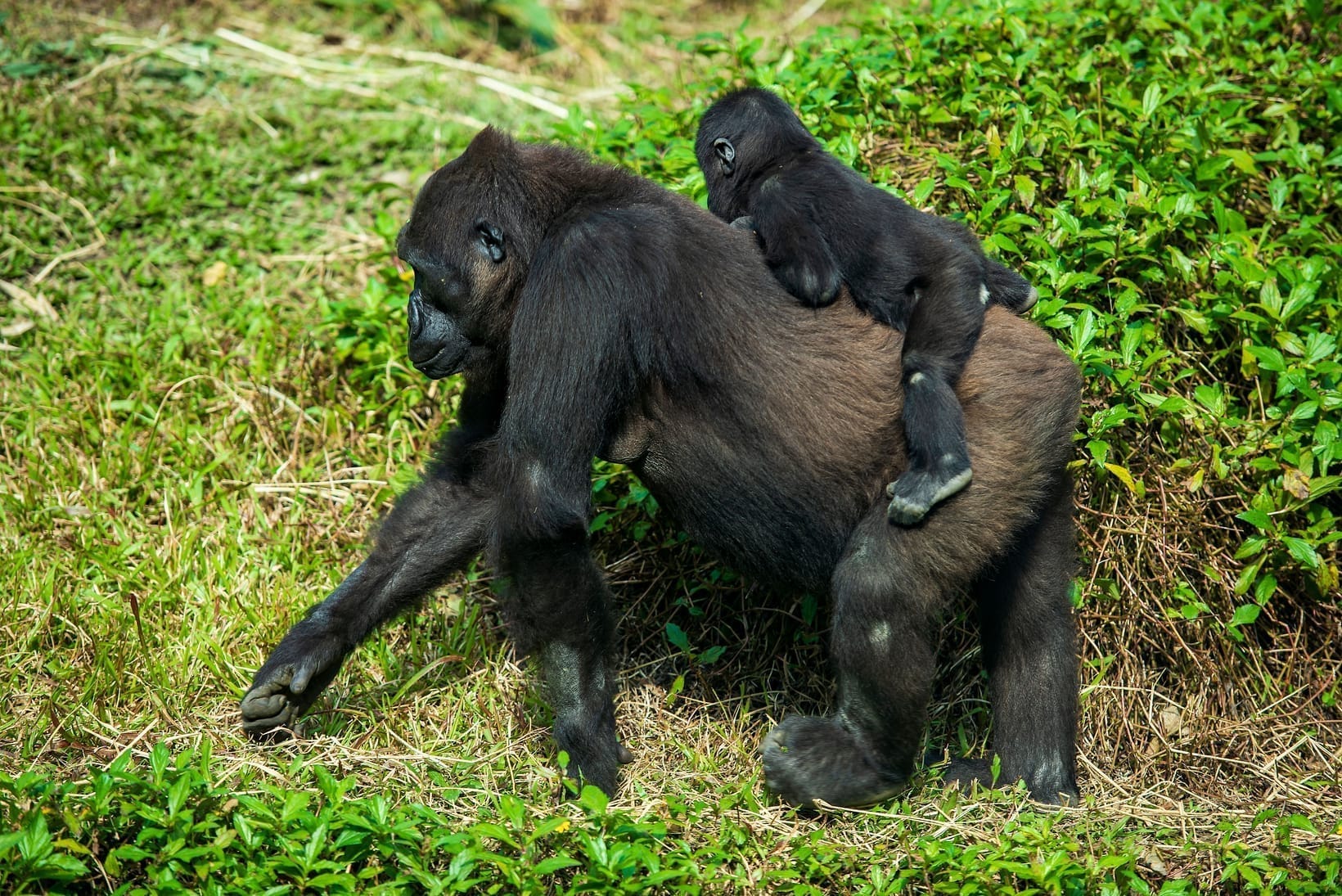
Short answerNo. A gorilla is a great ape, not a monkey. Apes and monkeys split from a common ancestor roughly 25 million years ago and have been separate branches ever since. The fastest test is the tail: monkeys have one, apes do not. Gorillas, chimpanzees, bonobos, orangutans, gibbons — and humans — are all apes.
It is a fair question, because everyday English uses “monkey” loosely for anything primate-shaped. Biologically the two groups are as distinct as cats and dogs, and once you know what to look for the difference is obvious in the field.
No — apes and monkeys are different
Both are primates. Beyond that they part company. The ape lineage separated from Old World monkeys around 25 million years ago, and everything that follows — the body plan, the brain, the way they move — diverged from there.
There are two families of ape. The great apes: gorillas, chimpanzees, bonobos, orangutans and humans. The lesser apes: gibbons and siamangs, in Southeast Asia. Everything else people call a monkey — baboons, colobus, macaques, vervets, capuchins, marmosets — sits on the other branch.
The tail test, and why it works
No ape has a tail. Essentially every monkey does. It is not a coincidence of appearance but a consequence of how each group moves.
Monkeys run along the tops of branches on all fours, and a tail is a counterweight and a rudder — in some South American species, a fifth limb that grips. Apes move beneath branches, hanging and swinging from fully rotating shoulder joints, and for that a tail is useless weight. Evolution discarded it.
Six differences you can see
| Apes | Monkeys | |
|---|---|---|
| Tail | None | Almost always present |
| Shoulders | Fully rotating — built for hanging and swinging | Restricted — built for running along branches |
| Chest | Broad and flat, shoulder blades on the back | Narrow and deep, shoulder blades at the sides |
| Brain size | Larger relative to body | Smaller relative to body |
| Size | Generally much larger | Generally much smaller |
| Lifespan | Long — gorillas commonly 35–40 years in the wild | Shorter as a rule |
| Tool use | Well documented, especially in chimpanzees | Rare and simple by comparison |
The apes, and where they live
| Ape | Where |
|---|---|
| Gorilla — four subspecies | Equatorial Africa. Mountain gorillas only in Uganda, Rwanda and the DRC. |
| Chimpanzee | West and Central Africa, and East Africa — Uganda's Kibale, Tanzania's Gombe and Mahale. |
| Bonobo | DR Congo only, south of the Congo River |
| Orangutan — three species | Borneo and Sumatra |
| Gibbons and siamangs | Southeast Asia — the lesser apes |
| Human | Everywhere |
It is a short list, and it is why great ape trekking is such a constrained experience. There is nowhere else to go — no country has added gorillas, and no zoo anywhere holds mountain gorillas, as we set out in mountain gorillas in zoos.
Uganda: apes and monkeys in one trip
Uganda is an unusually good place to see the distinction for yourself, because it holds both apes and a large share of Africa's monkeys — around 20 species in total.
| Primate | Ape or monkey? | Where |
|---|---|---|
| Mountain gorilla | Ape | Bwindi Impenetrable Forest, Mgahinga |
| Chimpanzee | Ape | Kibale Forest — highest density in Africa |
| Golden monkey | Monkey | Mgahinga, in the bamboo |
| Black-and-white colobus | Monkey | Kibale, Nyungwe, forest edges throughout |
| Red colobus | Monkey | Kibale — endangered and localised |
| Grey-cheeked mangabey | Monkey | Kibale canopy |
| L'Hoest's monkey | Monkey | Bwindi and the western forests |
| Olive baboon | Monkey | Savanna parks and roadsides everywhere |
| Bushbaby, potto | Neither — prosimians | Nocturnal, forest, seen on night walks |
A trip that takes in Bwindi and Kibale shows you both apes plus most of that monkey list, usually within a week. More detail in the primates of Uganda, and the two trekking experiences compared in chimpanzee trekking vs gorilla trekking.
Telling them apart in the field
Four cues that work in practice, in the order you will be able to use them.
- Look for the tail. Decisive. If it has one, it is a monkey.
- Watch how it moves. Running along the top of a branch on all fours is a monkey. Hanging or swinging beneath one, arm over arm, is an ape.
- Judge the size. In Uganda, anything bigger than a large dog and on the ground in forest is almost certainly an ape or a baboon — and a baboon has a tail.
- Listen. Chimpanzees announce themselves with pant-hoots and drumming on buttress roots, audible a long way off. Gorillas are far quieter — you usually smell and hear the vegetation moving before you hear the animals.
We run primate itineraries that put both apes and most of the monkeys in a single trip, with permits — $800 for gorillas, $400 for a full day with the Kibale chimpanzee researchers — bought before you travel. See how our primate trips are built, or tell us what you want to see.
Apes and monkeys: common questions
Is a gorilla a monkey? No. A gorilla is a great ape. Apes and monkeys are separate branches of the primate family tree that diverged roughly 25 million years ago. The quickest test is the tail: monkeys have one, apes do not. Gorillas, chimpanzees, bonobos, orangutans, gibbons and humans are all apes.
What is the difference between an ape and a monkey? Apes have no tail, larger brains relative to body size, broader chests, and shoulder joints that rotate fully for hanging and swinging. Monkeys almost all have tails, narrower chests, and move on all fours along branches rather than beneath them. Apes are also generally larger and longer-lived.
Are humans apes? Biologically, yes. Humans sit within the great ape family alongside gorillas, chimpanzees, bonobos and orangutans. We share roughly 98% of our DNA with gorillas and around 98.8% with chimpanzees — which is precisely why gorilla trekking has strict distance and health rules, since human respiratory infections transmit to them easily.
Which apes live in Uganda? Two: mountain gorillas in Bwindi Impenetrable Forest and Mgahinga, and chimpanzees, most accessibly in Kibale Forest, which holds the highest chimpanzee density in Africa. Uganda is one of very few countries where you can trek both on a single trip.
Are baboons monkeys or apes? Monkeys — Old World monkeys, specifically. They are large, ground-dwelling and superficially ape-like, which causes confusion, but they have tails and the anatomy of monkeys. Olive baboons are common across Uganda's savanna parks and along forest edges.
How many primate species does Uganda have? Around twenty, depending on how subspecies are counted — an unusually high number for a country of its size. Two are apes; the rest are monkeys and prosimians, including golden monkeys, black-and-white colobus, red colobus, grey-cheeked mangabey, L'Hoest's monkey, olive baboons and several bushbaby and potto species.
Sources
- IUCN Red List — Gorilla beringei beringeiAccessed 29 Jul 2026
- Uganda Wildlife Authority — Primates and national parksAccessed 29 Jul 2026