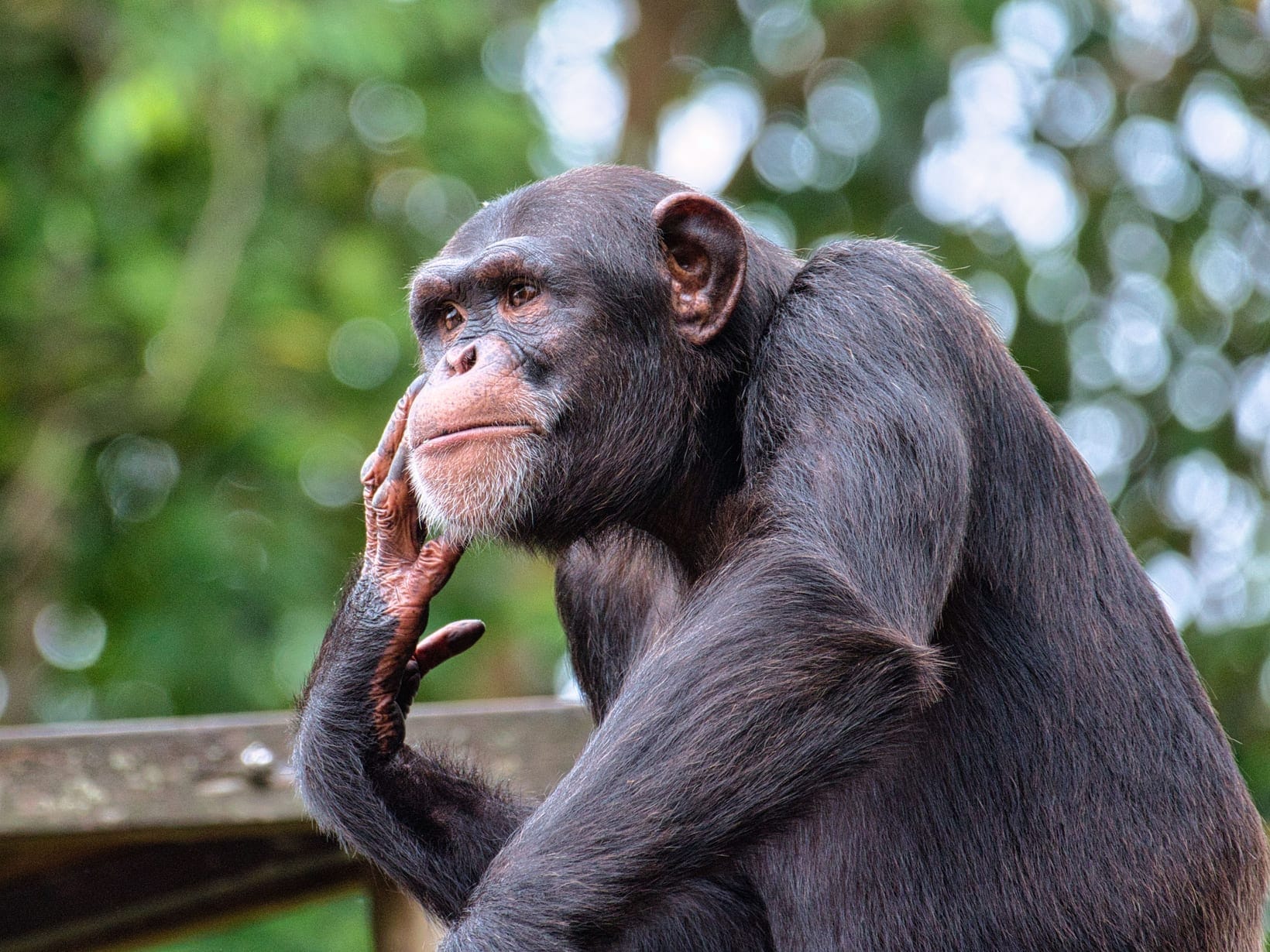
Short answerThe chimpanzee habituation experience gives you a full day with a part-habituated community in Kibale — from the night nests at dawn to new nests at dusk — alongside the researchers doing the habituating. It costs $400, against considerably less for standard one-hour tracking, and it is a genuinely demanding day.
Standard chimpanzee tracking gives you one hour, and with an animal that moves as fast as a chimpanzee an hour can pass in a blur of canopy and noise. The habituation experience is the answer to that, and it is substantially less well known than its gorilla equivalent.
For the standard version, see chimpanzee trekking in Kibale Forest.
What the habituation experience is
Habituating a chimpanzee community takes years of researchers following them daily until human presence stops registering as a threat. The habituation experience places paying visitors inside that ongoing process, with a community part-way through it.
The practical difference from standard tracking is that you are not visiting for a scheduled hour — you are joining the research team for their working day and staying with the chimps as long as you can keep up.
The shape of the day
| When | What happens |
|---|---|
| Before dawn | Leave the lodge in the dark to reach the night nests |
| First light | The community wakes and descends. This is the moment you came for. |
| Morning | Follow as they move and feed. Fast, often noisy. |
| Midday | Chimps rest and groom — the calmest and best viewing of the day |
| Afternoon | Feeding and travel resume; social activity picks up |
| Late afternoon | They build new nests for the night. You can stay to watch. |
Habituation vs standard tracking
| Habituation | Standard tracking | |
|---|---|---|
| Time with the chimps | A full day | One hour |
| Permit | $400 | $250 |
| Group size | Very small | Usually 6–8 |
| Start time | Before dawn | Morning or afternoon briefing |
| Physical demand | High — many hours on foot | Moderate |
| Community | Part-habituated, less settled | Fully habituated |
| Availability | Seasonal, limited | Year-round, twice daily |
| Who you're with | Researchers and trackers | Rangers and trackers |
Is it worth it?
The economics are more favourable than the gorilla equivalent. Gorilla habituation costs roughly double a standard gorilla permit for four times the contact. Chimpanzee habituation costs a smaller multiple of a standard chimp permit for roughly eight times the contact.
So in pure hours-per-pound terms this is one of the best-value primate experiences in East Africa, and it is far less booked than its gorilla counterpart.
Who it suits
Good fit:
- Repeat visitors who found the standard hour too short
- Anyone genuinely interested in primate behaviour and research
- Photographers who need time rather than a single window
- Travellers with good stamina and a tolerance for uncertainty
Poor fit:
- First-time visitors on a tight schedule — standard tracking delivers the core experience
- Anyone who would struggle with a pre-dawn start and a long day on foot
- Travellers who want a guaranteed close encounter
- Families with younger children — see our family safari guide for age limits
If you are weighing this against the gorilla version, see the Gorilla Habituation Experience explained — and chimpanzee vs gorilla trekking for the broader comparison.
Practical notes
- Confirm availability first. It is offered seasonally rather than year-round, and dates change.
- Stay at the forest edge, not the crater lakes — a pre-dawn start from 45 minutes away is brutal.
- Pack a full day's food and water, plus a dry bag. Kibale rains.
- Take proper boots. This is a full day on wet forest floor.
- Don't schedule anything the next morning.
| Tier | Properties we book |
|---|---|
| Luxury | Primate Lodge Kibale · Crater Safari Lodge · Kyaninga Lodge |
| Mid-range | Turaco Treetops · Kibale Forest Camp · Isunga Lodge |
| Budget | Chimpanzee Forest Guest House · Kibale Guest Cottages · Chimps Nest |
See where to stay at Kibale for the forest-edge versus crater-lakes decision, which matters more for this than for anything else at the park.
Ask us about current availability — this is one where the answer genuinely changes by season.
Chimpanzee habituation: common questions
What is the chimpanzee habituation experience? A permit that lets a small group spend a full day with a chimpanzee community that is still being habituated, alongside the researchers and trackers doing that work — from the moment the chimps leave their night nests to the moment they build new ones. It is offered in Kibale Forest, Uganda.
How much does chimpanzee habituation cost in Kibale? $400 per person for foreign non-residents, against $250 for a standard one-hour chimpanzee tracking permit. Those are the rates in the UWA Conservation Tariff for 2026–2028; foreign residents pay $350 and Rest-of-Africa visitors $300. The tariff also notes the habituation experience commences on 1 January 2027, so check bookability for earlier dates.
How long is the chimpanzee habituation experience? Most of the day. You start before dawn to be at the night nests as the chimps wake, follow them through the day as they feed, travel and rest, and can stay until they build their nests in the late afternoon. Many participants leave earlier — it is a long day.
Is chimpanzee habituation harder than normal chimp tracking? Considerably. The community is only part-habituated so it moves more and keeps more distance, the day starts before dawn, and you are on your feet for many hours in humid forest. It is a genuinely demanding day rather than a morning walk.
When can you do the chimpanzee habituation experience? It is generally offered during the low-season months when standard tracking demand is lower, rather than year-round. Availability and dates are set by the Uganda Wildlife Authority and change between seasons, so confirm before planning a trip around it.
Is chimpanzee habituation better than gorilla habituation? They are different. Gorilla habituation gives you four hours with a gorilla family in Bwindi at a much higher permit price. Chimpanzee habituation gives you a full day for far less money, but with a faster, more elusive animal and a harder day's walking.
Sources
- Uganda Wildlife Authority — Kibale National Park — chimpanzee habituation experienceAccessed 28 Jul 2026