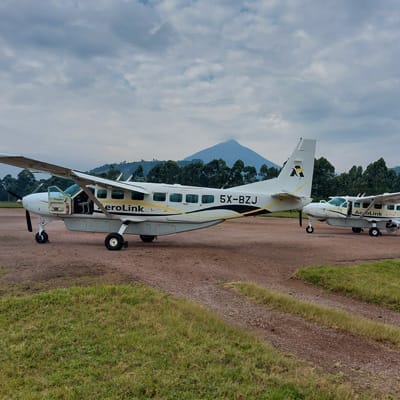
Short answerLight aircraft serve airstrips near Bwindi, Kidepo, Queen Elizabeth and Murchison. Flying converts the 8–10 hrs Entebbe–Bwindi road transfer into a short hop, and turns Kidepo from a two-day drive into a morning. UWA charges landing fees by seat count — $40 for the 7–14 seat band most safari flights fall into.
Uganda's parks are far apart and its roads are slower than the map suggests. Flying is the main lever available for buying that time back, and it is under-discussed relative to how much difference it makes.
What flying actually buys you
| Leg | By road | Effect of flying |
|---|---|---|
| Entebbe → Bwindi | 8–10 hrs | Roughly a day saved each way |
| Kampala → Kidepo | 10–12 hrs | Two days each way become a morning |
| Kampala → Queen Elizabeth | 7–8 hrs | Useful on short trips; less transformative |
| Kampala → Murchison | 4–6 hrs | Marginal — the drive is manageable and takes in Ziwa |
The pattern: flying is transformative for Bwindi and Kidepo, and marginal for Murchison. Our drive times guide has the underlying numbers, and road safari vs fly-in covers what you give up by not driving.
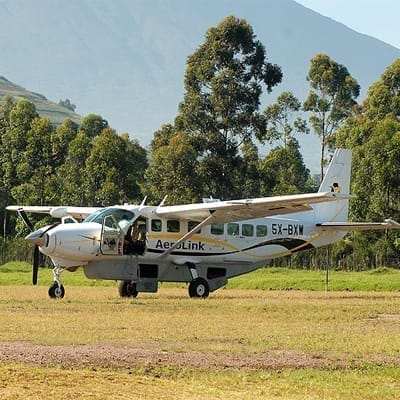 Uganda's park airstrips are grass or murram, and baggage limits are strict
The airstrips that matter
| Airstrip | Serves | Notes |
|---|---|---|
| Kihihi | Bwindi — northern sectors (Buhoma) | The right choice for a Buhoma permit |
| Kisoro | Bwindi — southern sectors (Rushaga, Nkuringo), Mgahinga | Also the closest to the Rwandan border |
| Kidepo | Kidepo Valley National Park | The reason Kidepo is realistic at all |
| Kasese | Queen Elizabeth, Rwenzori foothills | Useful for exiting the western circuit |
| Mweya / Kasenyi | Queen Elizabeth | Park airstrips |
| Pakuba / Chobe / Bugungu | Murchison Falls | Several strips serve the park |
| Entebbe | International arrivals | Where everything starts and ends |
Landing fees, and who pays them
| Aircraft | Fee |
|---|---|
| Up to 3 seats | $20 |
| 4–6 seats | $30 |
| 7–14 seats | $40 |
| Helicopter | $125 |
| Parking | $50 per day |
These sit inside your flight or package price rather than being billed to you at a strip, but they explain part of why a fly-in itinerary costs what it does — the aircraft is charged on every landing, and your park entrance is charged on top as normal. Our fees guide covers the rest.
The baggage limit nobody reads
The single most common unpleasant surprise on a fly-in itinerary. Light aircraft carry strict weight limits, usually specifying soft bags rather than hard suitcases, and the allowance is far below what an international flight permits.
- Soft bags only, in most cases. A hard case may simply not be accepted.
- Camera kit eats the allowance. Raise it at booking, not at the strip.
- Excess may be possible at a cost, or may not, depending on the load.
- Storage for the rest of your luggage can often be arranged in Entebbe.
When flying is worth it — and when it isn't
| If you… | Verdict |
|---|---|
| Have under five days and want gorillas | Fly — see our short safari guide |
| Are going to Kidepo | Fly, unless you have three weeks |
| Have two weeks on the western circuit | Drive — the road legs are part of the trip |
| Are older or have mobility limits | Fly the longest leg; the roads tire people more than the walking |
| Are on a tight budget | Drive, and break the long legs with Lake Mburo |
| Are flying into Kigali instead | You may not need a domestic flight at all |
That last row matters. Kigali to Bwindi is 4–5 hrs against 8–10 hrs from Entebbe, so an open-jaw routing through Rwanda can remove the need for a domestic flight entirely — see combining Uganda and Rwanda.
For pacing, see how many days a Uganda safari needs, and for the compressed version, short Uganda safaris.
Practical notes
- Permit first, then flight. The sector decides the airstrip.
- Confirm the baggage limit and pack in soft bags.
- Build slack. Light aircraft schedules shift with weather and loads.
- Never fly in on trek morning. Arrive the day before.
- Check what the fare includes — landing fees usually yes, park entrance no. See what's included in a safari package.
- Expect small aircraft. If that is a problem, say so early.
Tell us your dates and your permit sector and we will work out whether flying earns its cost on your particular trip.
Flying in Uganda: common questions
Can you fly between Uganda's national parks? Yes. Light aircraft serve airstrips near Bwindi, Kidepo, Queen Elizabeth and Murchison Falls from Entebbe. It is the standard way to reach Kidepo, and the main way to make a short gorilla trip work, because the Entebbe to Bwindi road transfer takes 8 to 10 hours.
Which airstrip is best for Bwindi — Kihihi or Kisoro? Kihihi serves the northern sectors, principally Buhoma. Kisoro serves the southern sectors — Rushaga and Nkuringo. Your gorilla permit names a sector, so the permit decides the airstrip, not the other way round. Booking the wrong one puts hours of mountain road between you and your briefing.
How much are aircraft landing fees in Uganda's parks? The Uganda Wildlife Authority charges per landing by seat count — $20 for up to three seats, $30 for four to six, $40 for seven to fourteen, and $125 for a helicopter. Parking is $50 per day. These are separate from passenger entry fees and are normally inside your flight or package price.
What is the baggage limit on Uganda's domestic flights? Light aircraft carry strict limits, usually in soft bags rather than hard cases. Camera equipment eats into the allowance quickly. Confirm the exact limit with your operator before packing, and raise serious photographic kit at booking rather than at check-in.
Is flying to Kidepo worth it? For most visitors, yes. Kidepo is 10 to 12 hours from Kampala by road, realistically two days each way, so flying turns four days of driving into a few hours. On a trip of under two weeks it is the difference between Kidepo being possible and not.
Do pilots pay park entrance fees in Uganda? Not if they are en route and spend under two hours in the park, per the UWA tariff. Landing fees are charged separately from passenger entry fees, which passengers still pay in the normal way.
Sources
- Uganda Wildlife Authority — Conservation Tariff July 2026 – June 2028, p.7Accessed 29 Jul 2026