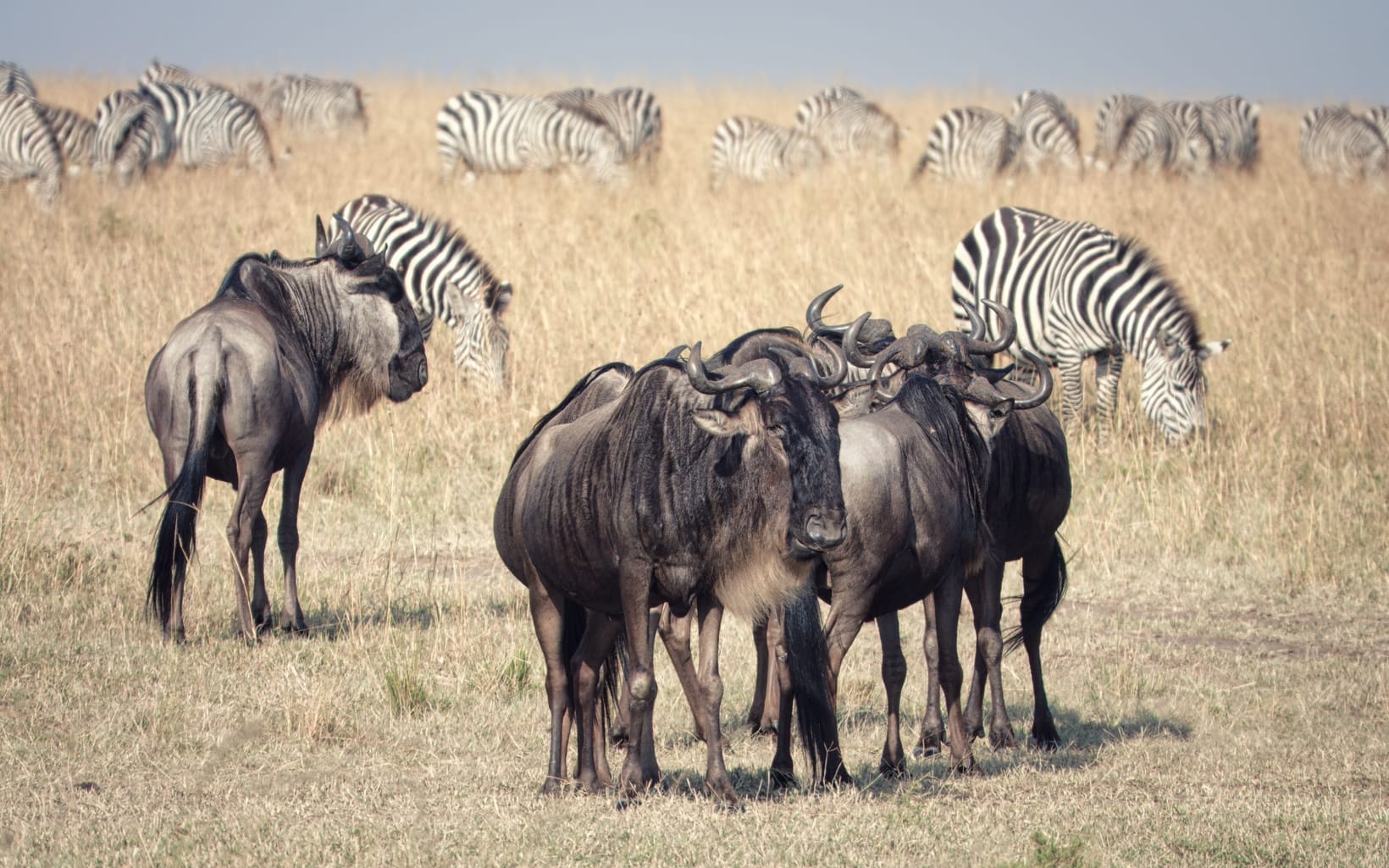
Short answerNo. The Great Wildebeest Migration happens entirely within the Serengeti–Mara ecosystem — northern Tanzania and south-western Kenya — and the herds never enter Uganda. There is no Ugandan leg, no Ugandan crossing point and no resident wildebeest population to speak of. Uganda is roughly 700 kilometres away, and what it offers instead is the thing the Serengeti cannot: mountain gorillas and chimpanzees.
This one needs saying because a number of Ugandan tour operators publish Great Migration pages. Read them closely and the migration is always happening in Tanzania or Kenya — but the page is on a Uganda safari site, optimised for people searching Uganda, and the distinction is left for the reader to work out.
No — it never enters Uganda
Around 1.5 million wildebeest, together with several hundred thousand zebra and Thomson's gazelle, move in a rough clockwise loop through the Serengeti ecosystem, spilling briefly north into Kenya's Masai Mara before returning south. That loop is the migration in its entirety.
It is a closed circuit driven by rainfall and grass growth. It has no western extension. The herds do not approach the Ugandan border, and there is no season in which any part of the movement occurs on Ugandan soil.
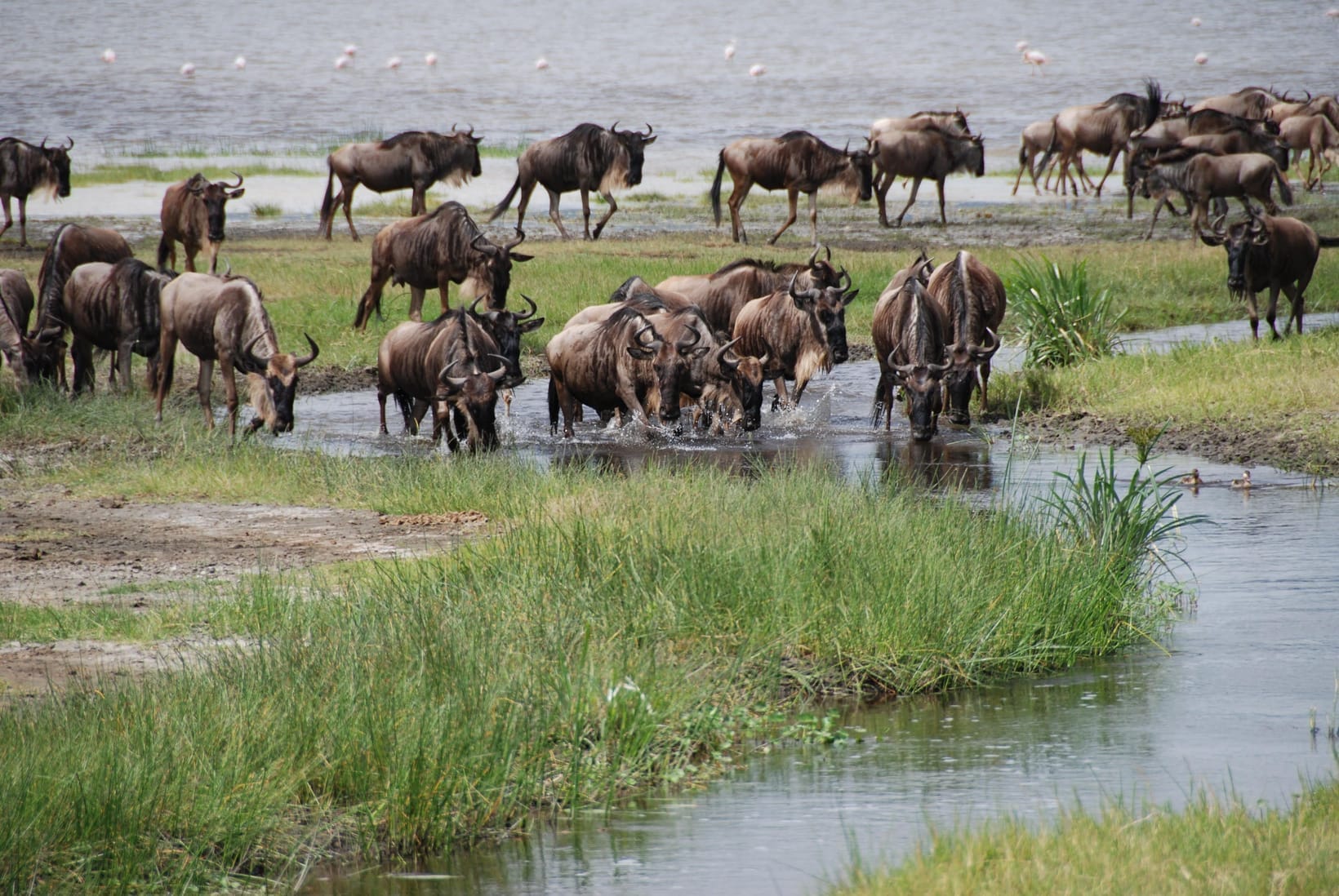 Uganda has no migration of this kind — the herds never cross its borders
Where the migration actually goes
| Place | Country | Role in the migration |
|---|---|---|
| Southern Serengeti / Ndutu | Tanzania | Calving grounds on the short-grass plains, roughly late Jan–Mar |
| Western Corridor / Grumeti | Tanzania | Herds move west and north around May–June; Grumeti River crossings |
| Northern Serengeti | Tanzania | Mara River crossings, roughly July–October |
| Masai Mara | Kenya | The northern extremity, roughly July–October |
| Uganda | Uganda | No role. Around 700 km west, in a different ecosystem entirely. |
Why it stops short of Uganda
The migration is not wandering — it is tracking new grass after rain across a specific volcanic-soil grassland system. Three things keep it east of Uganda.
The grass is wrong.The Serengeti's short-grass plains sit on mineral-rich volcanic ash from the Ngorongoro highlands, which produces exactly the calcium- and phosphorus-rich sward that lactating wildebeest need. Uganda's savanna is a different soil and a different grassland, largely wooded or bushed rather than open plain.
The geography interrupts. Between the Serengeti and Uganda sit Lake Victoria, the Rift escarpment, farmland and dense human settlement. There is no continuous grassland corridor for a million animals to walk down.
Uganda's rainfall is too even.The migration is driven by a pronounced wet-dry cycle that pushes herds toward whichever region has just had rain. Uganda's equatorial climate gives it two milder wet seasons and enough year-round moisture that resident grazers simply stay put.
The migration month by month
If it is the migration you actually want, this is the calendar to plan against.
| Period | Where | What's happening |
|---|---|---|
| Late Jan – Mar | Southern Serengeti, Ndutu | Calving. Hundreds of thousands of births in a few weeks, and the most concentrated predator action of the year. |
| Apr – May | Central Serengeti, moving west | Long rains. Herds strung out and moving; the quietest and cheapest months. |
| Jun – Jul | Western Corridor and north | Grumeti River crossings; herds massing before the Mara River. |
| Jul – Oct | Northern Serengeti and Masai Mara | The famous Mara River crossings. Unpredictable and impossible to schedule. |
| Nov – Dec | Moving back south | Short rains draw the herds toward the calving grounds again. |
What Uganda has instead
Uganda does not have a mass-herbivore spectacle and should not pretend to. What it has is a set of things the Serengeti cannot offer at all.
| Uganda | Serengeti–Mara |
|---|---|
| Mountain gorillas — Bwindi and Mgahinga | None. Nearest population is Uganda. |
| Chimpanzees at the highest density in Africa — Kibale | None accessible on the northern circuit |
| Around twenty primate species | A handful |
| Over 1,000 bird species | Excellent, but fewer |
| Tree-climbing lions at Ishasha | Tree-climbing lions at Lake Manyara |
| Boat safaris — Kazinga Channel, the Nile at Murchison | Limited |
| No wildebeest migration | The largest land-mammal migration on earth |
Uganda's equivalent of a crowd-scale spectacle is the Kazinga Channel in the afternoon — hundreds of hippo, elephant herds coming to drink and enormous congregations of waterbirds along a single stretch of water. It is not a migration. It is, on its own terms, one of the densest wildlife gatherings in East Africa.
Doing both in one trip
This is the practical answer for most people asking the question, and it is easier than the map suggests.
Entebbe to Nairobi is a scheduled flight of a little over an hour with several departures a day. Kilimanjaro, for the Serengeti, connects through Nairobi. So a fortnight can genuinely deliver mountain gorillas in Bwindi and the Mara River crossings in the same trip.
Eleven days — gorillas and the Serengeti. Entebbe → Bwindi (trek) → fly to Arusha → Tarangire → Serengeti (three nights, positioned for the season) → Ngorongoro → Lake Manyara. Detail in our guide to gorillas and Tanzania.
Eleven days — gorillas and the Masai Mara. Entebbe → Bwindi (trek) → fly to Nairobi → Amboseli → the Rift lakes → Masai Mara, timed for July–October if crossings are the goal. See gorillas and Kenya.
Reading a Ugandan migration page
If you land on a Uganda safari site advertising the Great Migration, three questions sort it out quickly.
- Which country is the migration day-by-day in? It will be Tanzania or Kenya. If the itinerary does not say, that is the answer to your question about the operator.
- Are the inter-country flights in the price? Entebbe–Nairobi and onward to Kilimanjaro are real costs, not rounding.
- Does the camp position match the month? A northern Serengeti camp in February is the wrong end of the ecosystem by several hundred kilometres.
We are a Ugandan operator and we will tell you plainly that the migration is not ours — it is in Kenya and Tanzania, and we build the combined trip that gets you to both. See how our two-country trips are routed, or tell us which month you can travel and we will tell you which chapter of the migration you would actually be seeing.
The Great Migration and Uganda: common questions
Is there a Great Migration in Uganda? No. The Great Wildebeest Migration is a closed circuit between Tanzania's Serengeti and Kenya's Masai Mara. The herds never cross into Uganda, and no comparable mass movement of large herbivores occurs anywhere in the country. Ugandan operators offering migration safaris are selling trips that fly you to Kenya or Tanzania.
Where does the Great Migration take place? Entirely within the Serengeti–Mara ecosystem, spanning northern Tanzania and south-western Kenya. Roughly 1.5 million wildebeest plus several hundred thousand zebra and gazelle move clockwise through the Serengeti and briefly into the Masai Mara before returning south. Two countries, one ecosystem.
Are there wildebeest in Uganda? No resident population of any consequence. Wildebeest are animals of open short-grass plains, and Uganda's savanna is largely wooded or bushed, sitting in a different ecological zone. Uganda's characteristic grazers are Uganda kob, topi, Jackson's hartebeest and buffalo.
Can you see the Great Migration from Uganda? Only by leaving Uganda. Entebbe to Nairobi is a scheduled flight of a little over an hour with several departures daily, and Kilimanjaro is reachable via Nairobi, so combining a Ugandan gorilla trek with the migration is straightforward. It is a two-country trip, not a Ugandan one.
When is the best time to see the Great Migration? It depends what you want to see. River crossings in the northern Serengeti and Masai Mara run roughly July to October. Calving on the southern Serengeti short-grass plains happens around late January to March and concentrates predator activity dramatically. The herds move continuously, so there is no off-season, only different chapters.
Does Uganda have anything comparable to the migration? Not in scale, and it would be dishonest to claim otherwise. What Uganda has that the Serengeti does not is mountain gorillas, the highest chimpanzee density in Africa, around twenty primate species and over a thousand bird species. Different spectacle, and one you cannot see in Kenya or Tanzania at all.
Sources
- Tanzania National Parks — Serengeti National Park — the wildebeest migrationAccessed 29 Jul 2026
- Kenya Wildlife Service — Masai Mara National ReserveAccessed 29 Jul 2026
- Uganda Wildlife Authority — National parks and wildlifeAccessed 29 Jul 2026