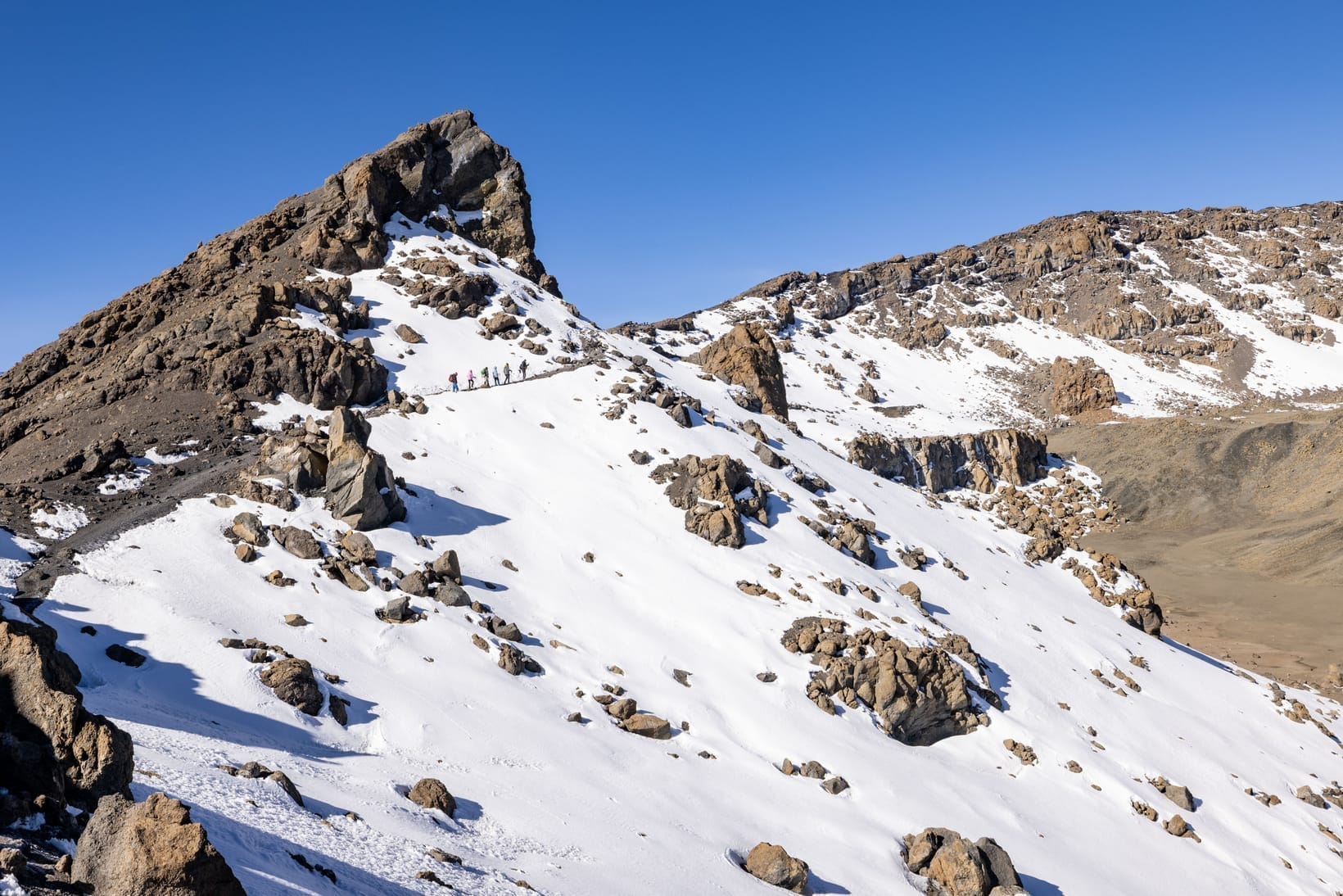
Short answerTanzania, entirely — summit, slopes and national park. The Kenyan border sits roughly 20 to 30 kilometres north of the mountain. The confusion exists because the famous photographs are taken from Kenya: Amboseli National Park looks straight at Kilimanjaro's northern face across flat, open plains, which is why the elephants beneath the snows are almost always Kenyan elephants. Tanzania owns the mountain; Kenya owns the view.
This is one of the most-asked questions in African travel, and unusually it is a misconception with a genuinely useful answer behind it — because the country that does not own the mountain is the better place to look at it.
Tanzania — entirely
Mount Kilimanjaro stands in north-eastern Tanzania. All 5,895 metres of it, all three volcanic cones — Kibo, Mawenzi and Shira — and the whole of Kilimanjaro National Park, a UNESCO World Heritage Site, are Tanzanian. No part of the mountain crosses into Kenya.
The nearest towns are Moshi and Arusha, both Tanzanian, and the gateway airport is Kilimanjaro International, between the two. Every climbing route starts on the Tanzanian side and is administered by Tanzanian park authorities.
Why everyone thinks it's Kenya
Not carelessness — it is the photographs.
The definitive image of Kilimanjaro is a snow-capped peak rising behind a herd of elephants on flat, dry, open ground. That photograph is almost always taken in Amboseli National Park, in Kenya. Amboseli sits on a dried lake bed directly north of the mountain: nothing between you and it, and enormous elephants for scale in the foreground.
On the Tanzanian side you are generally too close and among trees and settlement. You climb Kilimanjaro from Tanzania. You photograph it from Kenya. Since most people meet the mountain through pictures long before they meet it in person, the association sticks.
The straight line on the map
Look at the Kenya–Tanzania border and you will see a long, ruler-straight line running south-east from Lake Victoria that suddenly deviates south around Kilimanjaro before resuming. That kink is why the mountain is Tanzanian rather than Kenyan, and it dates from the 1886 partition between Britain and Germany — Kenya went to the British, Tanganyika to the Germans, and Kilimanjaro fell on the German side of the line.
Where to actually see it
| Place | Country | The view |
|---|---|---|
| Amboseli National Park | Kenya | The definitive view. Flat open plains, the full northern face, elephants in the foreground. |
| Tsavo West National Park | Kenya | Good distant views, more broken terrain, far fewer vehicles. |
| Moshi | Tanzania | Close under the southern slopes. Impressive, but you are too near for the classic wide shot. |
| Arusha / Mount Meru area | Tanzania | Distant views on clear days, usually with Meru in the way. |
| The mountain itself | Tanzania | Extraordinary, and the one place you cannot see Kilimanjaro — you are standing on it. |
Amboseli, and when the mountain shows
If the photograph is what you are after, Amboseli is the answer, and there is one planning decision that matters more than all the others.
Kilimanjaro generates its own weather. Through the middle of the day cloud builds over the summit and the mountain effectively disappears. It is normally clear at first light and again in the last hour before sunset. A traveller who arrives at Amboseli at midday, spends one night and leaves after breakfast gets essentially one proper chance.
Best months are the drier ones — roughly June to October and January to February. The green season is beautiful and much quieter, but the mountain hides more often.
Climbing it — and the Kenya question
You cannot climb Kilimanjaro from Kenya. All seven established routes — Marangu, Machame, Lemosho, Rongai, Shira, Umbwe and the Northern Circuit — begin at Tanzanian gates, and every climb must be booked through Tanzanian authorities with licensed Tanzanian guides. Rongai starts on the northern side nearest the Kenyan border, which is as close as the confusion gets to being true, and it is still firmly in Tanzania.
You can travel from Nairobi to Moshi or Arusha overland or by air and start from there, which is what “climbing Kilimanjaro from Kenya” means in practice. It is a border crossing, and Tanzania is not part of the East Africa Tourist Visa — you will need a separate Tanzanian visa, as explained in our guide to the East Africa Tourist Visa.
Building a trip around the view
Amboseli slots naturally into a Kenyan circuit, and — this is the part most people do not realise — into a gorilla trip too.
| Trip | How it works |
|---|---|
| Kenya circuit | Nairobi → Amboseli (2 nights) → Rift Valley lakes → Masai Mara. The classic, and the mountain is the opening act. |
| Gorillas plus Kenya | Bwindi for the trek, then fly Entebbe–Nairobi and drive south to Amboseli. Mountain gorillas and Kilimanjaro in one trip. |
| Kenya plus the climb | Amboseli for the view, cross to Moshi, then climb. You see the mountain properly before you are standing on it. |
That second option is the one worth pausing on. Entebbe to Nairobi is a scheduled flight of a little over an hour, so mountain gorillas in Bwindi and elephants under Kilimanjaro genuinely fit inside a fortnight — set out in are there gorillas in Kenya.
We build Kenya circuits and two-country trips that put Amboseli where the light is right rather than where the driving is convenient. See how our Kenya itineraries are routed, or tell us when you can travel and we will say honestly what your odds on the mountain look like that month.
Kilimanjaro's location: common questions
Is Mount Kilimanjaro in Kenya or Tanzania? Tanzania, entirely. The whole mountain — summit, slopes and Kilimanjaro National Park — lies within Tanzanian territory in the country's north-east. The Kenyan border runs roughly 20 to 30 kilometres to the north, which is close enough that the mountain dominates the skyline of southern Kenya without any part of it being Kenyan.
Can you see Kilimanjaro from Kenya? Yes, and it is the classic view. Amboseli National Park in southern Kenya looks directly at Kilimanjaro's northern face across flat, open ground, which is why the famous photographs of elephants beneath the snows are almost all taken in Kenya rather than Tanzania. Tsavo West also has good views.
Can you climb Kilimanjaro from Kenya? No. All seven established climbing routes start in Tanzania and every climb must be organised through Tanzanian park authorities with Tanzanian guides. You can travel overland from Nairobi to the trailhead towns of Moshi or Arusha, but the climb itself is wholly Tanzanian and you will cross the border to do it.
Why do people think Kilimanjaro is in Kenya? Because the best-known photographs of it are taken from Kenya. Amboseli's flat, treeless plains give an uninterrupted view of the northern face with elephants in the foreground, so the image most people carry of Kilimanjaro is a Kenyan one. As the local saying goes, Tanzania owns the mountain and Kenya owns the view.
What is the best place to photograph Kilimanjaro? Amboseli National Park in Kenya, from the northern side. The park is flat, open and close enough that the mountain fills the frame, and the resident elephants provide the foreground. In Tanzania the mountain is harder to photograph well because you are usually too close and among trees.
When is Kilimanjaro visible from Amboseli? Early morning and late afternoon, most reliably in the drier months of June to October and January to February. Cloud typically builds over the summit through the middle of the day and clears again toward evening. Two nights at Amboseli gives you four viewing windows rather than one, which matters more than any other planning decision.
Sources
- Tanzania National Parks — Kilimanjaro National ParkAccessed 29 Jul 2026
- Kenya Wildlife Service — Amboseli National ParkAccessed 29 Jul 2026
- UNESCO World Heritage Centre — Kilimanjaro National ParkAccessed 29 Jul 2026