Short answerThe Great Migration is a continuous year-round circuit of around two million wildebeest, zebra and gazelle around the Serengeti–Mara ecosystem — not a single event. Calving is in the southern Serengeti around late January to March; the Mara River crossings are roughly July to October. The herds are always somewhere.
More safari trips are mistimed over the migration than over anything else, and it is almost always the same error: treating it as an event with a date rather than a circuit with a rhythm.
What the migration actually is
Around two million animals — predominantly wildebeest, with several hundred thousand zebra and gazelle — moving continuously around an ecosystem spanning Tanzania's Serengetiand Kenya's Maasai Mara.
They are following rain and grass. The southern Serengeti's short grass plains are mineral-rich and ideal for calving but dry out; the north and the Mara hold water later in the year. The circuit is the consequence.
 The river crossings are the most dangerous moment of the migration
Month by month, where the herds are
| Period | Where | What's happening |
|---|---|---|
| Dec–Mar | Southern Serengeti and Ndutu | Herds on the short-grass plains. Calving from around late January. |
| Apr–May | Moving north-west through the central Serengeti | Long rains. Herds strung out, moving. Quietest tourist months. |
| Jun | Western Corridor and central Serengeti | Grumeti river crossings possible. Rutting season. |
| Jul–Aug | Northern Serengeti, first arrivals in the Mara | Mara River crossings begin. The famous window opens. |
| Sep–Oct | Maasai Mara and northern Serengeti | Peak crossing season. Herds moving back and forth across the river. |
| Nov | Moving south again | Short rains pull the herds back towards the southern plains. |
The calving season
Roughly late January to March, on the short-grass plains of the southern Serengeti and the Ndutu area of the Ngorongoro Conservation Area. Several hundred thousand calves are born within a few weeks — a synchronised birth pulse that overwhelms predators by sheer volume.
For wildlife viewing it is arguably the best window of the entire year. Every predator in the ecosystem is concentrated, active and hunting in daylight, and the plains are green and photogenic.
The river crossings
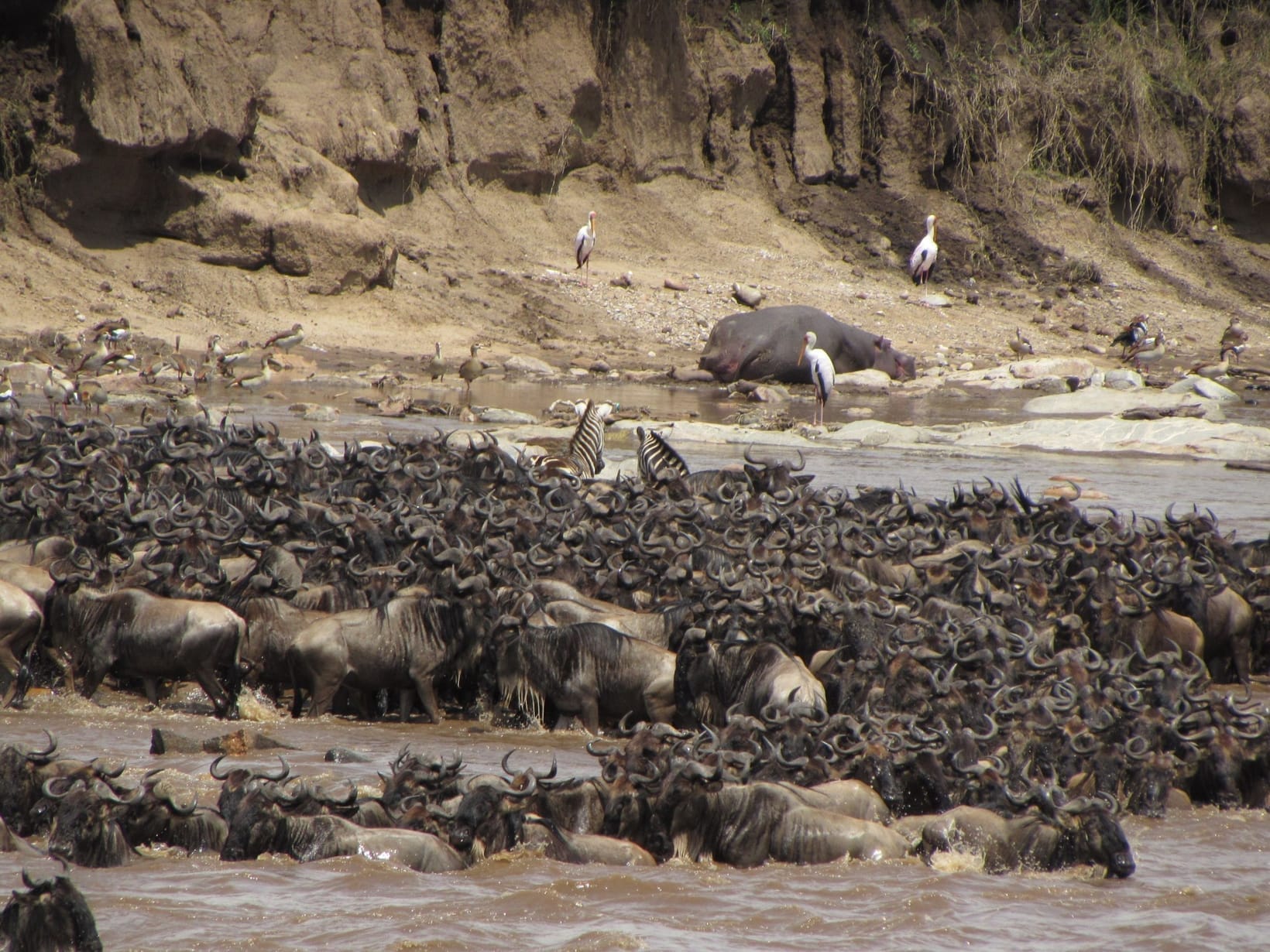
The Mara River crossings are the migration's signature image: herds massing on a bank, hesitating for hours, then pouring down into water holding very large Nile crocodiles.
What the photographs do not convey:
- They are unpredictable. A herd may build at a crossing point for hours and then turn away.
- They are crowded. Inside the National Reserve there is no cap on vehicles, and a good crossing draws a great many.
- They happen repeatedly. Herds cross north, then back south, sometimes several times in a season.
- They are brutal. Drownings, trampling, and crocodile kills are the normal outcome, not an aberration.
The Grumeti crossings in the western Serengeti around June are the lesser-known alternative — smaller, far less busy, and with the Grumeti's own outsized crocodiles.
Four things people get wrong
“The migration happens in August.” The crossings are around then. The migration is every month.
“It moves as one herd.” It spreads across a vast area in columns and scattered groups. There is no single front.
“You need Kenya for the migration.” The herds spend the majority of the year in Tanzania. Kenya has them for a few months.
“If I book the right dates I'll see a crossing.” Dates improve your odds. Nothing guarantees it.
Planning a trip around it
| You want | Go | Where |
|---|---|---|
| River crossings | Jul–Oct | Maasai Mara / northern Serengeti |
| Calving and predators | Late Jan–Mar | Southern Serengeti / Ndutu |
| Fewest vehicles | Apr–May or Nov | Central Serengeti |
| Best value | Apr–May | Anywhere in the ecosystem |
| Grumeti crossings | Jun | Western Corridor, Serengeti |
| Green season photography | Jan–Mar | Southern plains |
A few practical points. Give the Mara or the Serengeti three to four nights during crossing season, because more days is the only real way to improve your chances. Consider a mobile camp that relocates with the herds rather than a fixed lodge. And if you are combining with gorillas in Uganda or Rwanda, note that the pacing question gets considerably harder across two countries.
For the wildebeest themselves and the predators that follow them, see lion facts and spotted hyena facts. The ecosystem's scale is set out in the Serengeti guide — ~14,750 km² in the Tanzanian park alone.
Tell us your dates and we will tell you where the herds are most likely to be — and whether a different month would serve you better.
The Great Migration: common questions
What is the Great Migration? The year-round movement of around two million wildebeest, zebra and gazelle around the Serengeti–Mara ecosystem, following rainfall and fresh grazing. It is a continuous circuit rather than a single event, so the herds are always somewhere — the question is where, not whether.
When are the Mara River crossings? Roughly July to October, when the herds are in the northern Serengeti and the Maasai Mara. Crossings depend on the rains and shift year to year, and even in season a crossing may happen within minutes or not at all on a given day.
When is the wildebeest calving season? Roughly late January to March, in the southern Serengeti and the Ndutu area of the Ngorongoro Conservation Area, where several hundred thousand calves are born in a matter of weeks. It is the best predator-viewing window of the entire year.
Is the Great Migration better in Kenya or Tanzania? Neither is better; they show you different parts. Tanzania's Serengeti holds the herds for the majority of the year including calving. Kenya's Maasai Mara has them roughly July to October and is where the famous Mara River crossings happen. Your dates should decide the country, not the reverse.
Can you see the migration year-round? Yes — the herds are always somewhere in the ecosystem. What changes is which part of it, and what they are doing. Someone visiting in February sees calving in the south; someone visiting in August may see crossings in the north. There is no month with no migration.
Do the herds move in one big group? No, and this is the commonest misconception. The migration spreads across a huge area in columns and scattered concentrations, not as a single mass moving on a schedule. Some animals move ahead, some lag, and the front can be a long way from the tail.
Sources
- UNESCO World Heritage Centre — Serengeti National ParkAccessed 29 Jul 2026
- UNESCO World Heritage Centre — Ngorongoro Conservation AreaAccessed 29 Jul 2026