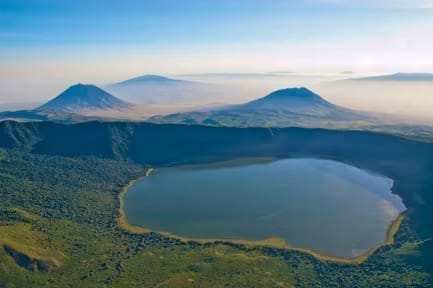
Short answerNgorongoro is the world's largest intact volcanic caldera — a floor of around 260 km² enclosed by walls roughly 600 m high, holding one of the densest concentrations of large mammals on earth. It is among the few places where all of the Big Five are realistically possible in one day, black rhino included. It is also busy.
The first sight of the crater from the rim is one of the genuine set pieces of African travel: a green bowl the better part of twenty kilometres across, with herds visible as scattered dots on the floor below.
What the crater is
A caldera, not an impact crater. A volcano that once stood higher than Kilimanjaro collapsed in on its own emptied magma chamber, leaving a vast bowl with intact walls.
Those walls are the reason for everything that follows. They are steep enough that most of the crater's large mammals never leave, which produces a more or less self-contained ecosystem in a very small area.
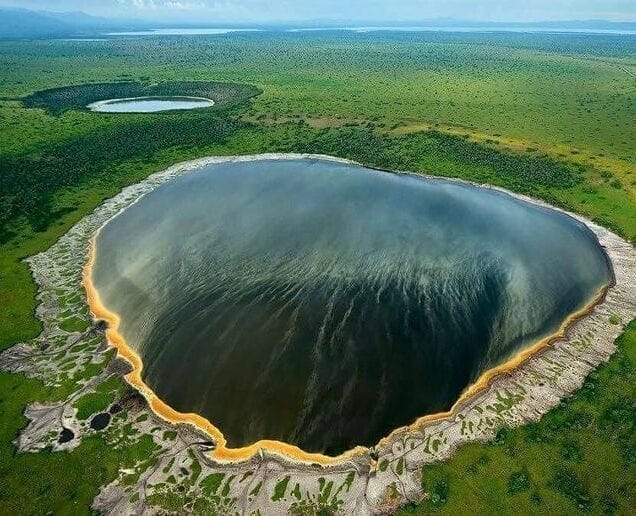 The crater floor from above — roughly 260 km² enclosed by the caldera wall
Why the density is so extraordinary
Permanent water, year-round grazing on the crater floor, and walls that discourage movement in and out. The result is a resident population that does not migrate — so unlike the Serengeti, Ngorongoro delivers essentially the same viewing in every month of the year.
| Species | Likelihood |
|---|---|
| Lion | Very high — resident prides on the floor |
| Elephant | High — often large old bulls with heavy tusks |
| Buffalo | Very high |
| Black rhino | Good — one of the most reliable places in East Africa |
| Leopard | Low — more likely in the forest on the rim |
| Spotted hyena | Very high, and often out-competing lions here |
| Wildebeest, zebra, gazelle | Abundant, resident, non-migratory |
| Flamingo | Seasonal, on the soda lake at Magadi |
| Golden jackal, serval | Regular on the open floor |
The black rhino
Ngorongoro is one of the few places in East Africa where a black rhino sighting is a realistic expectation rather than a long shot. The population is small, closely monitored and protected, and animals are often visible at distance on the open floor.
Bring binoculars and expect distance — this is rarely a close encounter, and vehicles are kept back. For the comparison with rhino tracking on foot, see our guide to Ziwa Rhino Sanctuary in Uganda, where the experience is completely different.
The honest problem: crowds
The crater floor is small, the wildlife is concentrated, and vehicle numbers are high. A lion sighting in high season can draw a substantial queue of vehicles, and the descent road can back up.
Beyond the crater floor
The Conservation Area is 8,292 km² — the crater is a small fraction of it, and the rest is genuinely worth time.
- Olduvai Gorge. One of the most significant palaeoanthropological sites in the world, on the road towards the Serengeti. A small museum and a genuinely affecting sense of place.
- Empakaai and Olmoti craters. Smaller calderas reached on foot, with almost no visitors — Empakaai holds a soda lake with flamingos.
- Ndutu. In the south of the Conservation Area, and where the wildebeest calving happens around late January to March — see our Great Migration guide.
- Maasai community visits. People live here, which is unusual for a protected area of this status.
The multiple-use arrangement is worth understanding: Ngorongoro was designed for Maasai pastoralists and wildlife to share the landscape, rather than for people to be excluded. It has been the subject of long-running and continuing dispute over grazing rights and residence, which is worth being aware of before a community visit.
Where to stay
| Tier | Properties we book |
|---|---|
| Luxury | Ngorongoro Crater Lodge · Ngorongoro Serena Safari Lodge |
| Mid-range | Ngorongoro Sopa Lodge |
| Budget | Rhino Lodge |
Rim lodges are the ones with the view and the early access; Karatu, down the hill, is cheaper and adds an hour each way. Our lodge versus tented camp guide applies here with one addition — the rim is cold at night, genuinely so, and a fireplace is not decorative.
Planning notes
- Stay on the rim if the budget allows. The early descent is the whole trick.
- One full day on the floor is the standard and is usually enough given permit conditions.
- Pack warm layers. The rim sits high and is cold in the evenings year-round.
- Bring binoculars — the rhino will be distant.
- Stop at Olduvai on the way to the Serengeti.
- Pair it with the Serengeti and Tarangire as the classic northern circuit.
See our northern circuit itineraries, or tell us your dates.
Ngorongoro Crater: common questions
What is the Ngorongoro Crater? The world's largest intact volcanic caldera — the collapsed cone of a volcano that once stood higher than Kilimanjaro. The floor is around 260 km², enclosed by walls roughly 600 m high, and it holds one of the densest concentrations of large mammals anywhere on earth.
Can you see the Big Five in Ngorongoro Crater? Yes, and it is one of the few places where all five are realistically possible in a single day. Lion, elephant and buffalo are readily seen, black rhino are present in small numbers and regularly sighted, and leopard occur — though as everywhere leopard remain the difficult one.
How long do you spend in the Ngorongoro Crater? Typically a half or full day on the crater floor, descending in the morning and coming back up in the afternoon. Time on the floor is limited by permit conditions, so most itineraries treat it as one intensive day rather than a multi-day base.
Is Ngorongoro worth it given the crowds? For most visitors yes, on the strength of the density and the setting — but go in early and be realistic. The crater floor is small and vehicle numbers are high, so a lion sighting can attract a queue. Travellers who prize solitude above all should weight the Serengeti more heavily.
Do people still live in the Ngorongoro Conservation Area? Yes. Unlike a national park, the Conservation Area is a multiple-use zone where Maasai pastoralists live and graze livestock alongside wildlife. It is one of the few protected areas in Africa designed around coexistence rather than exclusion, and the arrangement has been the subject of ongoing dispute.
What is Olduvai Gorge? A site within the Conservation Area that has produced some of the most important hominin fossil discoveries ever made, including work by Mary and Louis Leakey. It sits on the road between Ngorongoro and the Serengeti and makes a genuinely worthwhile stop.
Sources
- UNESCO World Heritage Centre — Ngorongoro Conservation AreaAccessed 29 Jul 2026
- Ngorongoro Conservation Area Authority — Visitor informationAccessed 29 Jul 2026