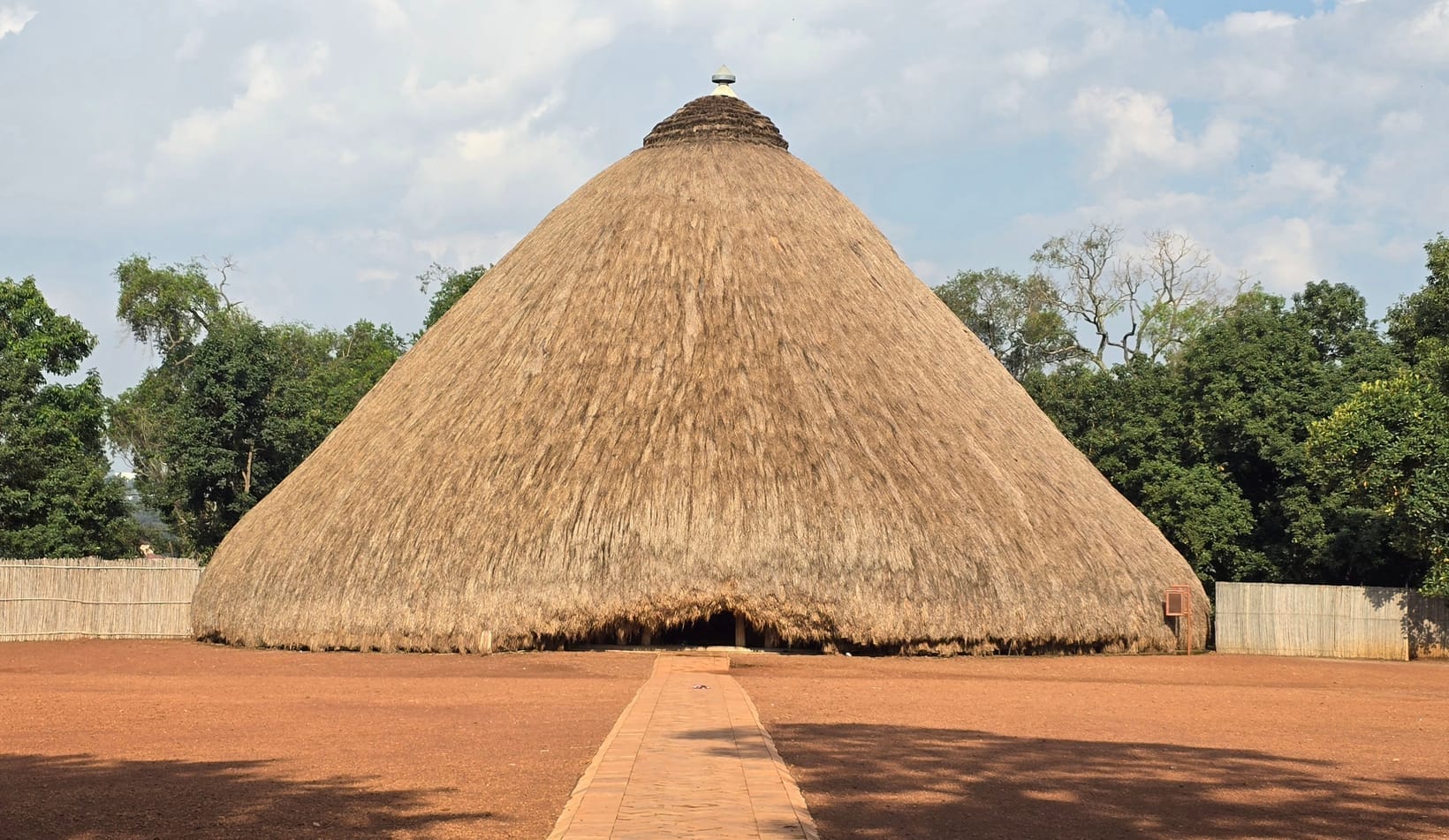
Short answerThe Kasubi Tombs are the royal burial ground of the kabakas of Buganda, on a hill in Kampala, and a UNESCO World Heritage Site. Four kings lie in the Muzibu Azaala Mpanga — one of the largest thatched buildings on earth, its dome rising some 23 metres without a nail in it. Fire destroyed that building in 2010 and the site was shut for roughly fourteen years. It has been rebuilt and is open again, which most travel writing still has not registered.
This is the most important cultural site in Uganda, it sits half an hour from Entebbe airport, and a great many safari itineraries drive straight past it. Here is why it is worth the morning.
What the Kasubi Tombs are
Buganda is the largest of Uganda's traditional kingdoms, centred on Kampala and the northern shore of Lake Victoria, and it long predates Uganda itself. Its king is the kabaka. Kasubi is where the kabakas are buried.
The site was inscribed by UNESCO in 2001 as the Tombs of Buganda Kings at Kasubi. What makes it unusual among World Heritage sites is that it is not a ruin or a museum piece: it remains an active religious and political site of the Buganda kingdom, maintained by hereditary keepers — many of them descendants of the wives and clan officials of the kings buried there — who live on the hill and look after it.
For the wider context of Uganda's kingdoms, see the kingdoms of Uganda.
The four kabakas
| Kabaka | Died | Why they matter |
|---|---|---|
| Mutesa I | 1884 | Built his palace here in 1882 on the hill he renamed Kasubi. It became his burial place, and the site's origin. |
| Mwanga II | 1903 | Mutesa's son. His reign covers the most turbulent period of Buganda's encounter with missionaries and the British. |
| Daudi Chwa II | 1939 | Reigned through the colonial protectorate period, coming to the throne as an infant. |
| Sir Edward Mutesa II | 1969 | The last kabaka before the kingdoms were abolished, and Uganda's first president. Died in exile in London. |
That span — 1884 to 1969 — covers Buganda's collision with missionaries, the imposition of the British protectorate, independence, and the abolition of the kingdoms in 1967. Four graves, and most of modern Ugandan history. Background in Uganda's history for travellers.
The Muzibu Azaala Mpanga
The main tomb building is the reason architects come here. It is a huge circular structure with a domed thatched roof rising roughly 23 metres — among the largest buildings of organic material anywhere in the world.
There is no metal in it. The frame is timber and reed, lashed with fibre; the roof is thatch laid in vast overlapping rings; the interior is hung with bark cloth, made by beating the inner bark of the mutuba fig — itself on UNESCO's intangible heritage list. Concentric rings of support poles inside represent the clans of Buganda, so the structure is a diagram of the kingdom's social order as well as a roof.
The 2010 fire
On the evening of 16 March 2010, the Muzibu Azaala Mpanga burned down. A building made of timber, reed, thatch and bark cloth burns extremely fast, and very little survived.
The cause has never been established. The loss was felt as a national wound — there were protests in Kampala, and deaths during the unrest that followed. UNESCO placed the site on the List of World Heritage in Danger.
Rebuilt, and open again
Reconstruction took years, because it was done properly. The decision was to rebuild using the original techniques and materials rather than a modern frame with a traditional skin: the same timber, the same lashing, the same thatch, the same bark cloth, with the same clans doing the same work their ancestors did.
The site was closed to visitors for roughly fourteen years. It has since reopened, and UNESCO has removed it from the List of World Heritage in Danger.
Visiting: what to expect
| Detail | |
|---|---|
| Where | Kasubi hill, north-west Kampala |
| From Entebbe airport | Roughly an hour, traffic depending |
| Time needed | 1–2 hours with a guide |
| Status | UNESCO World Heritage Site, inscribed 2001 |
| Guides | On-site guides from the Buganda kingdom — use them |
| Dress | Modest. Women are usually expected to cover their legs; wraps are available at the entrance. |
| Shoes | Removed before entering the main building |
| Photography | Permitted in most areas, restricted in others — ask |
It pairs naturally with the rest of a Kampala day — the Uganda Museum, the Gaddafi Mosque, Owino market. See our Kampala city guide.
Getting it right
This is a working spiritual site, not a monument. A few things matter.
- Take the guide. Without one the building is a large thatched hut. With one it is a diagram of a kingdom. The guides are from the kingdom and the fee supports the site.
- Remove your shoes before entering, and follow your guide on where you may and may not stand.
- Do not photograph the tomb area behind the bark-cloth curtain, or the keepers, without explicit permission.
- Dress modestly. Wraps are available at the entrance if you arrive in shorts.
- Keep your voice down. People are at work and at worship. Broader guidance in Ugandan etiquette and customs.
We build Kampala into itineraries at either end rather than treating the capital as an airport transfer. See how our Uganda trips are routed, or ask us to add a cultural day.
Kasubi Tombs: common questions
What are the Kasubi Tombs? The royal burial ground of the kings of Buganda, on a hill in Kampala, and a UNESCO World Heritage Site inscribed in 2001. Four kabakas are buried inside the main building, the Muzibu Azaala Mpanga. It is not a museum — it remains an active spiritual site for the Buganda kingdom, with hereditary keepers in residence.
Are the Kasubi Tombs open to visitors? Yes. The site was closed for roughly fourteen years after a fire destroyed the main tomb building in March 2010. Reconstruction was completed and the site reopened, and it has since been removed from UNESCO's List of World Heritage in Danger. A good deal of travel writing online has not caught up with this.
Which kings are buried at Kasubi? Four kabakas of Buganda: Mutesa I, who died in 1884; his son Mwanga II, who died in 1903; Daudi Chwa II, who died in 1939; and Sir Edward Mutesa II, who died in 1969 and was Uganda's first president. Their tombs sit behind a bark-cloth curtain in the main building.
What happened to the Kasubi Tombs in 2010? On the evening of 16 March 2010 a fire destroyed the Muzibu Azaala Mpanga, the great domed tomb building. Constructed almost entirely from timber, reed, thatch and bark cloth, it burned very fast. The cause has never been established, and the loss provoked national grief and unrest in Kampala.
Why is the Kasubi Tombs building significant architecturally? It is one of the largest thatched buildings anywhere — a vast circular structure with a domed roof rising to roughly 23 metres, built entirely from organic materials with no nails or metal frame. The reconstruction used the same traditional techniques and materials rather than modern substitutes, which is why it took so long.
How long do you need at the Kasubi Tombs? One to two hours with a guide is enough to see the site properly and understand what you are looking at. It sits in Kampala, so it slots easily into a city day at either end of a safari, usually alongside a market visit or the Uganda Museum.
Sources
- UNESCO World Heritage Centre — Tombs of Buganda Kings at KasubiAccessed 29 Jul 2026
- Encyclopaedia Britannica — Tombs of Buganda Kings at KasubiAccessed 29 Jul 2026