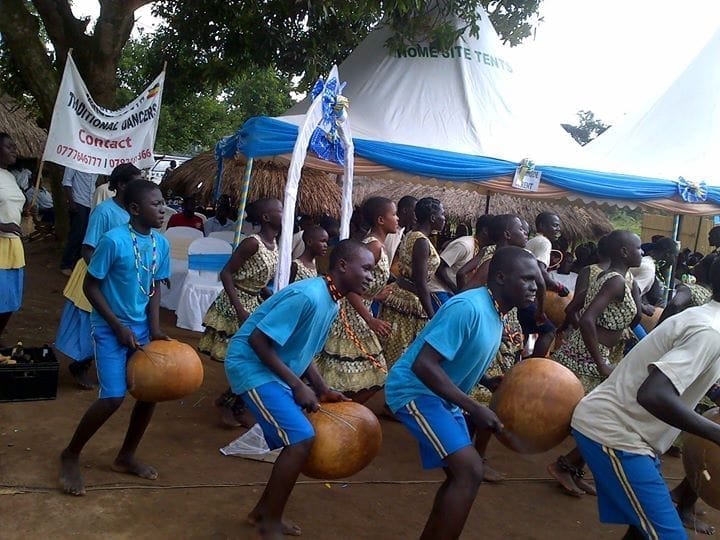
Short answerLarakaraka is the courtship dance of the Acholi of northern Uganda — the dance through which young people chose who to marry. Men form a semi-circle with their legs interlocked, feathers in their hair and calabashes in their left hands; women dance facing them. Then comes the moko, when each woman walks in and pushes her chosen man out of the line. The women do the choosing, in public, and everyone sees it happen.
Most write-ups of Ugandan dance give Larakaraka a single line — “a courtship dance of the Acholi” — and move on. That undersells one of the more remarkable pieces of social choreography in East Africa, so here it is properly.
What Larakaraka is
The Acholi are a Luo people of northern Uganda, spread across Gulu, Kitgum, Pader, Amuru, Omoro, Nwoya, Lamwo and Agago. They have a great many dances. Larakaraka is the one for young people of marriageable age, and it had a job to do: it was how you found a husband or a wife.
The young men dance in a semi-circle, legs interlocked with the men either side of them, singing short repeated songs. They wear ostrich or cockerel feathers on their heads, some wear beads at the neck, and each carries a calabash in his left hand. Locked together like that, nobody can hide. A man who tires, stumbles or falls out of time is visible to every family watching.
That is the point. The dance is an endurance test conducted in public. Stamina, rhythm, agility and the ability to keep going for hours were exactly the qualities an Acholi family wanted in a son-in-law, and Larakaraka displayed all four at once in front of everyone whose opinion mattered.
The women dance facing the line of men, working the lower body — hips and waist — and, in the traditional form, dancing silently. They are not the audience. They are assessing.
The moko — the moment it turns
The dance builds to a stage called the moko, and this is the part worth travelling for.
At the moko, each young woman identifies the man she has chosen, walks up to the semi-circle, and pushes him out of the line. The couple then withdraws from the dancing ground to a quieter spot to talk and get acquainted, before rejoining the dance later.
If she decides in his favour, she gives him something of hers — her beads or a handkerchief. Accepting it means they are courting. The whole community has watched it happen.
Calabashes and bicycle spokes
A complete Larakaraka orchestra is a short list: one big drum, two small drums, calabashes, bicycle spokes, and a fiddle.
The bicycle spokes are not a modern shortcut or a curiosity — they are the signature sound. A calabash gourd is struck with spokes to produce a sharp, metallic, carrying rhythm that travels a long way across open ground. Before the dance begins properly, that sound is the summons: it tells the surrounding villages that a Larakaraka is starting, and people walk toward it.
| Instrument | Role |
|---|---|
| Big drum | Holds the underlying pulse the dancers lock to |
| Two small drums | Carry the faster patterns and the drive |
| Calabash struck with bicycle spokes | The signature sound — sharp, metallic, and audible from a long way off |
| Calabashes held by the dancers | Shaken and patted by the men in the line as they dance |
| Fiddle | Melody line over the percussion |
| Voices | Short repeated songs sung by the men, often teasing or boastful |
Where it sits among Acholi dances
Acholi dance is not one thing. Different dances belong to different people, ages and occasions, and getting them mixed up is the most common error in travel writing about the region.
| Dance | Who performs it | Occasion |
|---|---|---|
| Larakaraka | Young men and women of marriageable age | Courtship; now weddings and celebrations |
| Bwola | Men, in a large circle, with the chief at the centre | The royal dance — performed for the Rwot, and at chiefs' installations |
| Otole | Men, roughly 30–50, with spears and shields | The war dance — historically before raids and confrontations |
| Dingi Dingi | Young girls | Merrymaking. Named for the sound of the small drums that drive it. |
Bwola in particular gets mislabelled as Larakaraka. They are easy to tell apart once you know: Bwola is a great circle of men around a chief, stately and formal; Larakaraka is a semi-circle of interlocked young men facing a line of young women, and it is not stately at all. More on the wider picture in traditional music and dance in Uganda and the tribes and cultures of Uganda.
What the war took, and what came back
You cannot write honestly about Acholi dance without this part.
For roughly two decades from the late 1980s, northern Uganda was the centre of the Lord's Resistance Army insurgency. Close to two million Acholi were displaced into camps. Alongside everything else that was lost, the ordinary machinery of cultural transmission stopped: the evening fire where elders taught — wang oo — the community gatherings, the weddings at which a young person would first see Larakaraka danced and learn it by watching.
A generation grew up in the camps without that. Acholi elders have been blunt about the consequence: children born in displacement did not learn what the dances were for.
Where to actually see it
| Where | What you get | Notes |
|---|---|---|
| Community groups around Gulu | The fullest version, with local musicians and dancers | Arrange ahead. Gulu is the heart of the Acholi sub-region. |
| Community groups around Kitgum | Similar, and fits naturally en route to Kidepo | Quieter and less visited than Gulu |
| Ndere Centre, Kampala | A polished stage version among dances from across Uganda | Excellent and professional, but a stage rather than a dancing ground |
| A wedding or community celebration | The real thing | Happens on its own schedule. You cannot book it — but if you are invited, go. |
Gulu and Kitgum sit on the road to Kidepo Valley National Park, which is the practical reason most travellers end up in the Acholi sub-region at all. That combination — Uganda's remotest and best savanna park, reached through its most culturally distinct region — is a genuinely good trip and one very few operators build.
Watching it properly
A few things that make the difference between a good visit and an awkward one.
- Ask before filming. Always, and accept no as an answer. A group performing for you is not a set.
- Make sure the money reaches the performers. Ask your operator directly how the group is paid and what proportion reaches the dancers and musicians. It is a fair question and the answer tells you a lot.
- Sit through the whole thing. Larakaraka builds. Leaving before the moko is leaving before the point.
- Join in if invited — and only if invited. You will probably be asked. You will certainly be worse at it than everyone else. Do it anyway; refusing reads as disdain.
- Talk to the elders present. The people who can explain what the moko meant when it still meant something are usually standing at the edge, and are generally glad to be asked.
- Do not tip mid-performance. Hand anything to the group leader afterwards, or let your guide handle it.
Broader guidance on this in Ugandan etiquette and customs, and on the northern route in where to stay at Kidepo.
We build northern Uganda trips that treat the Acholi sub-region as a destination rather than a drive-through, and we book cultural groups directly so the fee reaches the people dancing. See how our northern itineraries are routed, or tell us what you want to see.
Larakaraka: common questions
What is the Larakaraka dance? A courtship dance of the Acholi people of northern Uganda, performed by young men and women of marriageable age. The men dance in a semi-circle with their legs interlocked, wearing ostrich or cockerel feathers and carrying calabashes, while the women dance facing them. It is the dance through which Acholi young people traditionally chose a partner.
Which tribe performs Larakaraka? The Acholi, a Luo people of northern Uganda, concentrated in the districts of Gulu, Kitgum, Pader, Amuru, Omoro, Nwoya, Lamwo and Agago. Related Luo communities across the border in South Sudan share elements of the tradition.
What instruments are used in Larakaraka? A full Larakaraka orchestra needs one big drum, two small drums, calabashes, bicycle spokes and a fiddle. The bicycle spokes are the distinctive part — a calabash gourd is struck with them to produce the sharp, carrying rhythm that pulls people to the dancing ground.
What is the moko in Larakaraka? The stage of the dance where the women choose. Until then the young women dance silently facing the men; at the moko each woman identifies the man she prefers and pushes him out of the semi-circle. The couple then withdraws to talk before rejoining the dance. It is the point of the whole performance.
How does a woman accept a man in Larakaraka? By giving him something of hers — traditionally her beads or a handkerchief. Handing it over signals that she has accepted him as a suitor. It is a public, unambiguous gesture, made by the woman rather than the man, which is the detail most visitors find surprising.
Where can tourists see the Larakaraka dance? Most reliably with community cultural groups around Gulu and Kitgum in the Acholi sub-region, arranged in advance. It is also performed at the Ndere Centre in Kampala, which is a good option if you cannot travel north. Genuine performances at weddings and community celebrations happen on their own schedule, not a tourist one.
Is Larakaraka still performed today? Yes, though its social function has largely gone — young Acholi meet partners the way young people everywhere now do. What survives is the dance itself, performed at weddings, cultural festivals and community events, and taught deliberately by cultural groups and schools as part of a broader post-war revival of Acholi identity.
Sources
- Daily Monitor — Larakaraka: Where music meets romance in Acholi cultureAccessed 29 Jul 2026
- Library of Congress — Dance, Manhood and Warfare Amongst the Acholi People of Northern UgandaAccessed 29 Jul 2026
- Wikipedia — LarakarakaAccessed 29 Jul 2026