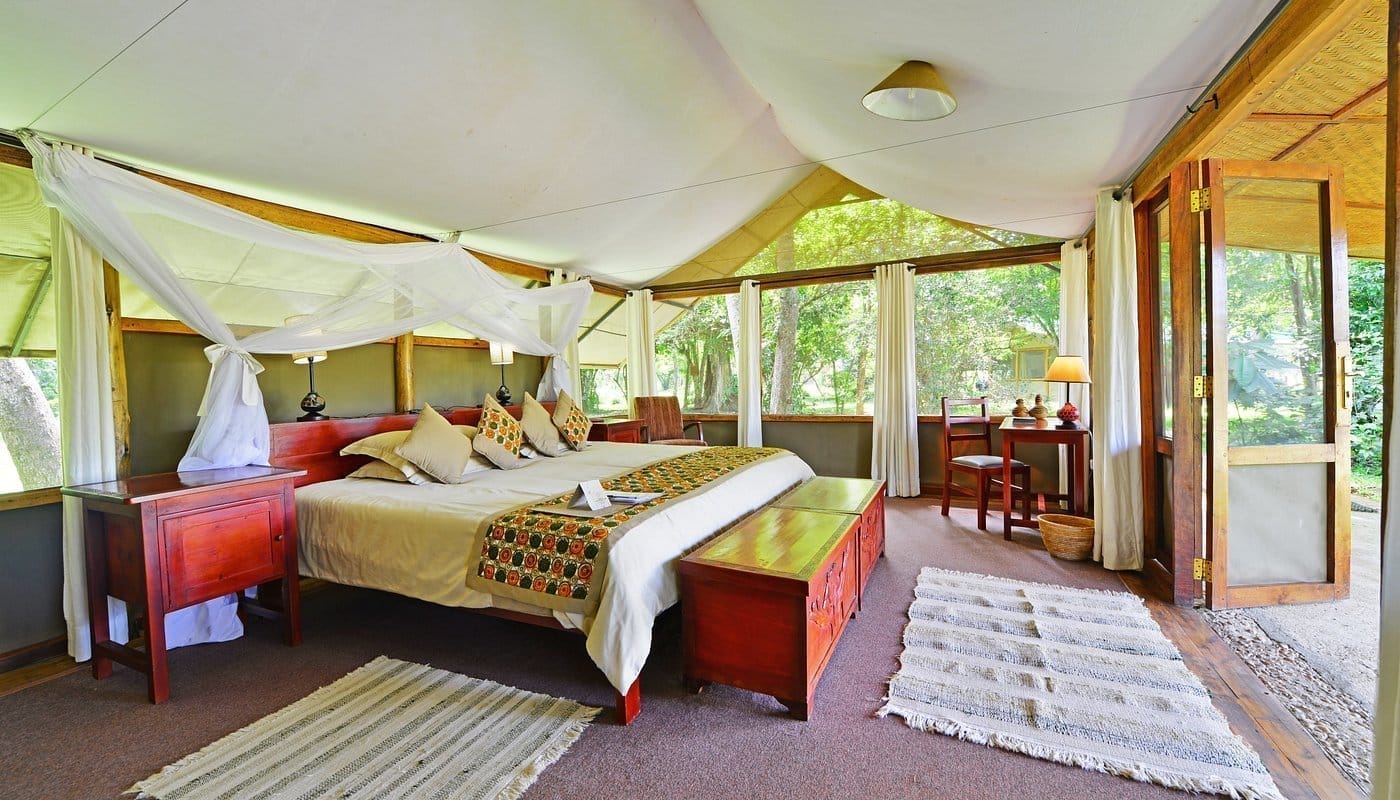
Short answerA lodge has solid walls; a tented camp has canvas ones on a permanent platform. That is the whole difference. Both come with real beds, en-suite bathrooms, electricity and full service at mid-range and above, and tented accommodation spans the entire price range — canvas is a style choice, not a budget one.
Almost every safari quote you receive will include both words, often for nights on the same trip, and almost nobody explains the difference. The assumption most first-time travellers arrive with — that a tent means roughing it and a lodge means comfort — is simply wrong, and it leads people to rule out some of the best places they could stay.
This guide explains what the terms actually mean, where each works, and how the choice plays out across Uganda's parks specifically. For the broader picture of what accommodation exists, see our guide to safari lodges in Uganda.
What the words actually mean
Safari lodge. A permanent building — brick, stone, timber, thatch. Rooms or separate cottages, solid walls and a door that locks. Usually a restaurant, often a pool, and generally a larger property with more rooms.
Tented camp. Canvas walls and roof over a permanent frame, usually on a raised platform or a concrete base. A proper bed, an en-suite bathroom built into the back of the tent, mains or solar power, and a zip rather than a door. Typically smaller — eight or ten tents is common where a lodge might have thirty rooms.
Mobile camp. A genuinely temporary camp that moves with the season, most associated with the Serengeti migration. Rare in Uganda.
Camping / rest camp.Actual camping — small tents, shared ablutions, sometimes your own equipment. This is what people picture when they hear “tent”, and it is a different thing entirely from a tented camp.
Lodge vs tented camp, compared
| Lodge | Tented camp | |
|---|---|---|
| Walls | Solid — brick, stone, timber | Canvas on a permanent frame |
| Bed | Standard bed | Standard bed |
| Bathroom | En-suite | En-suite at mid-range and above |
| Power | Mains or solar, usually all night | Solar with generator, sometimes scheduled hours |
| Sound insulation | Good | None — you hear everything outside |
| Property size | Often 20–40+ rooms | Often 6–12 tents |
| Temperature control | Fans, occasionally air conditioning | Airflow; hot water bottles in the highlands |
| Price range | Budget to luxury | Budget to ultra-luxury |
| Security at night | Lockable door | Zip; escorts provided in unfenced camps |
Four things people get wrong about tents
“It'll be uncomfortable.” At mid-range and above, a tented camp has the same bed, the same hot shower and usually better food than a lodge at the same price. What it does not have is soundproofing.
“It'll be cheaper.” Some of the most expensive accommodation in East Africa is under canvas. Small camps in exceptional positions charge accordingly.
“It's dangerous.” Animals walk through unfenced camps constantly and ignore zipped tents. The camp escorts you after dark because the real hazard is you walking into a buffalo in the dark, not an animal coming in.
“I won't sleep.”Some people genuinely don't, the first night. Hippo grazing a few metres away is loud, and so are hyena. Most people find by the second night that it is the reason they came.
Which one suits you
| If you… | Book |
|---|---|
| Are a light sleeper | Lodge |
| Want the wildlife audible at night | Tented camp |
| Are travelling with young children | Lodge |
| Are travelling with teenagers | Tented camp |
| Want a pool and a big terrace | Lodge |
| Want few other guests and a personal feel | Tented camp |
| Have mobility limitations | Lodge — camps often involve steps, decking and uneven paths |
| Are visiting a hot lowland park | Either; canvas often breathes better |
| Are honeymooning | Tented camp, usually — the small ones are more romantic |
Most itineraries we build mix the two, and that is deliberate: a couple of nights under canvas somewhere quiet, a couple in a lodge with a pool where the days are hot. If you are planning a honeymoon safari or a family trip with kids, the balance shifts, and both of those posts go into it.
How this plays out in Uganda specifically
Uganda skews towards lodges more than Kenya or Tanzania do. The classic East African tented camp is most associated with the Mara and Serengeti; in Uganda the accommodation is more often a permanent lodge or a cottage. Tented camps exist and some are excellent, but they are a smaller share of the market.
The parks where canvas is most worth seeking out are the hot, open ones — Murchison, Queen Elizabeth's Ishasha sector, and Kidepo, where the sense of space is the whole point. In the highland forests around Bwindi the calculation flips: it is cold and wet, and a solid building with a fireplace and a drying room beats canvas after six hours in the rain.
| Tier | Properties we book |
|---|---|
| Luxury | Ishasha Wilderness Camp · Savannah Resort Hotel |
| Mid-range | Ishasha Jungle Lodge · Enjojo Lodge |
| Budget | Ishasha Tree Climbing Lions View Lodge · Bull Bush River Camp |
Questions that settle it
Ask these of any property and the label stops mattering:
- Is the bathroom en-suite, and is the shower hot on demand or heated to a schedule?
- Are there power sockets in the room, and for how many hours a day?
- Is the property fenced? If not, what are the after-dark arrangements?
- How many rooms or tents? Six feels entirely different from forty at the same price.
- How far is it from the park gate or briefing point? The single most under-asked question in safari booking.
- Is there somewhere to dry wet kit? Essential in the forest parks, irrelevant in the savanna ones.
We quote every itinerary at three price points and mix lodges and camps according to the park and the season rather than a house style. Tell us which of the two appealsand we'll build around it.
Lodges and tented camps: common questions
What is the difference between a safari lodge and a tented camp? A lodge is a permanent building with solid walls. A tented camp has canvas walls on a permanent platform or frame — usually with a proper bed, en-suite bathroom, electricity and full service. The difference is the wall material and the degree of separation from the outside, not the level of comfort.
Are tented camps safe with wildlife around? Yes, when you follow the camp's rules. Camps in unfenced areas escort guests to and from their tent after dark, and the rule is simply not to walk around alone at night. Animals move through camps routinely and have no interest in a zipped tent. The genuine risk is walking into a buffalo in the dark, which is why the escort exists.
Are tented camps cheaper than lodges? Not reliably. Tented accommodation spans the whole price range — from basic camping to some of the most expensive properties in East Africa. Canvas is a style choice, not a budget one, and the most exclusive camps often cost more than the lodges near them.
Do tented camps have bathrooms and electricity? At mid-range and above, almost always — en-suite bathroom with a flushing toilet and hot shower, and power from solar with generator backup. At the budget end, facilities may be shared and power limited to certain hours. Ask specifically rather than assuming either way.
Is a tented camp too cold at night? It depends on altitude, not on canvas. Camps in the highland parks get genuinely cold at night and provide hot water bottles and heavy blankets for exactly that reason. Camps in the hot lowland parks like Murchison have the opposite problem, and canvas with good airflow is often more comfortable there than a sealed room.
Which is better for families with children? Lodges, generally, for very young children — solid walls, easier to supervise, often interconnecting rooms and a pool. Tented camps come into their own with older children and teenagers, who tend to find them far more exciting than a hotel room.
Sources
- Uganda Wildlife Authority — Accommodation and facilities in Uganda's national parksAccessed 28 Jul 2026