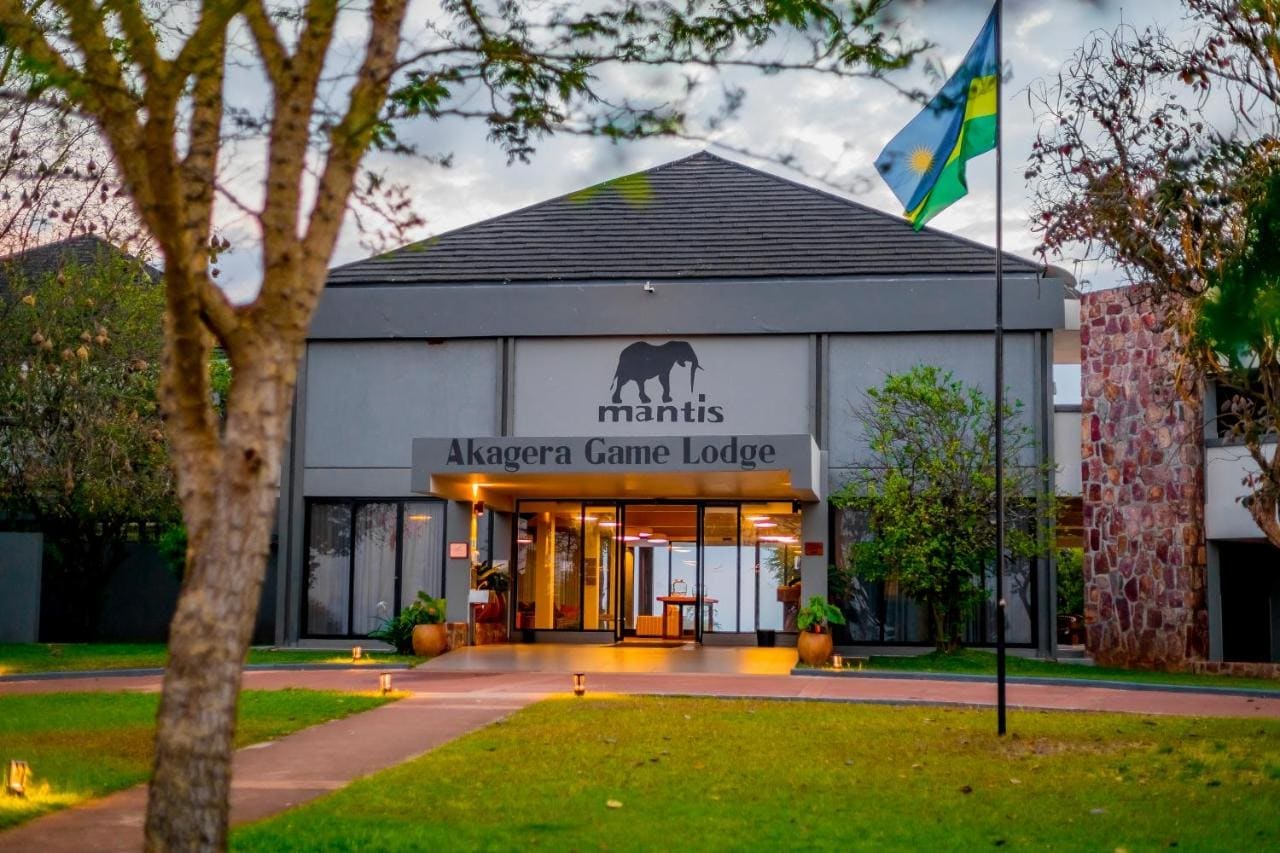
Short answerStay in the north of Akagera if wildlife is the priority — the northern plains hold the densest game and the reintroduced lion and rhino. The south, around Lake Ihema, suits shorter stays and late arrivals from Kigali. Akagera is Rwanda's only Big Five park and the natural savanna counterweight to a gorilla trek.
Akagera occupies Rwanda's eastern border with Tanzania — a mosaic of savanna, papyrus swamp and a chain of lakes along the Kagera river. It is the country's only savanna park and, for anyone whose Rwanda trip is otherwise entirely about primates, the thing that turns it into a rounded safari.
The accommodation list is short, and the choice comes down to one geographic decision. This guide covers that, plus how the park fits alongside gorilla trekking at Volcanoes.
The park that was rebuilt
Akagera lost roughly two-thirds of its area in the late 1990s and most of its large mammals with it. Lions were gone entirely. Under a joint management partnership from 2010 the park was fenced, poaching was brought under control, and lions were reintroduced in 2015 followed by eastern black rhino in 2017.
This matters when you decide what to expect. Akagera is not the Mara. The herds are smaller and the density is lower. What it offers instead is a genuinely interesting conservation story and a functioning Big Five park two hours from a capital city, which almost nowhere else can claim.
North or south — the real decision
| North | South (Lake Ihema) | |
|---|---|---|
| Game density | Highest — the open plains | Good, lake-focused |
| Lion and rhino | Main range | Less reliable |
| Boat trips | Further | Lake Ihema boat trips on the doorstep |
| Drive from Kigali | Longer — through the park | Shorter |
| Accommodation | The high-end camp | The established lodge and budget option |
| Crowds | Very quiet | Busier |
Where to stay at Akagera
| Tier | Properties we book |
|---|---|
| Luxury | Akagera Game Lodge · Magashi Camp |
| Mid-range | Ruzizi Tented Lodge |
| Budget | Akagera Rhino Lodge |
The list is genuinely this short. There is one high-end camp, one long-established lodge, a tented option, and a budget property — which makes availability the practical constraint in peak season, much as it is at Kidepo in Uganda.
What the tiers get you
| Tier | What you get | Suits |
|---|---|---|
| Luxury | Small camp in the north, in the best game area, full service and private guiding | Travellers giving Akagera two or three nights and wanting the wildlife |
| Mid-range | Comfortable tented accommodation on the lakes, reliable and well run | Most two-night visits |
| Budget | Simple rooms, functional, close to the southern gate | Short stops and self-drive travellers |
Combining Akagera with gorillas
This is how most people visit. A Rwanda trip built purely around a gorilla permit is short and expensive per day; adding Akagera gives it shape — forest and volcano at one end of the country, savanna and lakes at the other, with Kigali in the middle.
The usual sequence runs Kigali, Volcanoes for the trek, back through Kigali, then east to Akagera — or the reverse. Some itineraries add Lake Kivu on the western side, which makes for a fuller loop. Our comparison of Uganda and Rwanda for gorilla trekking covers how the two countries differ if you are still deciding.
How many nights
- One night — enough for an afternoon and a morning game drive in the south, or a boat trip on Lake Ihema. Thin, but it works as an add-on.
- Two nights — the sensible minimum. A full day lets you cover ground properly.
- Three nights — worth it if you are staying north and want a real chance at lion and rhino.
How to choose
- North for wildlife, south for convenience. Decide this before you look at properties.
- Don't day-trip the north from the south.
- Book early — there are only a handful of properties.
- Give it two nights minimum if you want more than a boat trip.
- Pack for heat, even if the rest of your Rwanda trip is cold.
For how Akagera fits alongside Rwanda's other two parks, see Rwanda's National Parks: The Complete Guide.
We run Akagera as part of combined Rwanda itineraries alongside Volcanoes and Lake Kivu. See how those are routed, or tell us how many days you have.
Akagera accommodation: common questions
Where should you stay in Akagera National Park? The north of the park if wildlife is the priority — the northern plains hold the highest concentrations and the reintroduced lions and rhino range there. The south, around Lake Ihema, is where the older established lodge sits and suits shorter stays and travellers arriving late from Kigali.
Can you see the Big Five at Akagera? Yes. Lions were reintroduced in 2015 and eastern black rhino in 2017, joining resident elephant, buffalo and leopard, making Akagera Rwanda's only Big Five destination. Leopard remain difficult to see, as everywhere.
How far is Akagera from Kigali? It is the closest national park to Kigali and comfortably reachable in a couple of hours on sealed road for most of the way, which is what makes a two-night Akagera extension realistic on even a short Rwanda trip.
Is Akagera worth visiting if I've been on safari elsewhere in East Africa? For its own sake, Akagera is a good rather than exceptional savanna park — the herds are smaller than the Mara or Serengeti. What makes it worth a visit is the story: it lost most of its large mammals and much of its area, and has been rebuilt into a functioning Big Five park within a generation. As a contrast to gorilla trekking on the same trip, it works very well.
Do you need a 4x4 for Akagera? For the northern plains and in the wet season, yes. The main southern tracks around Lake Ihema are manageable in a two-wheel-drive vehicle in dry conditions, but a 4x4 gives you the whole park in all weather and is what any guided trip will use.
Sources
- Rwanda Development Board — Akagera National Park — park informationAccessed 28 Jul 2026