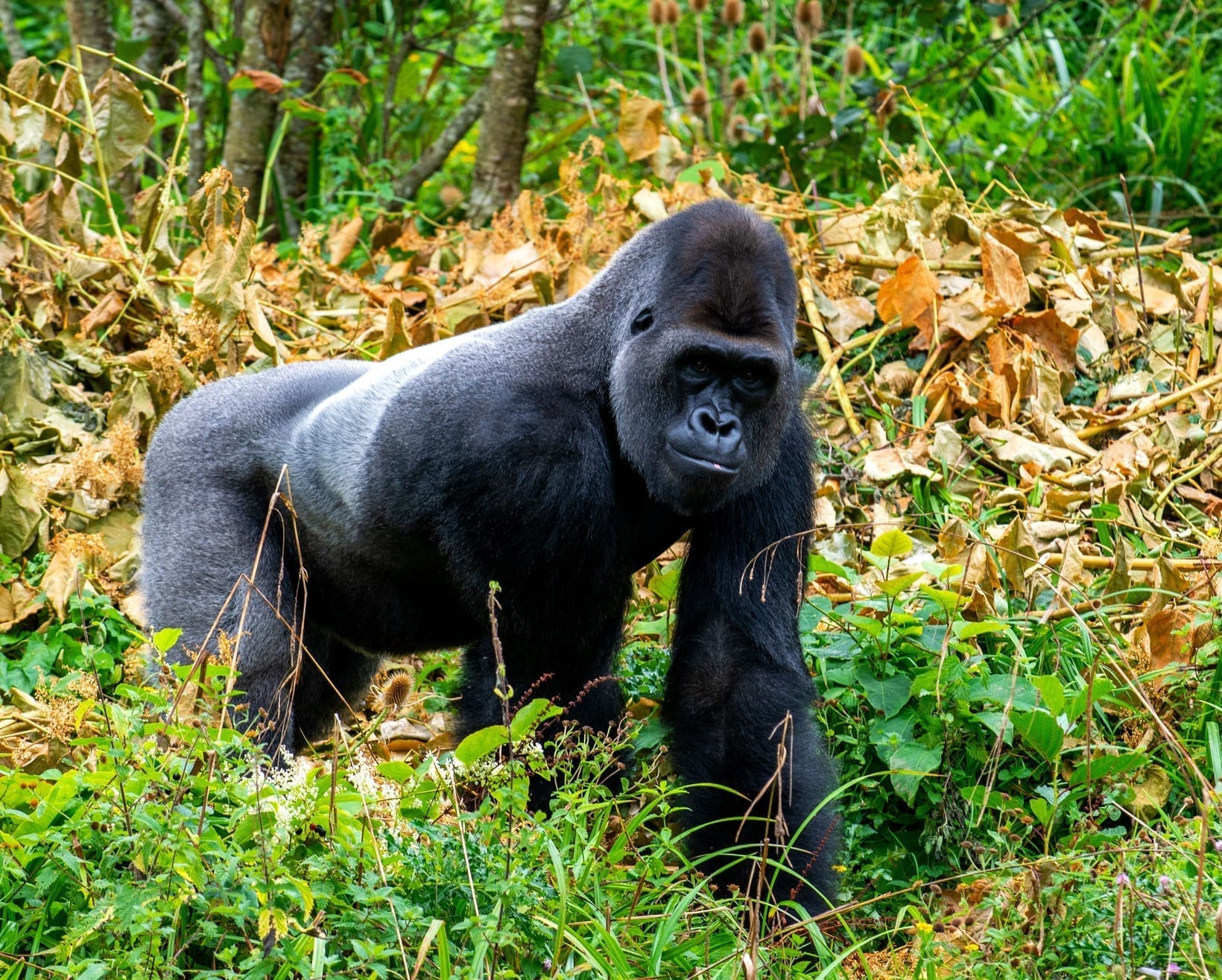
Short answerVolcanoes National Park is Rwanda's share of the Virunga Massif — five volcanoes, bamboo and montane forest, and the gorilla families Dian Fossey studied. Most visitors come for one hour with gorillas and leave. The park also offers golden monkey trekking, the hike to Fossey's grave, and volcano climbs that almost nobody does.
This is the most famous gorilla park in the world, and the one where modern gorilla conservation effectively began. It is also small, intensely managed, and organised around a single morning ritual at Kinigi that most visitors experience once and never return to.
This guide covers the park itself. For accommodation, see where to stay for gorilla trekking in Rwanda; for the wider country, planning a trip to Rwanda.
The park and the massif
The Virunga Massif is a chain of eight volcanoes straddling Rwanda, Uganda and DR Congo. Rwanda's Volcanoes National Park covers five of them; Uganda's Mgahinga covers three of the same peaks from the other side, and DR Congo's Virunga National Park holds the rest.
The gorillas do not recognise the borders. Families range across the massif, which is why Mgahinga's single habituated group sometimes walks into Rwanda and why the three countries coordinate on census work. The population picture is covered in how many mountain gorillas are left.
Everything you can do here
| Activity | Effort | Roughly how long |
|---|---|---|
| Gorilla trekking | Demanding — steep, muddy, at altitude | Half to full day |
| Golden monkey trekking | Moderate — shorter and lower | Half day |
| Dian Fossey grave hike | Moderate uphill | Around 3–4 hours |
| Bisoke crater lake | Hard — steep and very muddy | Around 6 hours return |
| Muhabura summit | Hard — long and steep | Full day |
| Karisimbi summit | Very hard — overnight camp at altitude | Two days |
| Musanze caves | Easy | 1–2 hours |
| Village and cultural visits | Easy | Half day |
Dian Fossey, Karisoke and the grave hike
Dian Fossey established the Karisoke Research Center in 1967 in the saddle between Karisimbi and Bisoke — the name combines the two — and worked there until her murder in 1985. Her research transformed what was known about mountain gorillas, and her campaigning against poaching made her enemies.
The original camp no longer stands, but the site can be visited on a guided hike. Fossey is buried there, in the gorilla graveyard she established, beside Digit — the young silverback whose killing in 1977 prompted her most public campaigning.
It is a moderate uphill walk of a few hours, generally much quieter than a gorilla trek, and for anyone who has read Gorillas in the Mist it is the more affecting of the two experiences.
Climbing the volcanoes
Barely any gorilla visitors do this, which is a shame — these are genuinely good mountains.
- Bisoke — the popular one. A steep, muddy day hike to a crater lake at around 3,711 m. Around six hours return, and the mud is the defining feature rather than the gradient.
- Muhabura — a long, relentless day up a classic cone, with views across the massif and into Uganda from the top.
- Karisimbi — the highest at 4,507 m, and a two-day ascent with a cold overnight camp. Serious, and a real mountain undertaking.
- Sabyinyo and Gahinga — climbable from either the Rwandan or Ugandan side.
Golden monkeys
Golden monkeys are a bright orange-and-gold subspecies of blue monkey found only in the Virunga volcanoes, and they are endangered. A permit costs $100 — a fraction of a gorilla permit — and the trek is shorter, lower and much easier.
They are also the opposite of gorillas as a viewing experience: fast, constantly moving, leaping through bamboo. Photographers find them considerably harder. Our golden monkey facts post covers the animal itself.
Kwita Izina, the naming ceremony
Each year Rwanda names the infant gorillas born in the preceding twelve months at a public ceremony near the park. Kwita Izina draws conservationists, government figures and international guests, and it has become a genuine national occasion rather than a tourism event.
Practically: accommodation around Musanze fills around the ceremony and rates rise. If your dates fall near it, book early — or, if you want to attend, plan around it deliberately.
Planning notes
- Secure the permit first. Everything else follows — see how to book gorilla permits.
- Give the park two days, not one. The single biggest improvement you can make to a Rwanda trip.
- Sleep near Kinigi, not Kigali.
- Trek before you hike. Not the other way round.
- Bring cold-weather layers. This is high, wet country, and evenings are cold year-round.
- Check your dates against Kwita Izina and against Umuganda, the last Saturday of each month.
For the rules that apply on the trek itself, see gorilla trekking rules and etiquette.
For how Volcanoes fits alongside Rwanda's other two parks, see Rwanda's National Parks: The Complete Guide.
We build Volcanoes into standalone Rwanda trips and into combined Uganda–Rwanda routes. See our gorilla trekking trips or tell us your dates.
Volcanoes National Park: common questions
What is there to do at Volcanoes National Park besides gorilla trekking? Golden monkey trekking, the hike to Dian Fossey's grave at the old Karisoke research site, day climbs of Bisoke to its crater lake or Muhabura, the multi-day Karisimbi ascent, the Musanze caves, and cultural experiences in the villages around the park. Most visitors do only the gorillas and leave, which is a missed opportunity if you have an extra day.
Can you visit Dian Fossey's grave? Yes. A guided hike leads to the site of the old Karisoke Research Center between Karisimbi and Bisoke, where Dian Fossey is buried alongside gorillas including Digit. It takes a few hours, is a moderate uphill walk, and is far quieter than a gorilla trek.
How hard is the Bisoke crater lake hike? It is a steep, muddy day hike to around 3,711 m, typically six hours return, with a crater lake at the summit. Steepness and mud rather than technical difficulty are the challenge — it is comparable in effort to a demanding gorilla trek and often harder underfoot.
What is Kwita Izina? Rwanda's annual gorilla naming ceremony, held near Volcanoes National Park, at which the year's infant gorillas are given names. It is a significant national event drawing conservationists and dignitaries, and accommodation around Musanze books out around it.
Are golden monkeys worth trekking at Volcanoes? Yes, particularly as a second activity. Golden monkeys are an endangered subspecies found only in the Virungas, the trek is far shorter and easier than a gorilla trek, the permit costs a fraction as much, and the animals are fast and acrobatic in a way gorillas are not.
How high are the volcanoes in Volcanoes National Park? Karisimbi is the highest at 4,507 m, followed by Muhabura, Bisoke at around 3,711 m, Sabyinyo and Gahinga. Karisimbi is a two-day ascent with an overnight camp; Bisoke and Muhabura are day hikes.
Sources
- Rwanda Development Board — Volcanoes National Park — activities and permitsAccessed 28 Jul 2026
- Dian Fossey Gorilla Fund — Karisoke Research CenterAccessed 28 Jul 2026