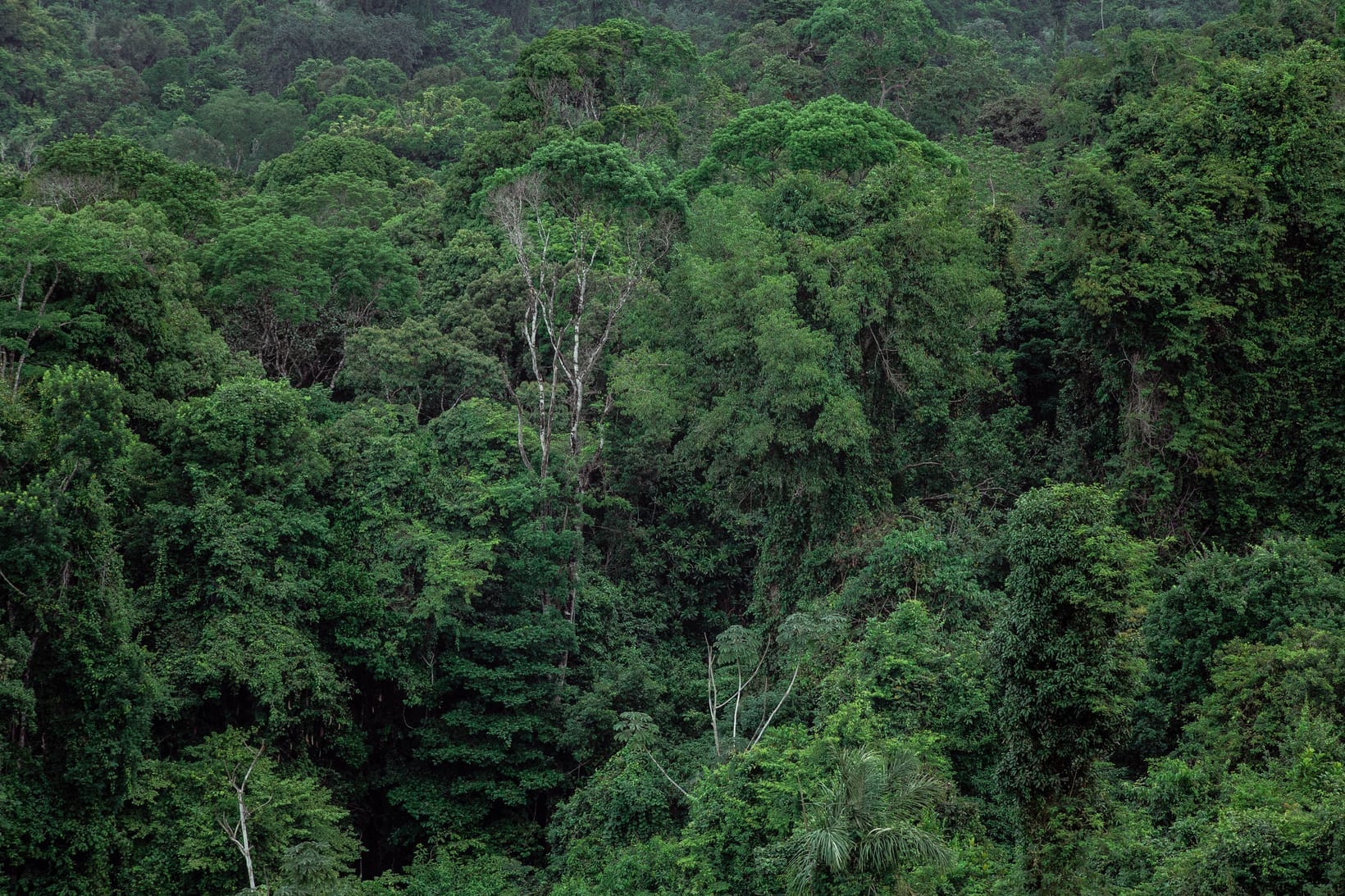
Short answerNyungwe is one of the largest surviving montane rainforests in Africa, a UNESCO World Heritage Site since 2023, holding 13 primate species including chimpanzees and enormous Angolan colobus troops. Its canopy walkway — around 160 m long and 70 m up — is the only one of its kind in East Africa. It sits in Rwanda's far south-west, a full day from Kigali.
Rwanda is known for gorillas, which means Nyungwe is routinely left off itineraries by travellers who have six days and spend them all in the north. That is a defensible choice on a short trip and a real loss on a longer one, because Nyungwe is a genuinely great forest.
One of Africa's great remaining rainforests
Nyungwe covers roughly a thousand square kilometres of unbroken montane rainforest along the Nile–Congo watershed. It survived the deforestation that removed most comparable forest across the region, and it now represents one of the largest intact blocks of its kind left in Africa — which is what the 2023 UNESCO inscription recognised.
Practically, that means walking under closed canopy for hours with tree ferns and epiphytes and constant birdsong, on trails that stay muddy and steep. It is a very different forest from Bwindi and from Kibale — older feeling, wetter, and considerably quieter in terms of other people.
The canopy walkway
The walkway is Nyungwe's signature. A suspension bridge strung between towers, roughly 160 metres long and around 70 metres above the forest floor, reached along the Igishigishigi trail.
What it gives you is a perspective that ground-level forest walking never does — you are level with the canopy where the birds and most of the primates actually spend their time, looking across the top of the forest rather than up into it.
Chimpanzee tracking
Nyungwe holds chimpanzees in two main areas — the Cyamudongo forest fragment and the main forest block. Tracking starts very early and the walking is steep and often slippery.
Being straightforward about it: Nyungwe chimpanzee tracking is harder and less certain than chimpanzee trekking in Kibale. Density is lower, the terrain is steeper, and the chimps move fast through difficult ground. Sightings happen regularly but are less dependable, and they are often brief and high in the canopy.
The colobus superclusters
This is what Nyungwe genuinely does better than anywhere. Angolan colobus here form troops that are among the largest recorded anywhere in Africa — hundreds of animals moving through the canopy together, which is a spectacle of a completely different order from a handful of monkeys in a tree.
Colobus trekking is easier than chimpanzee tracking and far more reliable. For most visitors it ends up being the better of the two primate activities, and it is under-sold almost everywhere. Our post on black-and-white colobus covers the animal.
Birding
Nyungwe is one of the best birding sites in the Albertine Rift, with a long list of endemics including Rwenzori turaco, red-collared babbler and handsome francolin. The main road through the forest is itself productive birding, which is unusual and convenient.
For birders building a wider regional trip, Nyungwe pairs naturally with Semulikiand Bwindi's Ruhija sector — see Bwindi's sectors.
Nyungwe or Kibale for primates?
| Nyungwe (Rwanda) | Kibale (Uganda) | |
|---|---|---|
| Primate species | 13 | 13 |
| Chimpanzee density | Lower | Highest in Africa |
| Chimp sighting reliability | Good but variable | High |
| Terrain | Steep, slippery | Mostly flat |
| Canopy walkway | Yes — the only one in East Africa | No |
| Colobus troops | Exceptional — among the largest anywhere | Present, ordinary sizes |
| Birding | Outstanding Albertine Rift endemics | Very good |
| Other visitors | Very few | Considerably more |
| Habituation experience | No | Yes — full day with researchers |
Getting there and planning
Nyungwe is in the far south-west, and the drive from Kigali takes most of a day. Most itineraries break it at Lake Kivu, which sits between Kigali and the forest and makes the journey a pleasure rather than a slog.
- Two nights minimum. One full day for chimps in the morning and the canopy walk in the afternoon.
- Three nights to add colobus trekking and a longer trail.
- Route it via Kivu in at least one direction.
- Expect rain. This is rainforest at altitude — waterproofs and boots with grip, not trainers.
- Book chimpanzee tracking in advance — group sizes are capped.
Nyungwe is the piece of Rwanda that rewards a longer trip, and the reason we push seven days rather than five when clients ask what is worth adding. See planning a trip to Rwanda for the wider shape, how it compares against Volcanoes and Akagera, or tell us how long you have.
Nyungwe: common questions
What is Nyungwe National Park known for? Montane rainforest, primates and its canopy walkway. Nyungwe holds 13 primate species including chimpanzees and exceptionally large troops of Angolan colobus, and it was inscribed as a UNESCO World Heritage Site in 2023. The suspended canopy walkway, around 70 m above the forest floor, is the signature attraction.
Is the Nyungwe canopy walk worth doing? Yes — it is the only canopy walkway of its kind in East Africa and the perspective on the forest is genuinely different from ground level. It takes a couple of hours including the approach trail. If you have a serious fear of heights, it is a suspended bridge that moves, so consider carefully.
How does chimpanzee trekking in Nyungwe compare with Kibale? Kibale in Uganda has higher chimpanzee density and a better success rate, and its terrain is gentler. Nyungwe is harder walking on steeper ground with lower certainty, but it comes with the canopy walkway, huge colobus troops and a far quieter forest. If chimpanzees are the priority, Kibale. If the forest as a whole is, Nyungwe.
How many primate species are in Nyungwe? Thirteen, including chimpanzees, Angolan colobus, L'Hoest's monkey, grey-cheeked mangabey and golden monkeys. The Angolan colobus troops here are among the largest recorded anywhere, sometimes numbering several hundred animals moving together.
How far is Nyungwe from Kigali? It is in Rwanda's far south-west and the drive from Kigali takes most of a day, usually broken at Lake Kivu or Huye. This is the main reason Nyungwe gets skipped on short Rwanda trips — it is the one part of the country that is not close to everything else.
How many days do you need at Nyungwe? Two nights minimum, giving one full day for chimpanzee tracking in the morning and the canopy walk in the afternoon. Three nights lets you add a colobus trek and one of the longer forest trails without compressing anything.
Sources
- UNESCO World Heritage Centre — Nyungwe National ParkAccessed 28 Jul 2026
- Rwanda Development Board — Nyungwe National Park — activities and permitsAccessed 28 Jul 2026