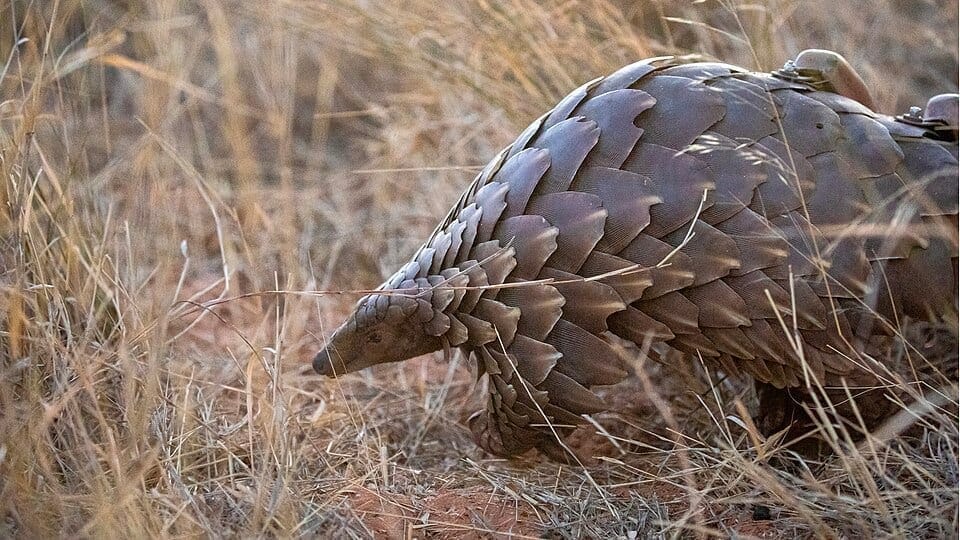
Short answerThe pangolin is the only mammal on earth covered in keratin scales. It has no teeth, eats ants and termites with a tongue that can be longer than its body, and rolls into an armoured ball when threatened — a defence that works against lions and makes it trivially easy for humans to collect. It is the most trafficked mammal in the world.
Almost nobody sees a pangolin. Guides who have worked Ugandan parks for twenty years count their sightings on one hand. It is on this site anyway, because it is one of the most extraordinary animals in Africa and because what is happening to it deserves saying.
What a pangolin actually is
A pangolin is a mammal, roughly the size of a large cat, entirely covered on its back, sides and tail in overlapping scales made of keratin — the same protein as your fingernails. Nothing else among the mammals has this.
It walks on its hind legs much of the time, tail out for balance, forelimbs curled inward to protect the long claws it uses for digging. It is nocturnal, solitary, largely silent, and extremely secretive.
| Detail | |
|---|---|
| Order | Pholidota — its own order, with no close living relatives |
| Species | Eight worldwide — four African, four Asian |
| Covering | Overlapping keratin scales, the only mammal with them |
| Teeth | None |
| Diet | Ants and termites, taken with a very long sticky tongue |
| Activity | Nocturnal |
| Defence | Rolls into a ball |
| Conservation | All eight species threatened; CITES Appendix I |
 Overlapping scales and no armour plates — the giveaway that this is a pangolin, not an armadillo
The scales, and the defence that fails
The scales are formidable. A threatened pangolin curls into a tight ball with its head tucked under its tail, presenting nothing but overlapping armour with sharp edges. A lion can roll it around and get nowhere; the defence is genuinely effective against everything with paws and teeth.
A mammal with no teeth
Pangolins have no teeth at all. They tear open ant nests and termite mounds with heavy front claws, then extract the insects with a tongue that in the larger species can be longer than the animal's head and body combined — anchored not in the mouth but near the pelvis.
The insects are ground up in a muscular stomach containing small stones the pangolin swallows deliberately, functioning much like a bird's gizzard. A single pangolin can eat many thousands of insects in a night, which makes it a significant controller of termite populations.
The most trafficked mammal on earth
Pangolin scales are used in some traditional medicine systems, and the meat is treated as a luxury in parts of Asia. Demand has driven poaching on an industrial scale, and enforcement agencies have repeatedly seized single shipments of scales representing tens of thousands of animals.
Asian pangolin populations were depleted first. Trafficking then shifted to Africa, which is why African species — including those in Uganda — are now under pressure they were not under a generation ago.
All eight species are listed on CITES Appendix I, prohibiting international commercial trade. The trade continues regardless.
Pangolins in Uganda
Uganda holds several African pangolin species. The giant pangolin — the largest in the world — occurs in forest and savanna mosaic, and the white-bellied or tree pangolin is arboreal and occurs in forested areas. Ground pangolins are present in drier savanna country.
They are recorded across a number of Ugandan parks, but records are exactly that — camera-trap images, tracks, and the occasional night sighting rather than reliable viewing.
Your realistic chances of seeing one
Low. Genuinely low. The honest framing:
- Night drives in the parks that permit them are the only realistic opportunity — see walking and night safaris in Uganda.
- It is luck, not skill. No guide can find you a pangolin the way they can find you a lion.
- Do not build an itinerary around it. Anyone selling a pangolin-focused trip is selling you something they cannot deliver.
- Treat it as the lottery ticket that comes with every night drive you take.
If nocturnal wildlife interests you generally, the night drive delivers plenty that is genuinely findable — bushbabies, genets, civets, porcupine — and our guide to Uganda's primates covers the nocturnal ones.
For the rest of Africa's under-appreciated animals, see African wild dog facts and spotted hyena facts.
Ask us about night drives if the nocturnal side of the bush appeals — it is the part of a safari most itineraries leave out entirely.
Pangolins: common questions
What is a pangolin? A nocturnal, insect-eating mammal covered in overlapping keratin scales — the only mammal in the world with them. Pangolins have no teeth, eat ants and termites with an extremely long sticky tongue, and roll into an armoured ball when threatened.
Why are pangolins the most trafficked mammal in the world? Their scales are used in some traditional medicine systems and their meat is treated as a luxury in parts of Asia, which has driven industrial-scale poaching. All eight pangolin species are threatened, and enormous seizures of scales representing tens of thousands of animals have been made repeatedly.
Are there pangolins in Uganda? Yes — Uganda holds several African pangolin species, including the giant pangolin and the white-bellied (tree) pangolin. They are present in a number of parks and forests but are strictly nocturnal, secretive and very rarely seen by visitors.
Can you see a pangolin on safari? Realistically, no — not as something you plan for. Experienced guides can go years without a sighting. The only meaningful chance is on a night drive in a park that permits them, and even then it is luck rather than skill.
Do pangolins have any predators? Lions and leopards will investigate them, and the rolled defence works well against most predators — a curled pangolin is essentially an armoured ball. It works far less well against humans, which is the central tragedy of the species: the defence that saves it from lions makes it trivially easy to pick up.
Are pangolins related to armadillos? No. The resemblance is convergent evolution — both evolved armour and an insect diet independently. Pangolins are more closely related to carnivores such as cats and dogs than to armadillos, which are South American and belong to an entirely different lineage.
Sources
- International Union for Conservation of Nature — Pangolin Specialist Group — species assessmentsAccessed 28 Jul 2026
- CITES — Pangolins — Appendix I listingAccessed 28 Jul 2026