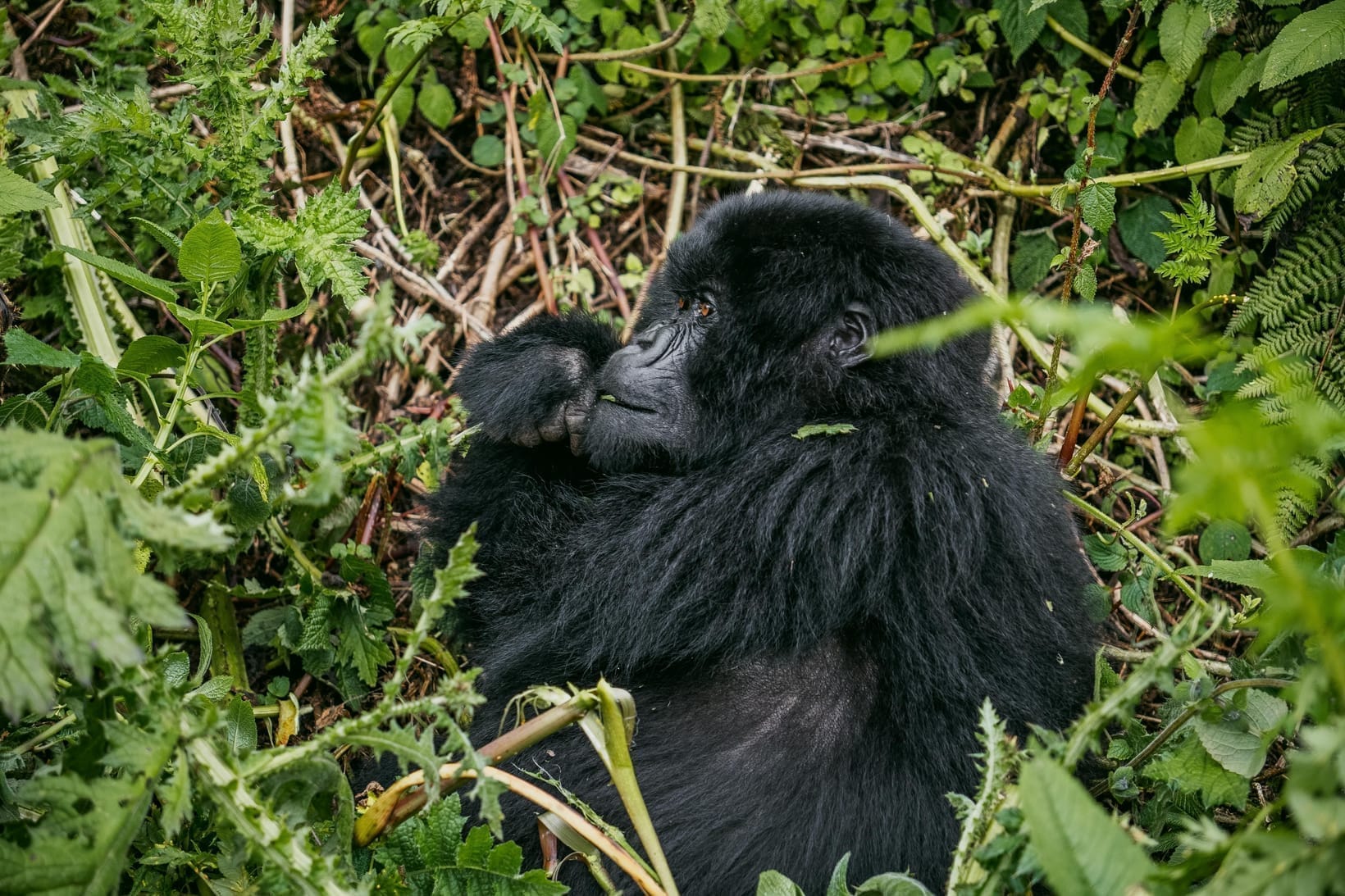
Short answerNo. “Silverback” is a life stage, not a species — it means an adult male gorilla, of any subspecies, who has grown the saddle of silver-grey hair across his back and hips at around 12 to 15 years old. There is no such animal as a silverback gorilla in the way there is a mountain gorilla or a western lowland gorilla. Every silverback is one of those; he has simply grown up.
The word gets used as though it named an animal — bigger, rarer and more formidable than an ordinary gorilla. It does not. It is closer in kind to “stallion” than to “zebra”: a description of sex and age, applied to an animal that already has a species name.
No — it's a life stage
As a male gorilla reaches full maturity, the black hair across his back, shoulders and hips is replaced by a distinct silver-grey saddle. The change is gradual, takes place between roughly 12 and 15 years of age, and arrives alongside the rest of adult male development: a pronounced bony crest on top of the skull anchoring enormous jaw muscles, a broad chest, and roughly double the mass of an adult female.
So a silverback is simply a fully grown male. He may be dominant or subordinate, leading a family of thirty or living entirely alone.
The stages a male passes through
| Stage | Age | What defines it |
|---|---|---|
| Infant | 0–3 years | Carried, then riding on the mother's back. Entirely dependent. |
| Juvenile | 3–6 years | Independent, playing constantly, still close to the mother. |
| Sub-adult | 6–8 years | Growing fast, socially peripheral within the group. |
| Blackback | 8–12 years | Sexually mature male, still black-haired. Often a son of the dominant male. |
| Silverback | 12+ years | Full maturity. The silver saddle, the sagittal crest, the mass. |
Which species has silverbacks
All of them. There are four gorilla subspecies and each produces silverbacks, because each has adult males.
| Subspecies | Where it lives |
|---|---|
| Mountain gorilla | Bwindi and the Virunga volcanoes — Uganda, Rwanda, DRC. The one you trek. |
| Eastern lowland (Grauer's) gorilla | Eastern DRC only |
| Western lowland gorilla | Cameroon, Gabon, Congo and neighbours. The zoo gorilla. |
| Cross River gorilla | A small area of the Nigeria–Cameroon border |
That last point catches people out: the silverback at your local zoo and the silverback in Bwindi are different subspecies, separated by roughly a million years and the Congo basin. We go through why in mountain gorillas in zoos. The mountain gorilla's coat is noticeably longer and denser — an adaptation to cold, wet, high-altitude forest — which is the difference you notice first in the wild.
What a silverback actually does
The dominant silverback is the group. He decides where it feeds, when it moves and where it nests; he mediates disputes between females; he defends against leopards, other silverbacks and perceived threats. Females join or leave a group based largely on their assessment of him.
The reputation for aggression is mostly the result of one behaviour — the display: a build-up of hooting, chest-beating with cupped hands, vegetation-throwing, a sideways run and a final ground-slap. It is loud, it is genuinely alarming at close quarters, and it is overwhelmingly bluff. It exists precisely so that fights do not have to happen.
When a dominant silverback dies without a successor in the group, the family often dissolves entirely — females disperse to other groups, and infants are at risk from incoming males. This is why a single death can matter so much to a population of roughly a thousand animals.
Blackbacks, and why they matter
A blackback is a sexually mature male aged roughly 8 to 12 who has not yet silvered. He faces a choice most people never think about: stay, or go.
Staying means living as a subordinate in a multi-male group, usually his father's, with limited breeding opportunity but the prospect of inheriting the family. Leaving means years alone — solitary males are a real feature of gorilla populations — until he can attract females and found a group of his own.
Multi-male groups matter for trekking, because they are more stable. When the dominant male dies, a subordinate takes over rather than the family fragmenting. Several of Bwindi's habituated families hold more than one silverback, which is why some treks show you three or four adult males in a single sitting.
What you'll see on a trek
Every habituated family has at least one silverback, so seeing one is effectively guaranteed on a successful trek. What varies is how many and how close.
| The rule | |
|---|---|
| Time with the family | 1 hour |
| Group size | 8 visitors maximum |
| Distance | 10 metres minimum — which the gorillas routinely ignore |
| Minimum age | 15 years |
| Uganda permit | $800 peak, $600 low season |
| Habituation Experience | 4 hours with 4 visitors, Rushaga sector only |
On size specifically, we have a separate piece on how big a silverback gorilla really is — the figures circulated online are frequently captive weights, which run well above wild ones. And for the other great ape confusion, gorilla vs chimpanzee.
We run treks in Bwindi and Mgahinga with permits bought before you travel and the lodge matched to your sector. See how our gorilla treks work, or tell us your dates.
Silverback gorillas: common questions
Is a silverback a species of gorilla? No. Silverback is a life stage, not a species. It describes any adult male gorilla, of any of the four subspecies, that has developed the saddle of silver-grey hair across his back and hips at sexual maturity. Every silverback is a gorilla; not every gorilla is a silverback.
At what age does a gorilla become a silverback? Around 12 to 15 years old. The silver saddle develops gradually across the back, shoulders and hips as the male reaches full physical maturity, alongside a pronounced sagittal crest on the skull and the muscle mass that roughly doubles his weight over a mature female's.
What is the difference between a silverback and a blackback? Age. A blackback is a sexually mature male roughly 8 to 12 years old who has not yet developed the silver saddle. Blackbacks live within the group, often as sons or younger brothers of the dominant male, and either inherit the family, leave to form their own, or spend years as solitary males first.
Can a gorilla family have more than one silverback? Yes, and it is common in mountain gorillas. Multi-male families exist where a dominant silverback tolerates subordinate ones, usually relatives. Bwindi has several such families. Multi-male groups tend to be more stable, because a subordinate can inherit the family rather than it fragmenting when the dominant male dies.
How big is a silverback gorilla? A wild adult male mountain gorilla typically weighs somewhere around 140 to 180 kilograms and stands roughly 1.6 to 1.7 metres upright, with an arm span considerably greater than his height. Females are roughly half the weight. Captive gorillas are often heavier than wild ones and are a poor guide to natural size.
Are silverbacks dangerous to humans? Not in the trekking context. Habituated families are used to a daily hour of human presence and simply carry on. Charges do happen and are almost always bluff — the rule is to stay still, look down and never run. Rangers brief you on this before you enter the forest and the incident rate on regulated treks is very low.
Is a silverback a bear? No. A silverback is an adult male gorilla — a great ape, and one of our closest living relatives. Bears are carnivorans, a completely separate branch of the mammal family tree, and there are no bears anywhere in Africa at all. The confusion comes from the bulk and the silvered back, but nothing about the animal is ursine.
What is a greyback gorilla? Not a separate kind of gorilla. People use greyback loosely for the same animal a silverback describes — a mature male whose saddle of hair has gone silver-grey with age. The recognised Acholi-free terms are blackback for a mature male aged roughly 8 to 12 who has not yet silvered, and silverback from about 12 onward.
Are silverback gorillas extinct? No. Silverbacks are adult male gorillas, so they exist wherever gorillas do. Mountain gorillas are endangered rather than extinct, and their numbers are rising — around 1,063 at the last full census, the only great ape whose population is increasing. The eastern lowland and Cross River gorillas are in far more serious trouble.
What is an alpha male silverback gorilla? The dominant silverback in a group — the one who decides where the family feeds, when it moves and where it nests, mediates disputes between females, and defends against leopards and rival males. In multi-male families he tolerates subordinate silverbacks, usually relatives, one of whom may inherit the group when he dies.
What is a silverback gorilla's habitat? It depends which subspecies. Mountain gorillas live in cool, wet montane forest between roughly 1,400 and 3,800 metres in Bwindi and the Virunga volcanoes — which is why their coats are so much longer than a zoo gorilla's. Western lowland gorillas, the ones in captivity, live in hot lowland rainforest and swamp across the Congo basin.
Sources
- Dian Fossey Gorilla Fund — Silverback gorillas — facts and behaviourAccessed 29 Jul 2026
- IUCN Red List — Gorilla beringei beringeiAccessed 29 Jul 2026